A bookkeeper keeps your day-to-day records clean—categorizing transactions, reconciling bank and credit-card accounts, and producing a monthly profit-and-loss statement and balance sheet you can actually trust. An accountant (often a CPA) interprets those records for tax returns, planning, entity choices, and formal financial statements. For most U.S. small businesses in 2026, the practical order is: get the books reliable first (DIY software or a bookkeeper), then add a CPA for tax season and milestones—and run both once you have employees, multi-state sales, or painful year-end cleanups.
Disclosure: SmallBizPayGuide publishes educational comparisons for U.S. SMB owners. We may earn a commission from qualifying affiliate links (for example Melio for bill pay or Gusto for payroll) when those tools are on-topic. This is not tax, legal, or accounting advice—confirm scope, credentials, and pricing with licensed professionals before you hire.
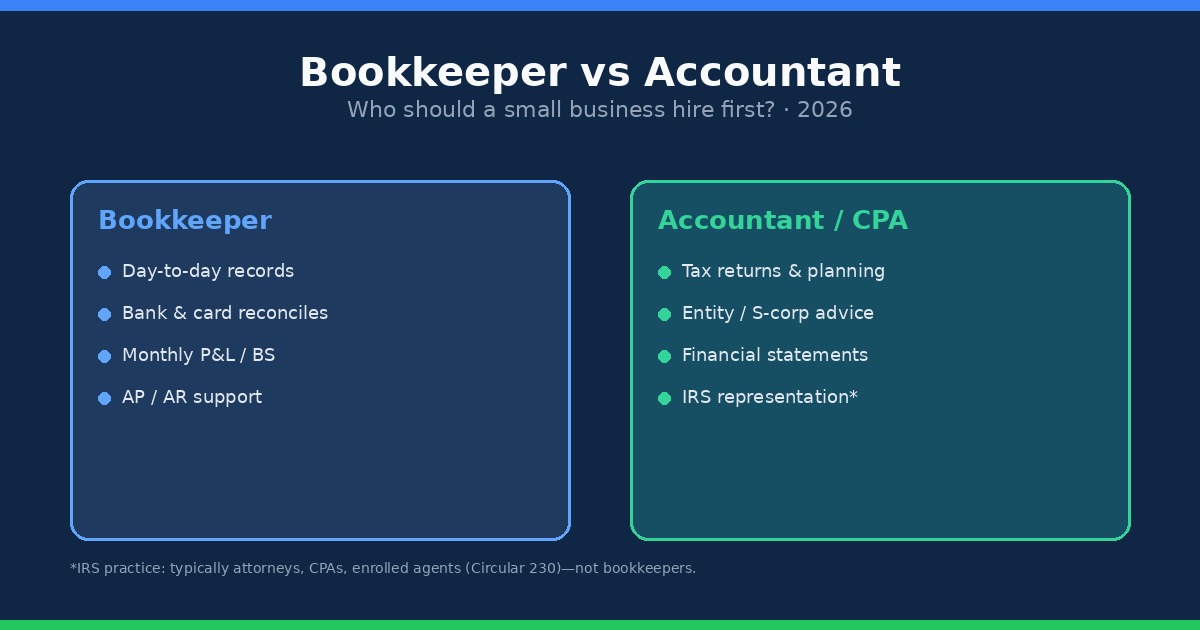
Bookkeeper vs accountant vs CPA: plain definitions
Takeaway: “Accountant” is a job family; CPA is a license—and bookkeeping is the recording layer underneath both.
People use these titles loosely, which is why quotes for the same work can differ by hundreds of dollars a month. Use the labels as a starting point, then read the engagement letter for actual scope.
- Bookkeeper: Records sales, bills, payroll journals, and transfers in your general ledger (often QuickBooks Online or Xero). Reconciles accounts. Helps with invoices, bills, and month-end reports for management use.
- Accountant: Broader role. May do bookkeeping, review accounting treatment, prepare financial statements, analyze results, or prepare tax returns—depending on training and what you hired them for.
- CPA (Certified Public Accountant): A state-licensed professional. Licensing typically requires education, the Uniform CPA Exam, and experience. CPAs are the people most owners mean when they say “I need an accountant for taxes or the IRS.”
A QuickBooks ProAdvisor badge or bookkeeping certificate is useful signal for software skill. It is not the same as a CPA license. If you need attest work, audited statements, or someone who can practice before the IRS, check the credential that matches that work.
Side-by-side: duties, cadence, cost, and credentials
Takeaway: Bookkeepers own the weekly/monthly close; accountants own interpretation, tax, and (when licensed) higher-stakes compliance.
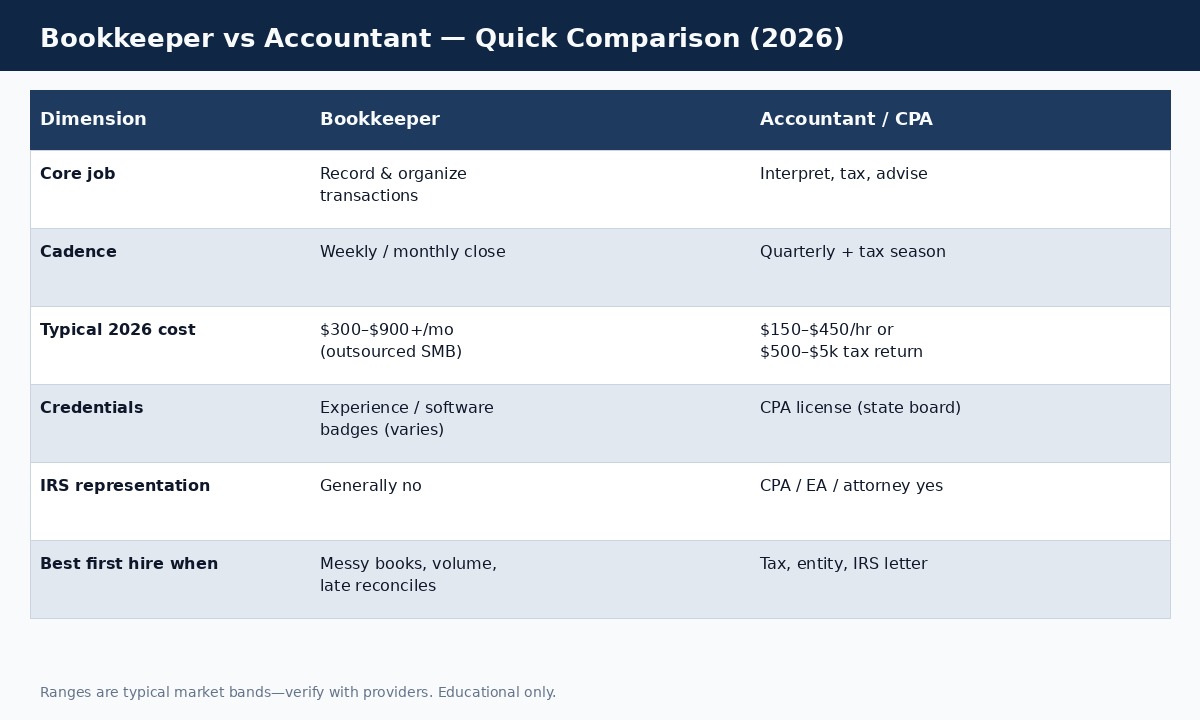
| Dimension | Bookkeeper | Accountant / CPA |
|---|---|---|
| Core job | Record and organize transactions | Interpret records; tax, statements, advice |
| Cadence | Weekly entries; monthly close | Quarterly reviews + tax season peaks |
| Typical 2026 cost (SMB) | Often ~$300–$900+/month outsourced; higher for complex volume | Often ~$150–$450/hour advisory; tax returns commonly hundreds to a few thousand dollars depending on entity |
| Credentials | Experience and software skill (varies widely) | CPA = state license; EA = IRS-enrolled agent |
| IRS representation | Generally not authorized to practice before the IRS | Attorneys, CPAs, and enrolled agents under Treasury Circular 230 rules |
| Best first hire when… | Reconciles slip, no monthly P&L, tax-season scramble | Entity change, employees, IRS notice, complex tax planning |
Who should you hire first?
Takeaway: Hire a bookkeeper (or fix DIY books) first unless tax, entity, or IRS issues are already on fire.
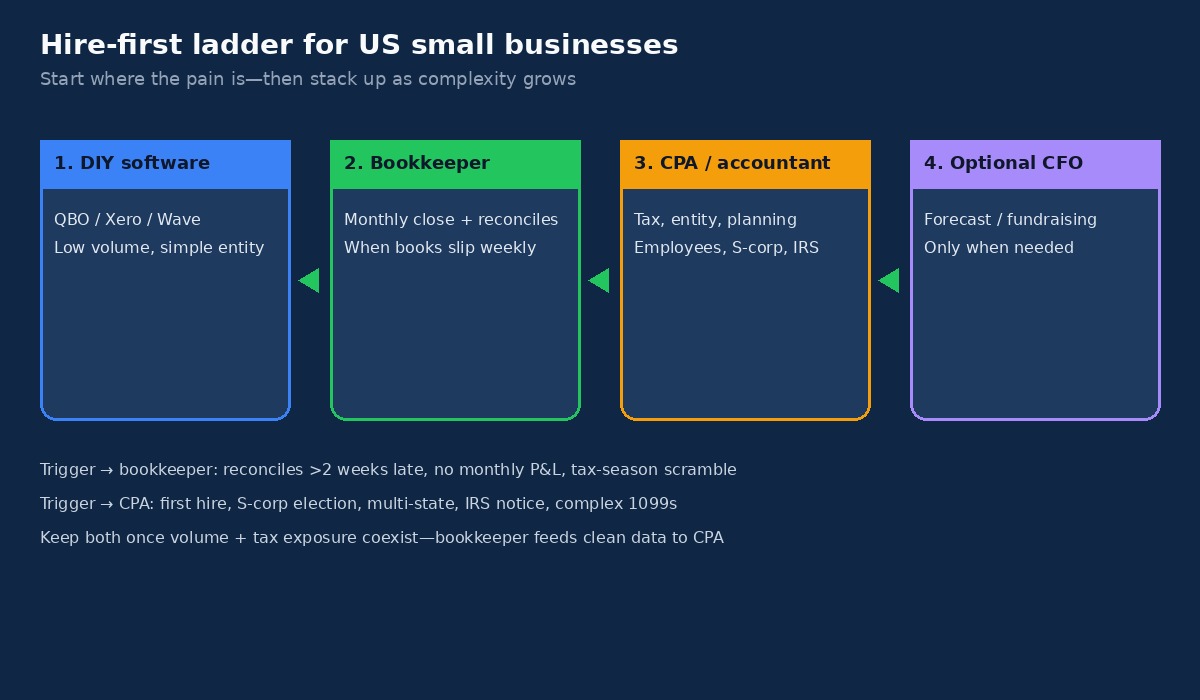
Use this checklist. Count the “yes” answers in each column.
Signals you need a bookkeeper soon
- Bank or credit-card reconciliations are more than two weeks behind
- You cannot produce a monthly P&L without a weekend of spreadsheet archaeology
- Vendor bills and receipts live in email, Slack, and a desk drawer
- Tax season starts with “catch-up” invoices from your CPA
- You sell on Stripe/Shopify and payouts do not match your books (see our Stripe payouts in QuickBooks guide)
- Accounts payable has no repeatable loop (see the AP checklist)
Signals you need an accountant/CPA now
- You are electing S-corp status or debating owner salary vs distributions (reasonable compensation guide)
- You are hiring your first W-2 employee or unsure about payroll setup (Do I need payroll for my LLC?, first-employee payroll runbook)
- You received an IRS or state notice and need representation
- Multi-state sales tax or nexus questions are driving entity and filing choices
- You need audited or reviewed financial statements for a lender or investor
If both columns light up, hire (or keep) monthly bookkeeping and engage a CPA—do not ask the CPA to restore six months of uncleared transactions at hourly rates.
What a bookkeeper actually does week to week
Takeaway: Good bookkeeping is a closed monthly loop—not a once-a-year dump of CSV files.
A solid small-business bookkeeping engagement usually includes:
- Connecting bank, card, and payment-processor feeds
- Categorizing income and expenses to a clean chart of accounts
- Reconciling every material account each month
- Recording bills and invoices (or reviewing what you entered)
- Posting payroll summaries from your payroll provider
- Delivering P&L, balance sheet, and a short list of open questions
Bookkeepers often sit next to bill-pay and vendor workflows. If checks are still leaving the office in envelopes, cleaning AP and moving recurring vendors to ACH can reduce categorization noise—see paying business bills online and, if you want a bill-pay tool overview, our Melio review. That is operations hygiene feeding the books—not a substitute for hiring the right finance help.
What an accountant or CPA does that a bookkeeper usually does not
Takeaway: Tax positions, entity strategy, and IRS practice sit above the ledger—and usually require licensed professionals.
Expect an accountant/CPA engagement to cover some mix of:
- Business and personal tax returns (Schedule C, Form 1120-S, 1065, etc.)
- Estimated tax planning and quarterly check-ins
- Entity selection and elections (LLC taxed as partnership vs S-corp)
- Owner compensation design for S-corps
- Depreciation, capitalization policies, and other judgment calls
- Formal financial statements under an agreed framework
- When licensed appropriately, representation before the IRS
Under Treasury Department Circular 230, practice before the IRS is generally limited to attorneys, CPAs, and enrolled agents (with some limited exceptions). A bookkeeper who keeps excellent books still should not be your default “call the IRS for me” person. Ask directly: “Who on your team is authorized to represent us if we get a notice?”
2026 cost ranges: bookkeeper vs accountant
Takeaway: Paying CPA hourly rates for routine categorization is the expensive mistake; paying nothing until April is the other one.
Prices vary by city, industry, and messiness of historical books. These typical 2026 market bands help you sanity-check quotes—not lock a vendor:
- Outsourced bookkeeping: commonly about $300–$900+ per month for many service SMBs; complex or high-volume businesses can exceed $1,500–$2,500/month
- Part-time in-house bookkeeper: often a larger payroll commitment than outsourcing at the same hours
- CPA / accountant hourly: commonly about $150–$450 per hour for compliance and advisory work, higher for specialists
- Business tax returns: often hundreds to a few thousand dollars depending on entity (Schedule C vs 1120-S vs multi-state)
- Bundled books + tax packages: many firms quote a single monthly fee; compare what’s included (catch-up, bill pay, payroll support, advisory hours)
When you compare proposals, normalize scope: number of bank/credit accounts, monthly transaction volume, accrual vs cash, inventory, multi-entity, payroll, and whether catch-up work is included. A cheap monthly fee that excludes reconciliation is not cheaper.
DIY QuickBooks/Xero vs hiring help: trigger points
Takeaway: Software is the ledger; a bookkeeper is the operating system that keeps it honest.
DIY bookkeeping with QuickBooks Online, Xero, or similar is reasonable when:
- Transaction volume is low and categories are simple
- You reconcile every account monthly without fail
- You have one entity and mostly domestic sales
- Your CPA only needs light cleanup at year-end
Outgrow DIY when reconciles slip, you stop trusting cash numbers, or your CPA’s cleanup bill exceeds a few months of bookkeeping fees. Owners who also run payroll should not treat payroll software as a replacement for either role—payroll creates W-2 liabilities and filing calendars that need clean books behind them. For cost shopping on a single employee, see cheapest payroll for one employee; for product comparisons, Gusto vs QuickBooks Payroll.
When you need both—and how the handoff should work
Takeaway: The efficient stack is clean monthly books feeding a CPA who does not redo the same categorization twice.
Most growing businesses land here:
- Bookkeeper: monthly close by an agreed date (for example, the 15th)
- CPA: quarterly tax estimates, year-end entries, returns, and planning calls
- Shared rules: chart of accounts map, capitalization threshold, owner-draw vs payroll coding, contractor vs employee flags
Worker classification is a classic handoff failure. If contractors and employees are mixed up in the books, both your bookkeeper and your CPA will chase the same problem. Align with W-2 vs 1099, collect forms with how to collect a W-9, and file with how to file 1099-NEC / Do I need to 1099 an LLC?.
Owner pay is another seam. Draws, payroll, and S-corp wages must be coded consistently or your “profit” number lies to you. Pair this article with how to pay yourself from an LLC.
Credentials and red flags
Takeaway: Verify license status and written scope before you share bank access.
- CPA: check the state board of accountancy for active license status
- Enrolled agent: IRS enrollment for tax representation without a CPA license
- Bookkeeper: ask for references, sample monthly package, software used, and who reviews their work
- Access: prefer accountant/bookkeeper user roles in QBO/Xero over sharing your personal login; use bill-pay approval workflows so one person cannot create and pay vendors alone
Red flags: guarantees of IRS outcomes, refusal to put scope in writing, pressure to move all banking to an unknown app overnight, or a “CPA” who cannot show a license number. Educational reminder—credentials and firm practices change; verify before you engage.
How this fits bill pay, payroll, and 1099 workflows
Takeaway: Bookkeeping quality rises when payment ops are boring and documented.
Your finance stack is usually three lanes:
- Bill pay / AP: vendors, approvals, ACH vs card (bill pay hub)
- Payroll: W-2 wages, deposits, filings (payroll hub)
- Tax compliance: sales tax, 1099s, estimated taxes (tax compliance hub)
A bookkeeper stitches those lanes into the ledger. A CPA reviews the tax consequences. If AP is chaotic, fix the workflow (and optionally a bill-pay tool) so categorization stops being guesswork. If you are about to hire, price payroll software and classifications before you ask a CPA to “just run payroll” at advisory rates—Gusto is one option many SMBs evaluate alongside QuickBooks Payroll; treat any affiliate link as optional research, not a hiring recommendation.
FAQ: bookkeeper vs accountant for small business
Is a bookkeeper the same as an accountant?
No. Bookkeepers focus on recording and reconciling transactions. Accountants interpret those records and often handle tax and advisory work. Some accountants also do bookkeeping; many bookkeepers do not prepare complex tax returns.
Do I need a CPA, or is a bookkeeper enough?
If your only pain is messy monthly books, start with a bookkeeper (or disciplined DIY). Add a CPA when you need tax returns, entity advice, planning, or IRS representation.
Can a bookkeeper prepare my business tax return?
Some bookkeepers prepare simple returns; many do not. Tax preparation and especially IRS representation often require a CPA, enrolled agent, or attorney. Ask what they are licensed and insured to file—and who signs the return.
How much does a bookkeeper cost for a small business in 2026?
Many U.S. small businesses pay roughly $300–$900+ per month for outsourced bookkeeping, with higher fees for volume, inventory, multi-entity, or catch-up work. Get quotes against a written scope.
How much does a CPA cost for a small business?
Hourly rates commonly fall around $150–$450 for standard work; tax returns are often flat fees that scale with entity complexity. Bundled monthly packages may combine books and tax—compare inclusions carefully.
Should I hire a bookkeeper or buy QuickBooks first?
Buy (or keep) software first so there is a system of record. Hire a bookkeeper when you cannot keep that system current. Software without a monthly close still produces unreliable numbers.
When do I need both a bookkeeper and an accountant?
When transaction volume and tax exposure coexist—employees, S-corp wages, multi-state activity, or growth that needs quarterly planning. The bookkeeper keeps the ledger current; the CPA uses it.
Can a bookkeeper represent me before the IRS?
Generally no. Practice before the IRS is governed mainly by attorneys, CPAs, and enrolled agents under Circular 230. Confirm credentials if representation matters to you.
Next step
Use the hire-first checklist above, then pick the lane that matches your pain: clean up accounts payable and bill pay if vendors are the mess; tighten payroll and classification if hiring is next; or review tax compliance and software comparisons before you sign an engagement. If bill-pay tooling is part of getting books under control, start with our Melio review or Melio’s site (affiliate)—only after you know monthly bookkeeping ownership is clear.