Disclosure: This guide is educational and may include affiliate links. We may earn a commission if you sign up through our Melio or Gusto partner links, at no extra cost to you. It is not legal, tax, accounting, or financial advice. Form W-9 and backup withholding rules depend on your facts and current IRS guidance. Verify details on IRS.gov and with a qualified CPA or attorney before you act.
To collect a W-9 from a contractor, request a completed, signed Form W-9 before you make the first payment, review the legal name, taxpayer identification number (TIN), federal tax classification, address, and signature, then store the form securely. The IRS independent contractor guidance says to keep the W-9 for four years in case questions arise. A W-9 does not replace Form 1099-NEC; it gives you the TIN and entity details you need when payments hit the reporting threshold. If a U.S. payee will not furnish a TIN in the required way, backup withholding at 24% may apply to reportable payments.
Who this guide is for
This checklist is for U.S. small-business owners, office managers, and bookkeepers who pay freelancers, consultants, or vendors for services. It sits in the same tax compliance and contractor-payment workflow as our guides on how to file Form 1099-NEC and whether you need to 1099 an LLC. If you are hiring a W-2 employee instead, use payroll onboarding, not Form W-9.
What is Form W-9?
Form W-9, Request for Taxpayer Identification Number and Certification, is the IRS form U.S. persons use to give a payer their correct name and TIN and to certify certain backup-withholding facts under penalties of perjury. According to the IRS page on forms and associated taxes for independent contractors (reviewed for this 2026 guide), once you determine someone is an independent contractor, the first step is to have them complete Form W-9 so you can request the correct name and TIN.
The form is not filed with the IRS by the business that requests it. You keep it. Later, if you must file Form 1099-NEC or another information return, you pull the name and TIN from that W-9 (or from a later update).
When should you collect a W-9 from a contractor?
Collect the W-9 before the first payment whenever you expect to pay a U.S. independent contractor or vendor for services in your trade or business. Do not wait until December. Waiting creates two problems: you may lack a TIN when 1099 season starts, and you may already have made reportable payments that required backup withholding.
Request a W-9 even if you think payments will stay under the Form 1099-NEC reporting threshold. Thresholds change, projects expand, and a TIN on file is cheap insurance. For payments made in calendar year 2026, the IRS raised the minimum reporting threshold for certain information returns (including many 1099-NEC situations) to $2,000, with inflation adjustments planned in later years. Before 2026, the long-standing figure many owners remember was $600. Confirm the year’s amount in the current Instructions for Forms 1099-MISC and 1099-NEC and Publication 1099 materials on IRS.gov. Threshold size does not make W-9 collection optional.
- New contractor or vendor — send the blank form (or a secure digital W-9 tool) with the contract or onboarding packet.
- Name or TIN change — request a fresh W-9 when legal name, entity type, or TIN changes.
- Stale file — many SMBs refresh W-9s every few years or before a large recurring engagement.
- IRS “B” notice — if the IRS says a name/TIN combination does not match, follow the backup withholding notice process and request a corrected certification as required.
W-9 vs 1099: how they connect
Owners often search “w9 vs 1099” because the forms feel interchangeable. They are not.
| Form | Who completes it | Purpose | Filed with IRS? |
|---|---|---|---|
| Form W-9 | The contractor / payee (U.S. person) | Gives you name, TIN, entity type, and certifications | No — payer keeps it |
| Form 1099-NEC | You (the payer / requester) | Reports nonemployee compensation that meets the year’s rules | Yes — to IRS and a copy to the recipient when required |
Think of W-9 as onboarding paperwork and 1099-NEC as year-end reporting. Our 1099-NEC filing guide covers thresholds, deadlines, and IRS IRIS e-file. This article stops at collecting and validating the W-9 so that filing step is possible.
Step-by-step: how to collect a W-9 from a contractor
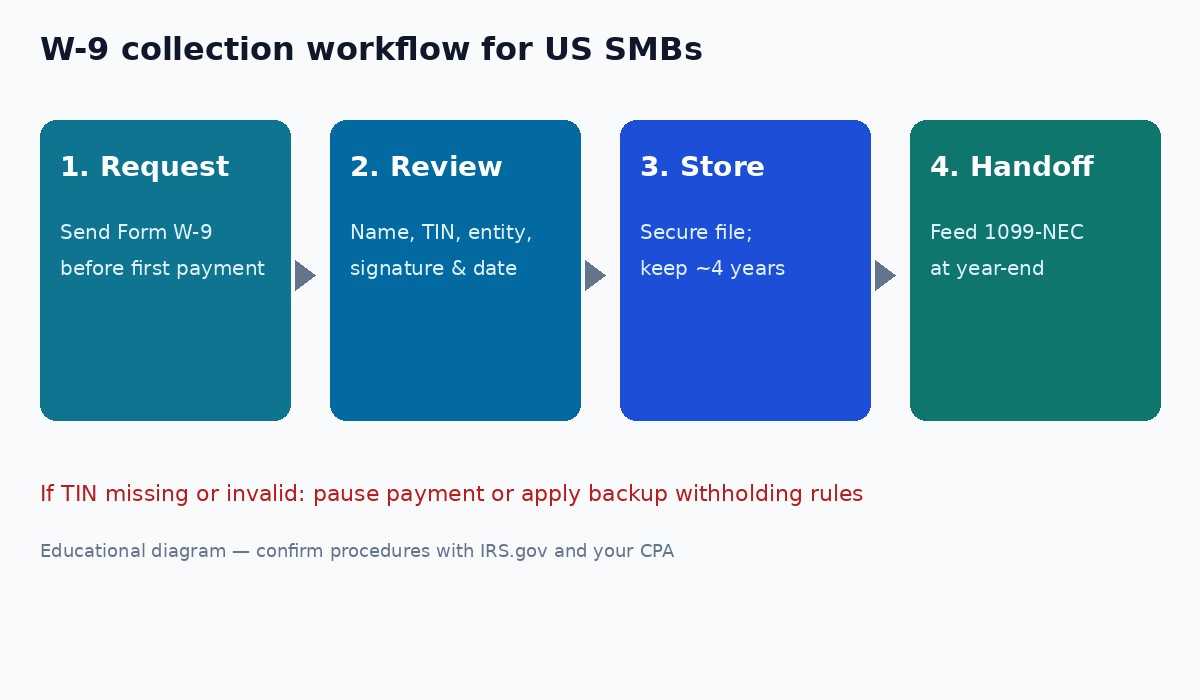
Use this sequence for every new U.S. service payee. Adjust only if your CPA or payroll/AP platform already automates parts of it.
- Confirm worker status first. Form W-9 assumes you have already decided the person is not your employee. Misclassification is a separate issue; see our overview of W-2 vs 1099 and talk to counsel when the facts are mixed.
- Send the current Form W-9. Download the PDF from IRS.gov or use a reputable AP tool that presents an IRS-acceptable substitute. Avoid random blog rewrites of the form.
- Ask for completion before first payment. Put the request in writing (email is fine) and tie payment setup to a completed form in your checklist.
- Review every required field. Name, classification, TIN, address, signature, and date. Incomplete forms create year-end fire drills.
- Match the TIN type to the person or entity. Individuals and sole proprietors often use an SSN (or an EIN if they have one). Corporations, partnerships, and many LLCs use an EIN. The name on line 1 should match IRS records for that TIN.
- Store the form securely. Limit who can open the folder or vault. W-9s contain TINs, which are sensitive personal and business data.
- Link the W-9 to the vendor record. In your bookkeeping or bill-pay system, attach the file to the same vendor you will pay all year. That link is what makes January 1099 prep sane.
- Update when facts change. New legal name after marriage, LLC election change, or new EIN means a new W-9.
What to check on a completed W-9
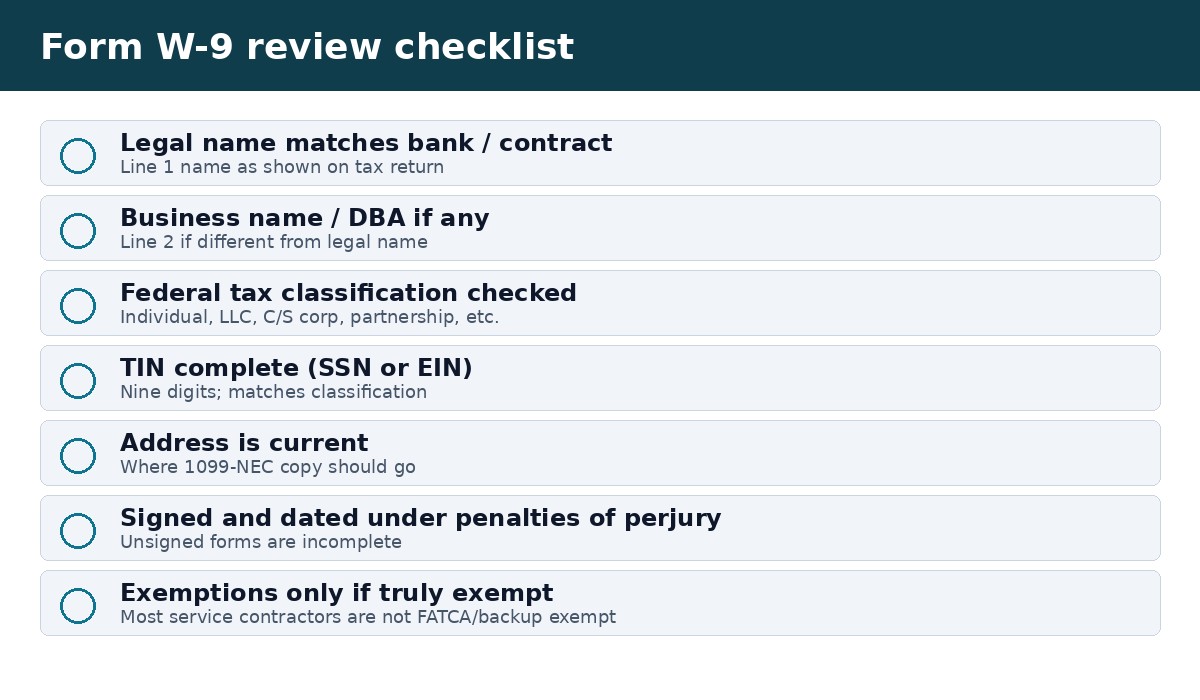
A fast visual review catches most problems:
- Line 1 name — legal name as shown on the payee’s tax return, not a nickname or brand-only label.
- Line 2 — business name/DBA only if different.
- Federal tax classification — individual/sole proprietor, C corporation, S corporation, partnership, trust/estate, LLC with the correct tax classification, or other as instructed on the form.
- Exemptions — most freelancers who provide services are not exempt from backup withholding. Do not invent exemption codes for them.
- Address — where you will mail or deliver the recipient copy of Form 1099-NEC.
- Part I TIN — nine digits; SSN or EIN consistent with the classification checked.
- Part II certification — signed and dated. An unsigned W-9 is not a completed certification for requester purposes.
If something looks off (EIN on an individual box, blank TIN, missing signature), send it back before you pay. Cleaning it up later is harder once money has moved.
What if a contractor refuses to provide a W-9?
You can choose not to engage someone who will not complete Form W-9. Many small businesses make a completed W-9 a condition of payment setup for that reason.
If you still make reportable payments to a U.S. person who has not provided a TIN in the manner required, the IRS backup withholding rules may require you to withhold 24% of those reportable payments and deposit the tax. The IRS independent contractor page and the Instructions for the Requester of Form W-9 explain that backup withholding can apply when a payee fails to furnish a TIN, when the IRS notifies you that a TIN is incorrect and the payee does not certify as required, and in certain other interest/dividend underreporting situations that are less common for service payments. Remit backup withholding on Form 945 when required. If you do not withhold when you should have, you can become liable for the uncollected amount.
This is YMYL territory. Do not guess rates or deposit schedules from memory. Read the current requester instructions and Publication 1281 / Topic No. 307 materials on IRS.gov, or ask your CPA how to handle a specific stubborn payee.
Backup withholding at a glance
Backup withholding is not the same as employee payroll withholding. It is a flat percentage taken from certain information-return reportable payments when TIN rules are not met. For current periods the rate commonly stated by the IRS is 24%. Key points for SMB contractor pay:
- Missing TIN or obviously invalid TIN → start backup withholding on reportable payments as the rules require.
- IRS name/TIN mismatch notices (“B” notices) have their own timelines and second-notice rules; follow Publication 1281 rather than improvising.
- If you backup withhold, you generally still report the payment on the appropriate Form 1099 and show the amount withheld.
- The 60-day “Applied For” awaiting-TIN grace period discussed in requester instructions for some interest and dividend payments does not give contractors a free pass on nonemployee compensation. Service payments can require immediate backup withholding when a TIN is missing.
Do you need a W-9 from an LLC or corporation?
Yes—request Form W-9 from U.S. LLCs and corporations you pay for services. The W-9 tells you how the entity is classified for federal tax purposes and which TIN to use. Whether you later file Form 1099-NEC is a separate question. Corporations are often excepted from 1099-NEC for many service payments, but single-member LLCs disregarded as separate from their owners, partnerships, and some other payees still land on many 1099 lists. Read the exceptions in the 1099-NEC instructions and see Do I Need to 1099 an LLC? before you skip reporting.
Collecting the W-9 first still helps: you learn whether the payee claims C corp, S corp, partnership, or disregarded LLC status instead of guessing from a marketing website.
Foreign contractors: W-9 vs W-8 forms
Form W-9 is for U.S. persons. A foreign person generally should not provide Form W-9. Instead, payers often collect a Form W-8BEN (individuals) or W-8BEN-E (entities), and withholding under chapter 3 / NRA rules can apply to U.S.-source payments for independent personal services. The IRS notes that if you cannot determine whether the payee is foreign or U.S., presumption rules may treat the payee as a U.S. person and point you toward backup withholding—another reason to resolve documentation before the first invoice.
Cross-border contractor pay also raises payment-rail questions. For process ideas (not tax advice), see ways to pay 1099 contractors and paying contractors with Melio.
How long should you keep Form W-9 on file?
The IRS independent contractor guidance states that the W-9 should be kept in your files for four years for future reference if the worker or the IRS has questions. Your state, industry, or insurance contracts may ask for longer retention. When you dispose of old forms, shred or securely delete them; TINs are identity-theft targets.
Practical storage tips for small teams:
- One vendor folder (or vault record) per payee, with the latest W-9 on top and older versions archived.
- Access limited to owners, bookkeepers, and AP staff who need TINs.
- A simple log: vendor name, date received, TIN type (SSN/EIN—not the full number in the log if you can avoid it), and next review date.
- Same vendor ID in bill pay and QuickBooks (or your ledger) so January exports match the W-9 file.
Year-round payment tracking (and a soft Melio note)
A perfect W-9 does not help if your payment history is a pile of Venmo screenshots. Track contractor and vendor payments in one system all year: date, amount, invoice, and vendor ID tied to the W-9. That is the input to Form 1099-NEC totals.
If you still mail paper checks or juggle multiple bank portals, consider a dedicated bill pay workflow. Melio is one option some small businesses use to pay vendors and contractors from a clearer payment history. Melio does not replace Form W-9 collection or IRS filing for you—treat it as a payment trail, not a tax product. Pair it with your own W-9 vault and, at year-end, the filing steps in our 1099-NEC guide.
When the hire-employee path fits instead
If the person works your hours, uses your tools, and is integrated into your business like staff, they may be an employee. Employees get Form W-4 and a Form W-2, not Form W-9 and Form 1099-NEC. For first-hire payroll setup, see our payroll pillar and first-employee guides. Gusto is one payroll platform small teams use when the classification decision lands on W-2; use it only after you are confident the worker is an employee.
Common W-9 collection mistakes
- Paying first, asking later — then discovering a blank TIN in January.
- Accepting an unsigned PDF — certification requires a signature under penalties of perjury.
- Using a DBA without the legal name — 1099s and IRS matching use the legal name/TIN pair.
- Skipping W-9s for “small” jobs — multiple small jobs can cross the year’s reporting threshold.
- Treating W-9 as a filed tax return — you keep it; you do not e-file the W-9 itself.
- Ignoring LLC classification boxes — “LLC” alone is incomplete without the tax classification the form requests.
- Emailing unencrypted TINs casually — use a secure upload link or portal when you can.
- Forgetting foreign-payee documentation — W-9 is the wrong form for non-U.S. persons.
FAQ: collecting Form W-9 from contractors
When should I collect a W-9 from a contractor?
Before the first payment to a U.S. independent contractor or service vendor, and again whenever their legal name, TIN, or entity classification changes.
What if a contractor will not give me a W-9?
You can decline to pay until the form is complete. If you make reportable payments without a required TIN certification, backup withholding at the IRS rate (currently stated as 24%) may apply. Confirm the facts with the requester instructions and your CPA.
How long should I keep Form W-9 on file?
The IRS independent contractor guidance says to keep the W-9 for four years. Longer retention may be appropriate for your state or contracts.
Do I need a W-9 if I pay less than the 1099 threshold?
Yes, it is still good practice. Thresholds can change, and additional work during the year can push you over. A W-9 on file is what lets you file accurately if you do.
Do corporations and LLCs fill out Form W-9?
U.S. entities generally complete Form W-9 so you have the correct name, TIN, and tax classification. Whether Form 1099-NEC is required afterward depends on the payee type and the 1099 instructions.
What is backup withholding on contractor payments?
It is mandatory withholding (commonly 24%) on certain reportable payments when TIN rules are not met. Deposit and report it as the IRS requires (often via Form 945 and the related 1099).
Is Form W-9 the same as Form 1099-NEC?
No. W-9 is completed by the payee and kept by you. Form 1099-NEC is filed by you to report nonemployee compensation when required.
Is this legal or tax advice?
No. This article is general education for U.S. small businesses. Confirm current forms, rates, and filing duties on IRS.gov and with a qualified professional.
Related reading
- How to File 1099-NEC in 2026
- Do I Need to 1099 an LLC?
- W-2 vs 1099
- Best ways to pay 1099 contractors
- Accounts payable checklist
- Software comparisons
If you want a cleaner vendor payment history to pair with your W-9 files, you can explore Melio for small-business bill pay. Keep Form W-9 collection and IRS filing on your checklist either way.
Sources (verify current editions): IRS About Form W-9; Instructions for the Requester of Form W-9; IRS “Forms and associated taxes for independent contractors”; IRS backup withholding resources; Instructions for Forms 1099-MISC and 1099-NEC / Publication 1099 materials for reporting thresholds.