Disclosure: This guide is educational and may include affiliate links. We may earn a commission if you sign up through our Gusto or Melio partner links, at no extra cost to you. It is not legal, tax, accounting, or financial advice. S corporation compensation rules depend on your facts, state law, and current IRS guidance. Verify details on IRS.gov and with a qualified CPA or attorney before you act.
Reasonable compensation for an S corp owner is the fair W-2 pay you would give a non-owner employee for the same services, experience, and time you put into the business. If you perform more than minor services and take money out of the company, the IRS expects you to run payroll for a reasonable salary first. Remaining profits can usually leave as distributions that are not subject to Social Security and Medicare (FICA) taxes when the salary is properly set. There is no IRS-approved 60/40 split or fixed percentage. Use comparable market pay, document your role, and review the number each year with your CPA.
What is reasonable compensation for an S corp owner?
In plain terms, reasonable compensation is the salary that matches the work you actually do. The IRS page on S corporation compensation and medical insurance issues (reviewed for this 2026 guide) states that an S corporation must pay reasonable compensation to a shareholder-employee for services before non-wage distributions may be made. The Form 1120-S instructions say the same idea: distributions and other payments to a corporate officer must be treated as wages to the extent they are reasonable compensation for services rendered.
IRS Fact Sheet FS-2008-25 (Wage Compensation for S Corporation Officers) adds that corporate officers who provide more than minor services and who receive or are entitled to receive payment are employees for federal employment tax purposes. An officer who does no real work, or only minor services, and who is not paid, may fall outside that employee treatment. Most active owner-operators do not fit that narrow exception.
Reasonable compensation is a facts-and-circumstances standard. The IRS does not publish a safe-harbor dollar amount or percentage of profit. Online “rules of thumb” that split income 60% salary / 40% distributions are marketing shorthand, not authority you can cite in an exam.
Salary vs distributions: how the split works
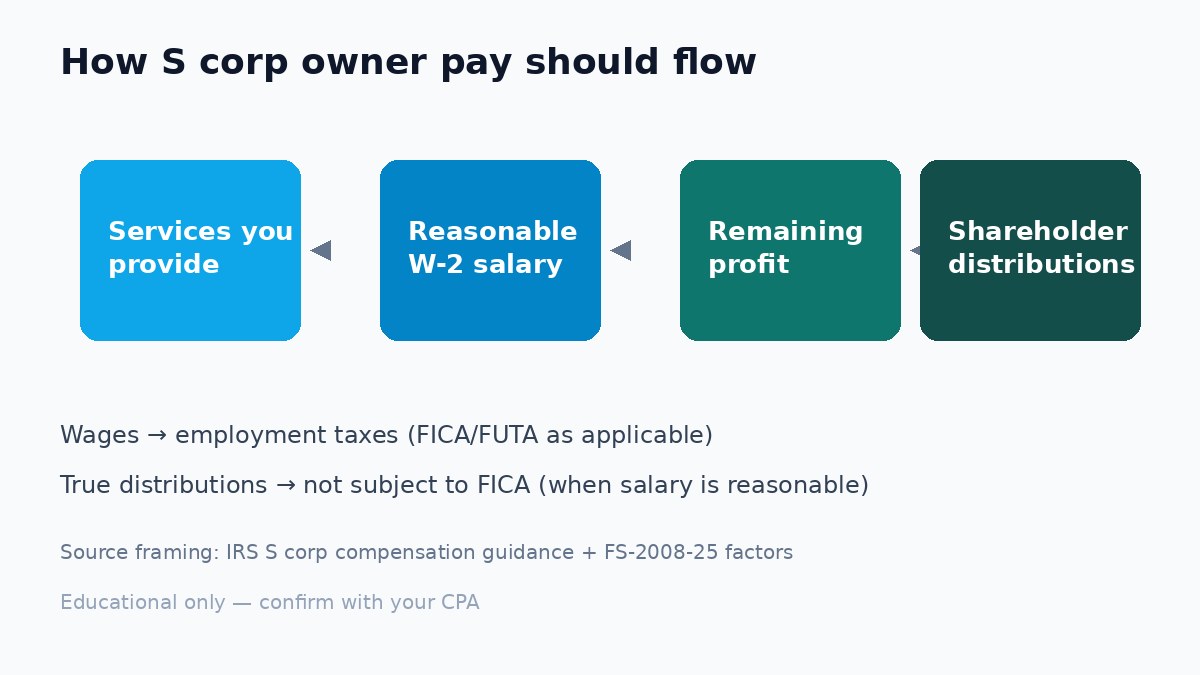
Think of owner pay in two buckets:
| Bucket | What it is | Employment taxes | Typical paperwork |
|---|---|---|---|
| W-2 salary (reasonable compensation) | Pay for services you provide as an employee-officer | Subject to Social Security, Medicare, and federal unemployment rules that apply to wages | Payroll runs, Form W-2, employment tax deposits/returns |
| Shareholder distribution | Share of remaining S corp profit after expenses (including your salary) | Not subject to FICA when it is a true distribution, not recharacterized wages | Bank transfer / distribution journal; flows through on Schedule K-1 |
Cash leaving the company does not automatically become a tax-free “owner draw.” For an S corp, the label on the bank transfer matters less than whether you already paid yourself reasonable wages for the services that produced the company’s receipts. If you skip salary and take only “distributions,” the IRS can reclassify those payments as wages and assess employment taxes, interest, and penalties.
What factors does the IRS look at for reasonable compensation?
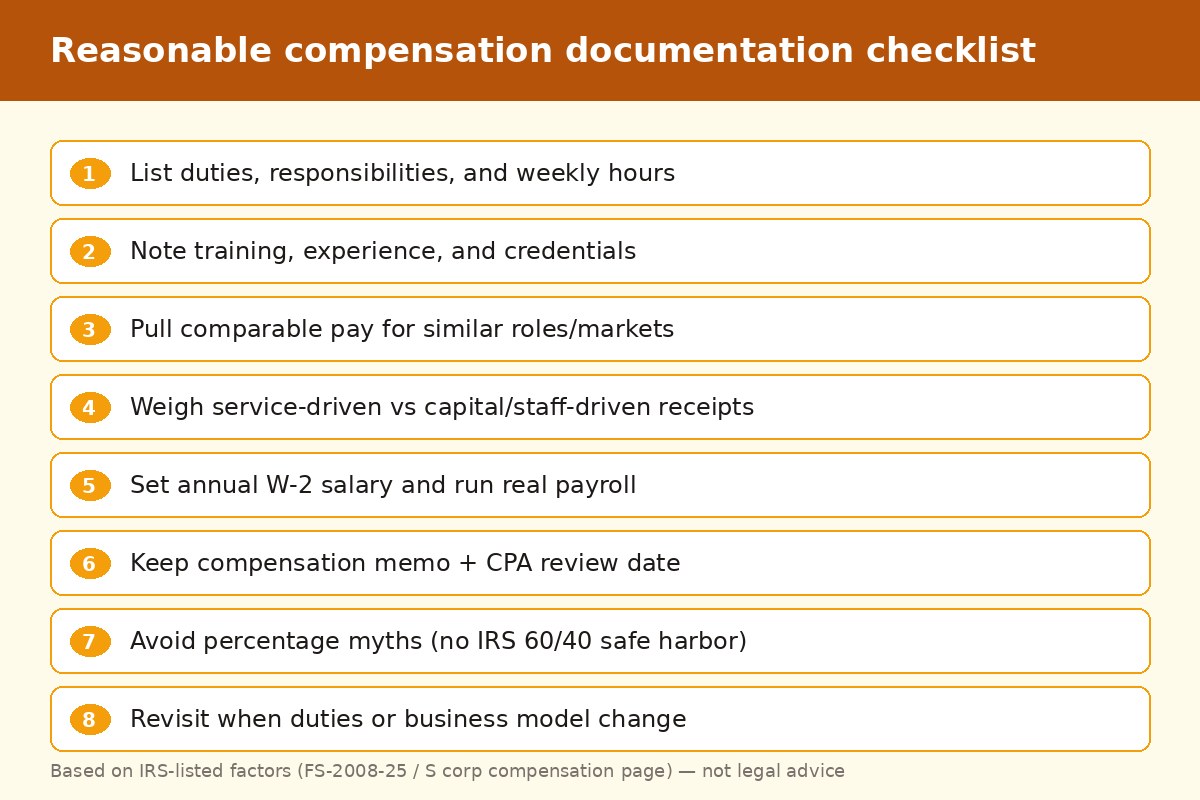
FS-2008-25 and the IRS compensation page list factors courts and examiners commonly weigh. None of them is a formula by itself. Use them as a documentation checklist:
- Training and experience — credentials, years in the field, specialized skills.
- Duties and responsibilities — CEO, rainmaker, bookkeeper, technician, or all of the above.
- Time and effort — full-time vs part-time; hours that actually go into the business.
- Dividend / distribution history — pattern of paying little or no wages while taking large distributions.
- Payments to non-shareholder employees — what you pay other people for similar work.
- Timing and manner of bonuses — year-end cash dumps labeled as something other than wages.
- Comparable businesses — what similar companies pay for similar services in your market.
- Compensation agreements — written salary policy, board minutes, or CPA memo.
- Use of a formula — a consistent method (for example, market salary survey + hours) that you apply each year.
The IRS also looks at the source of gross receipts. To the extent receipts come from your personal services, payments to you look more like wages. To the extent receipts come from non-shareholder employees, capital, or equipment, more of the profit can support non-wage distributions. A solo consultant who bills for their own time sits in a different spot than an owner of a warehouse with many W-2 staff and heavy equipment.
How do payroll taxes apply to S corp reasonable compensation?
W-2 wages are subject to employment taxes. In broad strokes for US federal payroll:
- Social Security and Medicare (FICA) — employee and employer portions apply to wages up to the Social Security wage base (Medicare has no wage base; Additional Medicare Tax may apply at higher wages).
- Federal unemployment (FUTA) — generally applies to wages, subject to the FUTA wage base and credits.
- Income tax withholding — federal (and usually state) income tax withholding on wages, based on your Form W-4.
Proper shareholder distributions are not subject to FICA. That difference is why underpaying salary is a common audit target. The employment-tax savings only holds when the salary itself is reasonable. If the IRS reclassifies distributions as wages, you can owe the employment taxes that should have been paid, plus interest and penalties.
S corp profit still flows to you on Schedule K-1 and is generally subject to income tax on your Form 1040, whether you take it as a distribution or leave it in the company. Reasonable compensation is mainly about employment taxes and wage characterization, not about making K-1 income disappear.
For how payroll taxes work when you hire beyond yourself, see our guide on payroll taxes for your first employee and the payroll hub.
Can I take only distributions from my S corp?
Usually no, if you perform more than minor services and receive money from the company. FS-2008-25 treats active officer-shareholders who are paid (or entitled to payment) as employees. Taking only distributions while you do the billable work, close sales, manage staff, or run day-to-day operations is the fact pattern examiners challenge.
Narrow situations where little or no salary may fit include an officer who truly performs no services (or only minor ones) and receives no remuneration. Passive investors who do not work in the business are different from working owners. If you are unsure which box you are in, ask a CPA before you design a “distributions only” plan.
Related reading for entity pay mechanics: how to pay yourself from an LLC and do I need payroll for my LLC? — both matter once you elect S corp taxation and start treating yourself as an employee-officer.
What happens if S corp salary is too low?
If the IRS determines that wages were unreasonably low, it can recharacterize distributions (and sometimes other payments) as wages. Practical fallout for a small business can include:
- Back employer and employee Social Security and Medicare taxes on the reclassified amount
- Failure-to-deposit or failure-to-file penalties on employment tax returns
- Interest accruing from the original due dates
- Amended payroll filings and corrected Forms W-2 / W-2c
- Extra CPA and bookkeeping time to unwind the books
The IRS has authority to reclassify payments; courts have supported that approach in many officer-compensation cases. Exact outcomes depend on the facts of each case. The cheaper path for most SMBs is to set a defensible salary up front and keep the workpapers.
Step-by-step: how to set S corp owner salary vs distributions
Use this checklist as an operational process. Your CPA should still sign off on the number for your facts.
1. Write down what you actually do
List roles: sales, delivery of services, management, bookkeeping, marketing. Estimate hours per week for each role. Be honest about part-time vs full-time work. If another person would need three job titles to replace you, note that.
2. Gather comparable pay data
Pull market ranges for those roles in your geography and industry. Sources often include Bureau of Labor Statistics occupational data, industry salary surveys, and recruiting ranges you would actually pay a hire. Adjust for part-time hours and for blended roles. Save PDFs or screenshots with dates.
3. Separate service-driven profit from capital-driven profit
Ask: what share of gross receipts depends on your personal services versus staff, systems, or equipment? A higher service share usually supports a higher salary floor. A capital-heavy business may justify more distributions after a market salary for management time.
4. Set an annual W-2 salary and run payroll
Convert the reasoned annual figure into a recurring payroll amount (biweekly or semimonthly is common). Enroll as an employee on payroll, withhold taxes, and deposit employment taxes on time. Owner-only S corps still need real payroll, not informal transfers labeled “salary.”
5. Take remaining available cash as distributions (when appropriate)
After salary, payroll taxes, operating expenses, and a cash reserve for tax estimates and working capital, remaining profit can often leave as distributions according to ownership percentages. Do not drain the account below what you need for upcoming tax deposits and vendor bills. For vendor and AP workflows separate from owner payroll, see the bill pay hub.
6. Document the decision once a year
Keep a short memo: roles, hours, comparable data sources, chosen salary, and CPA review date. Update it when your duties or the business model change. Consistency year to year helps more than a one-time spreadsheet you never reopen.
Owner-only payroll: tools that make the salary real
Reasonable compensation only works if wages actually hit a Form W-2. For many one-person or very small S corps, that means a simple payroll product that can run owner pay, file employment returns, and issue W-2s. If you are comparing options for a tiny headcount, start with best payroll software for 1–5 employees and Gusto vs QuickBooks Payroll.
Gusto is a practical fit when you need owner payroll without building a DIY tax calendar. It can run recurring S corp officer pay, handle federal and state payroll filings in supported states, and produce year-end W-2s — the paperwork that makes “reasonable compensation” visible on audit. Confirm current pricing and state coverage on Gusto’s site before you switch; we do not invent fee tables here.
If you also pay contractors, keep W-2 owner pay separate from 1099 workflows. See W-2 vs 1099, do I need to 1099 an LLC?, and how to file Form 1099-NEC. For first-hire setup beyond yourself, use how to run payroll for your first employee.
Common mistakes that weaken an S corp salary position
- Using a blog percentage instead of market data — “60/40” is not an IRS safe harbor.
- Zero or token salary while taking large monthly transfers — classic recharacterization risk.
- Calling irregular ACH pulls “distributions” with no W-2 at all — paperwork gap examiners notice.
- Ignoring your own job mix — a full-time rainmaker plus bookkeeper plus technician rarely matches a part-time admin salary.
- Never updating the number — duties, rates, and hours change; last year’s figure may not fit this year.
- Skipping state payroll registration — federal W-2 thinking without state withholding/UI accounts creates separate compliance problems.
- Confusing LLC draws with S corp wages — after an S election, working owners generally need payroll, not informal draws alone.
Where tax-compliance education fits
Reasonable compensation sits at the intersection of payroll and entity tax compliance. Browse the tax compliance hub for related filing topics, and the comparisons hub when you evaluate payroll products. Educational articles help you ask better CPA questions; they do not replace a return preparer who knows your numbers.
FAQ: S corp reasonable compensation
What is reasonable compensation for an S corp owner?
It is fair W-2 pay for the services you provide, based on duties, time, experience, and what comparable businesses pay — not a fixed percentage of profit. See the IRS S corporation compensation page and FS-2008-25.
How do I set S corp owner salary vs distributions?
Document your roles and hours, gather comparable salary data, set a W-2 salary, run payroll, then take remaining available profit as distributions when cash flow allows. Review with a CPA annually.
Is there a 60/40 or percentage rule for S corp reasonable compensation?
No. The IRS has not published a safe-harbor percentage. Percentage splits that appear online are not a substitute for a facts-and-circumstances analysis.
Can I take only distributions from my S corp?
Generally not if you perform more than minor services and receive payments. Active officer-shareholders are typically treated as employees who need reasonable wages first.
What happens if my S corp salary is too low?
The IRS may reclassify distributions as wages and assess employment taxes, interest, and penalties, and you may need corrected payroll filings.
How do payroll taxes apply to S corp reasonable compensation?
W-2 wages are subject to FICA, FUTA (as applicable), and income tax withholding. Proper distributions are not subject to FICA, but K-1 profit is still generally subject to income tax.
Do I need payroll software for an owner-only S corp?
You need a reliable way to run wages, withhold, deposit taxes, and issue a W-2. Many owner-only S corps use payroll software such as Gusto rather than manual deposits and paper filings.
Is this tax or legal advice?
No. This article is educational only. Confirm your salary method and filings with a qualified CPA or tax attorney and current IRS publications.
Related reading
- Payroll hub
- Tax compliance hub
- Bill pay hub
- Comparisons hub
- How to pay yourself from an LLC
- Do I need payroll for my LLC?
- Best payroll software for 1–5 employees
Next step: If you are ready to run owner W-2 pay on a schedule, compare a small-business payroll option such as Gusto, then have your CPA review the salary figure against your duties and market data before the next payroll cycle.