Disclosure: This payroll hub is educational and may include affiliate links. We may earn a commission if you sign up through our Gusto partner link, at no extra cost to you. It is not legal, tax, accounting, or financial advice. Tax rules, deposit schedules, product pricing, and eligibility change; verify details with the IRS, your state agencies, your payroll provider, and a qualified professional before you act.
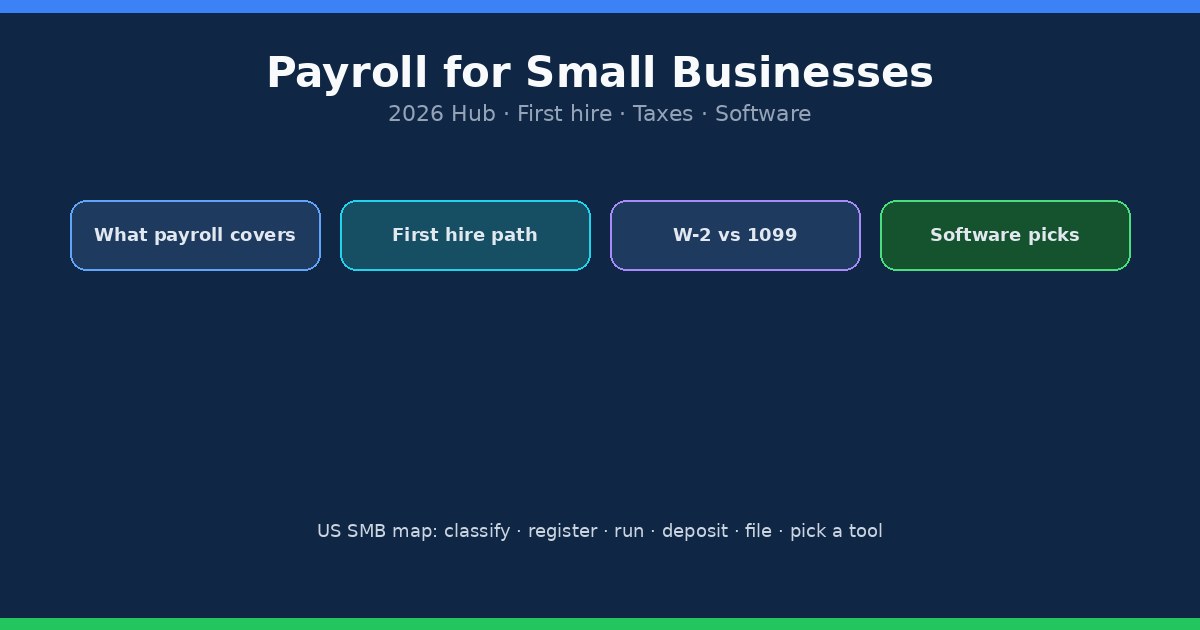
Payroll for small businesses is the work of paying people on time, withholding and remitting the right taxes, and keeping records that survive an audit or a bank loan review. For most US shops that means classifying workers, registering accounts, collecting forms, choosing a pay schedule, running gross-to-net, then depositing and filing on the calendars that apply to you. This page is the cluster hub for that topic. Use it to orient, then follow the linked guides for the deep steps.
What payroll covers for a US small business
In practice, payroll is more than a Friday ACH. It includes worker classification, employer identification and state tax accounts, new-hire paperwork, pay frequency, wage calculations, federal and state income tax withholding, FICA, unemployment taxes, benefit and garnishments when they apply, employee pay stubs, and year-end forms such as W-2s. Contractors sit nearby: you may pay them from the same tool, but the tax and form path is different.
If you still pay people from a personal bank account and a spreadsheet, you already do a version of payroll. The question in 2026 is whether that version matches your risk. One reliable contractor paid by invoice can live outside payroll software for a while. Your first W-2 employee usually cannot. Missed deposits, late filings, and misclassification penalties tend to cost more than a starter payroll plan.
For the step-by-step first employee runbook, keep how to run payroll for your first employee next to this hub. For the paperwork sequence before day one, use the new-hire payroll checklist for small businesses.
Who this hub is for
Use this map if you are hiring your first employee, deciding whether an LLC owner needs payroll versus draws, classifying W-2 versus 1099 workers, or choosing software for a team of one to five. Skip the mega how-to tone here; the linked posts carry the checklists and comparisons. Come back when you need the decision tree: which classification, which tax path, which guide next.
First hire path: from offer to first payday
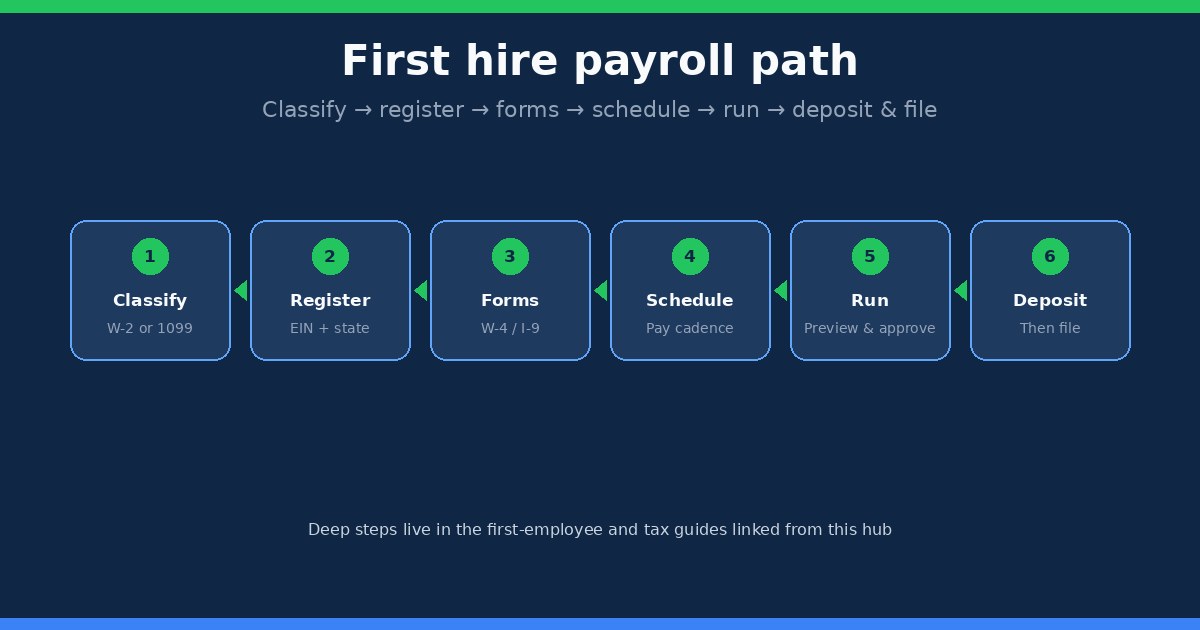
Most first-hire snags happen before payday. Confirm the role is employee work under IRS and DOL guidance, get or confirm your EIN, open the state withholding and unemployment accounts your location requires, collect W-4 and I-9 (and state equivalents), pick a legal pay schedule, then set up banking and funding lead times in your payroll tool. Only then does the first preview of gross to net make sense.
Owners often underestimate funding windows. Direct deposit is not instant in every setup. Build a buffer so the first approved run clears before employees expect money in their accounts. Preview carefully: wage type, hours, salary, tips if any, deductions, and employer taxes should match what you intended to offer.
The full sequence lives in how to run payroll for your first employee and the new-hire payroll checklist. Tax-specific deposit and filing notes sit in payroll taxes for your first employee.
W-2 vs 1099: classify before you pay
Classification is a facts-and-circumstances test, not a preference for cheaper taxes. Employees typically work under your direction on how, when, and where the work gets done, using your tools, as part of your ongoing business. Independent contractors usually control their methods, can serve other clients, and invoice for deliverables. Labels in a contract help only when the working reality matches.
Paying someone as a 1099 contractor when they should be a W-2 employee creates back taxes, penalties, and benefit exposure. The reverse mistake (payroll for a true contractor) adds cost and paperwork you did not need. Read the comparison in W-2 vs 1099: what small business owners need to know before you set up either path.
If the worker is a contractor, you still need a payment method, a W-9, and a plan for 1099-NEC when thresholds apply. That can be payroll software contractor pay, or bank ACH and invoicing without a payroll product. See how to pay contractors with Gusto and best ways to pay 1099 contractors without payroll software.
Taxes and deposits: withhold, remit, then file
For employees, you generally withhold federal income tax, Social Security, and Medicare, then add the employer share of FICA and federal unemployment where it applies. States add withholding and unemployment rules of their own. Local taxes exist in some cities and counties. Deposit schedules depend on your lookback period and amounts; monthly and semiweekly patterns are common at federal level, but your notice and history control what you must do.
Filing is separate from depositing. Forms such as 941 (or 944 for some small employers), state equivalents, and annual W-2/W-3 packages sit on calendars that do not always match deposit days. Treat “approved payroll” as incomplete until deposits and filings are tracked. Software helps, but you still own the calendar if a bank reject or setup gap appears.
Walkthrough detail for first-hire owners is in payroll taxes for your first employee: what small business owners should know. Confirm current IRS Publication 15 guidance and your state agency pages before you rely on any blog schedule.
LLC owners: payroll, draws, and when you need both
Single-member LLCs taxed as disregarded entities often take owner draws rather than W-2 wages. Multi-member partnerships usually take guaranteed payments or distributive shares rather than classic employee payroll for owners. Electing S corporation taxation changes the picture: reasonable compensation as wages is a common expectation before leftover profit distributions.
Hiring employees under an LLC almost always means running payroll for those workers even if the owner still uses draws. The LLC question is therefore two questions: How do I pay myself under my tax election? Do I have workers who require payroll? Start with Do I Need Payroll for My LLC? and how to pay yourself from an LLC: payroll, draws, and common mistakes.
Software picks for teams of 1 to 5
Starter payroll software fits when you want calculated withholding, direct deposit, tax deposits and filings, and employee self-service without hiring a payroll clerk. For very small headcount, prioritize setup time, tax filing support in your states, contractor pay if you need it, and clean accounting sync over enterprise HR suites.
Gusto is a common fit for US SMBs that want full-service payroll plus optional benefits and contractor payments in one place. QuickBooks Payroll can make sense when your books already live in QuickBooks and you want payroll tightly next to the ledger. Compare tradeoffs in Gusto vs QuickBooks Payroll and the shortlist in best payroll software for 1 to 5 employees. Broader software shortlists sit under comparisons.
Pick the lightest stack that covers your states, worker types, and filing needs. Upgrade when headcount, multi-state complexity, or benefits enrollment outgrow the starter plan, not because a feature list looked impressive on a pricing page.
Start here: reading path through the cluster
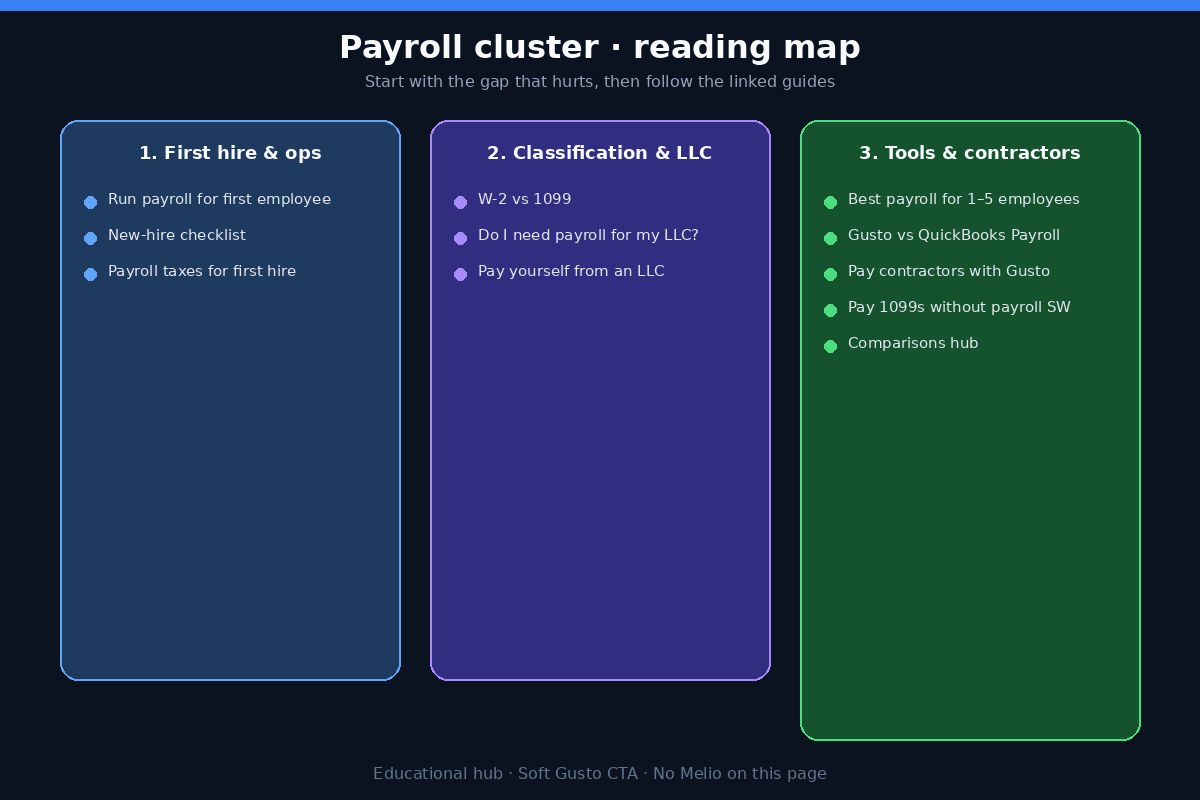
Use this order if you are new to the topic. Skip ahead if you already know which gap hurts most.
1. First hire and ops
- How to run payroll for your first employee — end-to-end first payday runbook
- New-hire payroll checklist for small businesses — forms and setup before day one
- Payroll taxes for your first employee — withhold, deposit, and file basics
2. Classification and LLC pay
3. Tools and contractors
- Best payroll software for 1 to 5 employees
- Gusto vs QuickBooks Payroll
- How to pay contractors with Gusto
- Best ways to pay 1099 contractors without payroll software
- Comparisons hub
FAQ
Do I need payroll software for one employee?
Not legally required in every case, but strongly practical. Manual withholding math, deposit calendars, and year-end forms are easy to get wrong. Starter software usually costs less than a single missed deposit penalty cycle for many small employers.
Can I pay myself and my first employee from the same system?
Often yes for wages, if your tax election supports owner wages. Owner draws and distributions may still happen outside the payroll run. Match the method to your entity taxation, then keep employee payroll clean and on schedule.
When should I use Gusto instead of staying in QuickBooks only?
When you want a payroll-first product with strong employee self-service and optional benefits, or when QuickBooks Payroll’s plan features and pricing do not match your states and headcount. If the ledger already lives in QuickBooks and payroll integration is the priority, read Gusto vs QuickBooks Payroll with your real workflow in mind.
Are contractors paid through payroll?
Some tools let you pay contractors alongside employees. That does not turn them into employees. Collect a W-9, avoid employee-style control, and issue 1099-NEC when required. See the Gusto contractor guide and the no-payroll-software options linked above.
What should I do this week?
Confirm classification for anyone you pay, verify EIN and state accounts, collect missing W-4/I-9 or W-9 forms, pick a pay schedule you can fund, and run a preview in software or with your advisor before the first live payday. Bookmark the tax deposit calendar that applies to you.
Try Gusto
If a full-service payroll path fits your shop, Gusto is a practical place to run employee payroll, handle tax filings in supported jurisdictions, and optionally pay contractors in the same workspace. Explore Gusto through our partner link: Try Gusto. Terms, eligibility, and offers can change; verify pricing, state coverage, filing support, and plan features on Gusto before you enroll. If you are still choosing between Gusto and QuickBooks Payroll, start with Gusto vs QuickBooks Payroll instead of forcing a tool into the wrong books workflow.
Related cluster links for bookmarking: first employee payroll, new-hire checklist, payroll taxes, LLC payroll, pay yourself from an LLC, W-2 vs 1099, Gusto vs QuickBooks Payroll, best payroll for 1–5, contractors with Gusto, 1099 pay without payroll software, and comparisons.
Official references worth keeping nearby include IRS Publication 15 (Circular E), IRS worker classification materials, and your state workforce and revenue agency pages. Rules and product features change; treat this hub as an operations map, then confirm current requirements with your providers and advisors.