Disclosure: This guide is educational and may include affiliate links. We may earn a commission if you sign up through our Melio or Gusto partner links, at no extra cost to you. It is not legal, tax, accounting, or financial advice. Form 1099-NEC rules depend on payment type, payee classification, dollar thresholds for the tax year, and exceptions in IRS instructions. Verify details on IRS.gov and with a qualified CPA or attorney before you act.
Yes, you often need Form 1099-NEC when your trade or business pays an LLC for nonemployee services and the year’s payments meet the IRS reporting threshold, unless the LLC is treated as a corporation for federal tax purposes and an exception does not apply. The LLC label on an invoice is not enough. Read the federal tax classification on Form W-9, track payments by vendor, then compare the total to the threshold for that calendar year. For payments made before 2026 the IRS reporting threshold for Form 1099-NEC nonemployee compensation is $600; for payments made in 2026 it is $2,000 (see IRS: Am I required to file a Form 1099?). After 2026, check Pub. 1099 for any inflation-adjusted amount.
Quick answer: do you need to 1099 an LLC?
Usually yes when you paid a single-member LLC taxed as a disregarded entity, or a multi-member LLC taxed as a partnership, for services in your trade or business, and the year’s reportable total meets the threshold. Usually no for ordinary nonemployee service payments to an LLC that is treated as a C corporation or S corporation. IRS instructions generally exclude payments to corporations, including an LLC treated as a C or S corporation, with important exceptions such as certain payments to attorneys. Always start from the W-9, not from the vendor’s marketing name. For the broader employee-versus-contractor question, see W-2 vs 1099.
| LLC federal tax picture (from W-9) | Ordinary trade/business services , 1099-NEC? |
|---|---|
| Single-member / disregarded | Usually yes when threshold and other 1099-NEC conditions are met |
| Partnership (multi-member default) | Usually yes when threshold and conditions are met |
| S corporation | Generally no for ordinary services; confirm exceptions in IRS instructions |
| C corporation | Generally no for ordinary services; confirm exceptions in IRS instructions |
Who this guide is for
Use this if you pay U.S. freelancers, agencies, consultants, or vendors that invoice as LLCs and you are building a clean W-9 and year-end filing process. It also helps AP leads who keep hearing “corporations are exempt” and want to know what that means when the legal name ends in LLC. Skip this if you need a binding opinion on a specific payee, multi-state information-return rules, or backup-withholding mechanics beyond a high-level flag. Those belong with a CPA or tax attorney. For how contractor payments fit next to payroll ops, see the tax compliance hub and payroll hub.
What Form 1099-NEC reports (and what it does not)
Form 1099-NEC reports nonemployee compensation: amounts you paid in the course of your trade or business to someone who is not your employee for services (including parts and materials when they are part of that service payment), when the reporting conditions and threshold are met. The IRS summarizes the classic four conditions on its page for reporting payments to independent contractors: the payee is not your employee; the payment is for services in your trade or business; the payee is an individual, partnership, estate, or in some cases a corporation; and the year’s reportable payments meet the threshold.
Personal payments outside a trade or business are generally not reportable on these business information returns. Employee wages belong on Form W-2 and payroll filings, not on 1099-NEC. Product-only purchases and other payment types may land on different forms or nowhere in the 1099-NEC box set. Use the current Instructions for Forms 1099-MISC and 1099-NEC rather than guessing from a blog memory.
What is the 1099-NEC dollar threshold in 2026?
According to IRS.gov, for payments made before 2026 the Form 1099-NEC reporting threshold is $600. For payments made in 2026 the reporting threshold is $2,000. For payments made after 2026, see Publication 1099 for the inflation-adjusted reporting threshold. Many older articles and templates still say “$600” without the year split; if you are filing for 2026 calendar-year payments, use the $2,000 figure from the IRS page unless newer official guidance changes it. You must also file Form 1099-NEC when you withheld federal income tax under backup withholding rules, regardless of the payment amount.
Ops implication: set your AP or bookkeeping report to sum reportable nonemployee service payments per payee TIN for the calendar year, then compare against the threshold that applies to that year. Do not mix personal reimbursements and employee wages into the same “contractor” export.
Does LLC tax classification change whether you file?
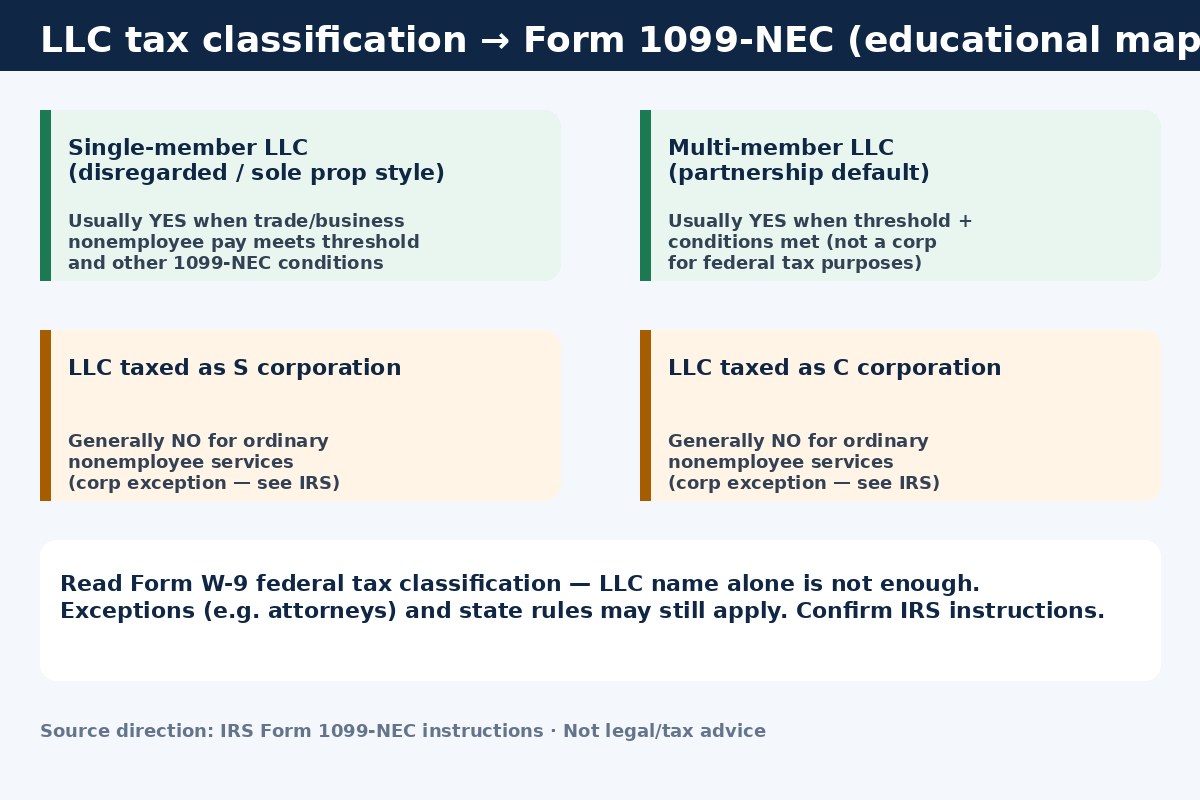
An LLC is a state legal entity. Federal tax treatment is a separate lever. By default, a single-member LLC is often a disregarded entity. A multi-member LLC is often taxed as a partnership. An LLC can elect to be taxed as a corporation, and when eligible it may be an S corporation. IRS instructions for Forms 1099-MISC and 1099-NEC generally say you do not report payments to a corporation (including an LLC treated as a C or S corporation) on Form 1099-NEC for ordinary nonemployee compensation, while pointing you to the “reportable payments to corporations” exceptions (attorneys are a common example called out in IRS materials).
That is why “Do I need to 1099 an LLC?” is really “How is this LLC classified for federal tax purposes, and is this payment type still reportable?” Two vendors can both say LLC on the invoice and produce opposite filing answers after you read their W-9s.
How to read an LLC’s Form W-9
Collect Form W-9 before the first payment whenever you can. The federal tax classification section is the decision input. Look for whether the LLC is disregarded, partnership, C corporation, or S corporation as indicated on the form the payee completes. Note the name and TIN (SSN or EIN) exactly as they will appear on any information return. An EIN instead of an SSN does not, by itself, mean “skip the 1099.” Plenty of reportable disregarded entities and partnerships use an EIN.
Store the W-9 where AP and bookkeeping can both find it. If a vendor refuses to provide a W-9, pause and talk to your CPA about backup withholding and whether you should pay at all. For payment workflows without a full payroll suite, see best ways to pay 1099 contractors without payroll software.
Step-by-step: decide before year-end
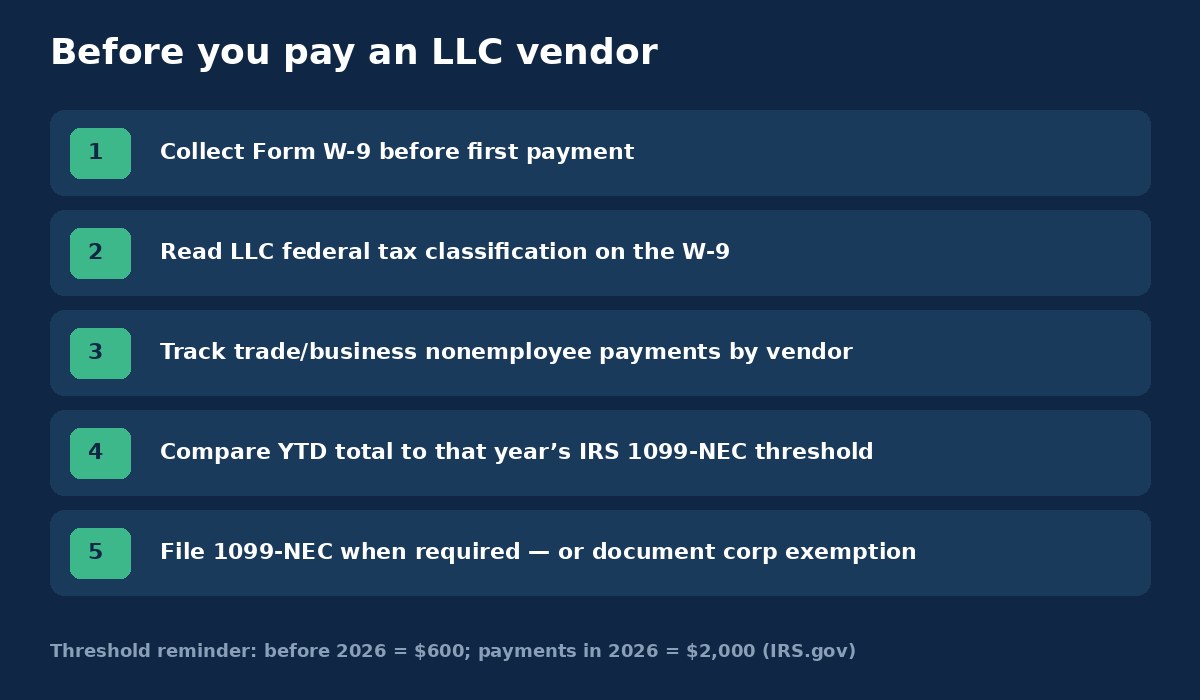
- Collect a completed Form W-9 before the first payment (or as soon as you notice it is missing).
- Record the LLC’s federal tax classification and TIN in your vendor master.
- Tag invoices as trade-or-business nonemployee services when that is what you bought.
- Run a year-to-date payment total by TIN; apply the IRS threshold for that calendar year ($600 before 2026; $2,000 for payments made in 2026 per IRS.gov).
- If classification is disregarded or partnership and the threshold and conditions are met, prepare Form 1099-NEC. If classification is C or S corporation for ordinary services, document the corporate exception, and still check attorney/medical and other IRS exception lists before you skip filing.
File and furnish copies on the IRS calendar for Form 1099-NEC (recipient and IRS due dates are typically late January; confirm the current year’s Instructions for Forms 1099-MISC and 1099-NEC). If you file 10 or more information returns, e-filing rules generally apply. See IRS guidance on information returns.
Card and network payments: where Form 1099-K can matter
When you pay a vendor with a payment card or through certain third-party network settlement flows, the processor may have its own information-reporting obligations (often discussed in connection with Form 1099-K). That does not replace your duty to classify workers correctly or to understand when your own 1099-NEC filing still applies for direct payments you make outside those networks. Keep funding method visible in your AP export so January you are not double-counting or missing direct ACH/check totals. Soft language here on purpose: processor rules and 1099-K thresholds change; verify current IRS and processor notices rather than copying a blog number.
Paying LLC vendors in practice
Most small teams need three habits more than they need a new acronym: W-9 on file, payment history by TIN, and a January filing checklist. How you move the money (ACH, check, or card-funded bill pay) should still leave an audit trail that matches the vendor master. If you pay invoice-style LLC contractors and vendors through a business bill-pay tool, keep the same W-9 discipline; the payment rail does not invent a corporate exemption. For Melio-specific contractor payment mechanics, see can you pay contractors with Melio and the broader bill pay hub.
Try Melio if you want a simple way to pay LLC vendors by ACH, check, or card-funded payments while you keep W-9 and year-end 1099 work in your books or with your CPA. Melio is a payments layer, not a substitute for reading IRS instructions or for employee payroll.
When the hire-employee path fits instead
If the person you are paying looks like an employee under IRS worker-classification factors (behavioral control, financial control, and type of relationship), paying their LLC and hoping a 1099 fixes the risk is the wrong tool. Misclassification can cost more than a payroll subscription. Use W-2 vs 1099, then decide whether you need payroll for the role. Owner-operator questions about your own LLC (draws versus wages) belong in do I need payroll for my LLC and how to pay yourself from an LLC.
When you truly need W-2 payroll or a workforce tool that also helps with contractor records, compare that path separately from AP bill pay. Soft option: explore Gusto for employee payroll, and see how to pay contractors with Gusto if you want contractor payments inside a payroll-style product. For tool shopping across categories, the comparisons hub is the index.
Common mistakes when 1099’ing LLC vendors
- Treating every LLC as “corporation = skip 1099” without reading the W-9 classification.
- Using a stale $600 rule of thumb for 2026 calendar-year payments without checking IRS.gov ($2,000 for payments made in 2026).
- Paying before a W-9 is on file, then scrambling in January with missing TINs.
- Assuming an EIN automatically means exempt.
- Mixing employee wages, owner draws, and contractor invoices in one undifferentiated “pay anyone” export.
- Ignoring attorney and other reportable-to-corporation exceptions called out in IRS instructions.
- Forgetting that backup withholding can create a 1099-NEC filing duty even below the normal dollar threshold.
FAQ: do I need to 1099 an LLC?
Do I need to 1099 an LLC if I paid them more than the reporting threshold?
Often yes for disregarded and partnership LLCs when the payment is nonemployee compensation in your trade or business and the other 1099-NEC conditions are met. Corporate-taxed LLCs are generally excluded for ordinary services. Confirm the year’s threshold and any exceptions on IRS.gov.
Is an LLC the same as a corporation for 1099-NEC?
No. LLC is a legal form. Corporation treatment for information reporting usually follows federal tax classification (including an LLC treated as a C or S corporation), not the letters after the name.
Does a single-member LLC need a 1099-NEC?
If it is disregarded for federal tax purposes and you meet the 1099-NEC conditions and threshold, you usually file. Read the W-9; some single-member LLCs elect corporate taxation.
What if the LLC is taxed as an S corporation or C corporation?
IRS instructions generally exclude ordinary nonemployee service payments to corporations, including LLCs treated as C or S corporations. Check the instructions for payments that remain reportable to corporations (for example, certain attorney payments).
Does an EIN on the W-9 mean I can skip the 1099?
No. Classification drives the exemption analysis more than whether the TIN is an EIN or SSN.
Do credit card or payment-network payouts still need a 1099-NEC from me?
Sometimes the network or processor has separate reporting (often discussed with Form 1099-K). Your direct ACH/check totals can still sit in 1099-NEC scope. Keep funding methods separated in reports and confirm current IRS rules with your CPA.
What if I never collected a W-9 from the LLC?
Request it immediately. Missing TINs create filing and potential backup-withholding issues. Your CPA can advise on next steps for already-paid amounts.
Is this legal or tax advice?
No. This is educational content for U.S. small-business operators. Use IRS publications and a qualified professional for your facts.
Related reading
- Tax compliance hub
- Bill pay hub
- Payroll hub
- Comparisons hub
- W-2 vs 1099
- Best ways to pay 1099 contractors without payroll software
- Can you pay contractors with Melio
- How to pay contractors with Gusto
- Do I need payroll for my LLC
- How to pay yourself from an LLC
Bottom line for ops: collect the W-9, trust the federal tax classification, apply the correct year’s IRS threshold, and file Form 1099-NEC when the rules say you must. For paying LLC vendors day to day, Try Melio can simplify ACH, check, and card-funded bill pay while you keep compliance work with your books and CPA.