Form W-9 and Form W-2 answer different paperwork questions. A W-9 is a Request for Taxpayer Identification Number and Certification that a payee—usually an independent contractor or vendor—gives you so you can report payments on an information return such as Form 1099-NEC. A W-2 is a Wage and Tax Statement that you, as the employer, prepare for each employee to report wages and taxes withheld. Employees generally complete Form W-4 for withholding, not a W-9. If you are stuck on “W-9 or W-2,” start with worker classification, then pick the matching forms.
Disclosure: This guide is educational for U.S. small business owners. It is not legal, tax, accounting, or employment advice. IRS forms, thresholds, and due dates change. Confirm current instructions on IRS.gov and with a qualified professional before you classify workers, withhold tax, or file returns.
Research note: Form purposes and the 2026 Form 1099-NEC reporting threshold were checked on IRS About Form W-9, About Form W-2, About Form W-4, and Am I required to file a Form 1099… on November 3, 2026. Re-check before you file.

Who this guide is for
I wrote this for owners and ops leads who hear “send me your W-9” and “we’ll send your W-2” in the same week and want a clean map. It fits if you are hiring your first employee, engaging freelancers, or cleaning up vendor files before year-end. If you already know the person is an employee and only need payroll setup, jump to the W-2 / W-4 section and our payroll hub. If the question is really employee versus contractor status, pair this page with W-2 vs 1099.
Takeaway: W-9 vs W-2 is a forms comparison that only makes sense after you know whether the worker is a contractor or an employee.
What Form W-9 is for
According to the IRS, you use Form W-9 so a person or entity can provide their correct Taxpayer Identification Number (TIN) to someone who must file an information return. Common examples include income paid to that person, certain real-estate or debt items, and other reportable payments listed on the form’s “About” page. In small-business practice, that usually means: you engage a contractor or vendor, you ask for a completed W-9 before you pay them regularly, and you store the TIN so you can issue Form 1099-NEC (or another information return) when required.
The contractor fills out the W-9. You do not fill it out for them as if it were a year-end wage form. You are the requester; they certify their name, TIN, federal tax classification, and related certifications. Keep the form in your records. You generally do not mail every W-9 to the IRS just because you collected it.
Takeaway: A W-9 is the payee’s TIN certification to you—the paperwork that supports later information returns, not an employee wage statement.
What Form W-2 is for
Form W-2 is the employer’s Wage and Tax Statement. The IRS states that every employer engaged in a trade or business who pays remuneration for services performed by an employee must file Form W-2 for each employee when the usual wage-reporting conditions apply (for example, when income, Social Security, or Medicare tax was withheld, or when other reporting rules in the W-2 instructions are met).
In ops language: you run payroll, withhold employee taxes, pay the employer share of employment taxes on schedule, and at year-end you furnish employee copies of Form W-2 and file Copy A with the Social Security Administration (with Form W-3 as the transmittal). The statutory furnish-and-file date is generally January 31 for the prior calendar year’s wages. If January 31 falls on a weekend or legal holiday, the deadline moves to the next business day—as happened for 2025 Forms W-2, which were due February 2, 2026 per IRS Topic 752 and SSA employer guidance.
Takeaway: A W-2 is something you prepare for an employee after a year of payroll—not something a contractor hands you on day one.
W-9 form vs W-2: side-by-side comparison
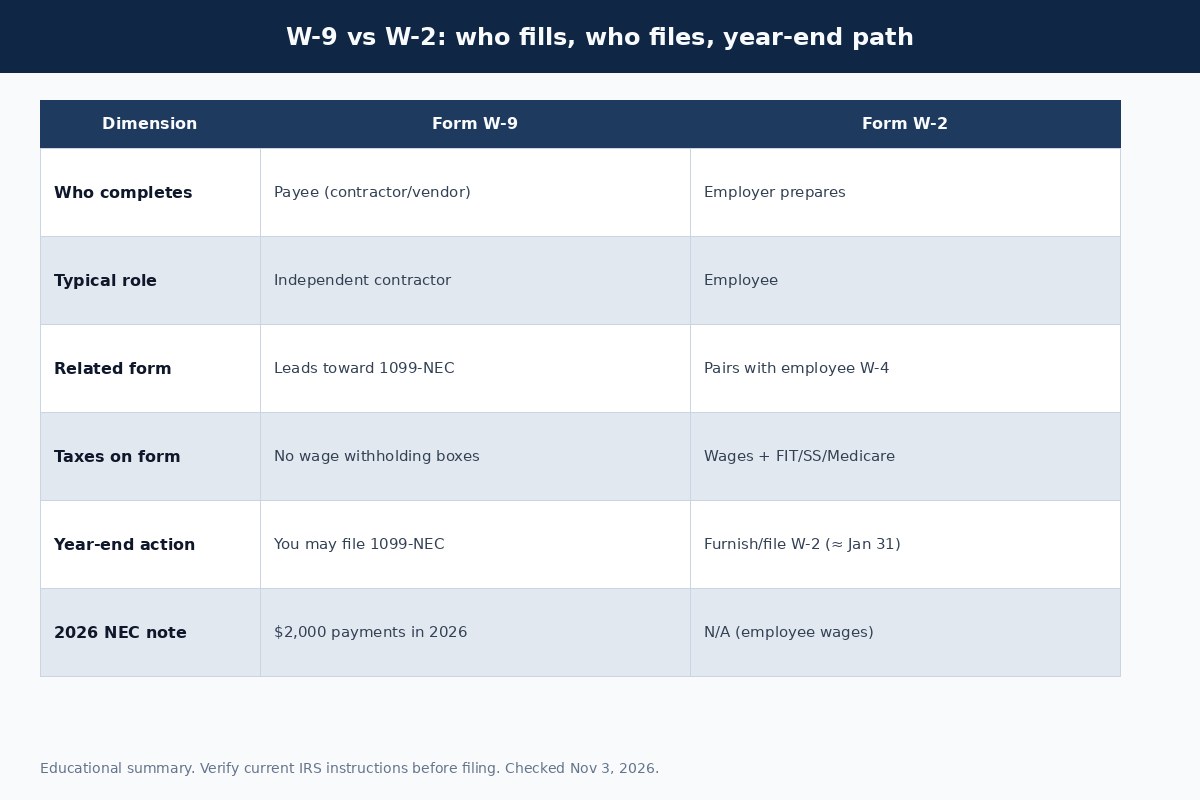
| Dimension | Form W-9 | Form W-2 |
|---|---|---|
| Official job | Request for TIN and certification | Wage and Tax Statement |
| Who completes it | Payee (contractor, vendor, or other payee) | Employer prepares it for each employee |
| Typical relationship | Independent contractor / reportable payee | Employee |
| Related onboarding form | W-9 itself | Employee Form W-4 for withholding |
| What it mainly supports | Information returns (often 1099-NEC) | Wage reporting to employee + SSA |
| Federal wage withholding on the form | No employee wage boxes | Shows wages and taxes withheld |
| Common year-end follow-through | File 1099-NEC when rules require | Furnish/file W-2 (generally by Jan 31) |
Takeaway: Same tax season, different roles—W-9 is inbound TIN data from a payee; W-2 is outbound wage reporting from you as employer.
Employees use Form W-4 — not Form W-9
This is the mix-up I see most often in Slack threads and onboarding checklists. New employees complete Form W-4, Employee’s Withholding Certificate, so you know how much federal income tax to withhold from wages. They do not complete a W-9 to “get on payroll.”
Contractors complete a W-9 so you have a certified TIN for information reporting. Asking an employee for a W-9, or asking a true contractor for a W-4 as if they were on payroll, usually signals that classification is still fuzzy. Fix the relationship facts first, then request the matching form. Our deeper classification walkthrough lives on W-2 vs 1099: what small business owners need to know.
Takeaway: Employee onboarding = W-4 + payroll; contractor onboarding = W-9 + invoice payments—do not swap those forms to “save steps.”
How a W-9 connects to Form 1099-NEC
Collecting a W-9 does not automatically mean you will issue a 1099-NEC. The W-9 gives you the TIN and certifications you need if a filing requirement applies. Whether you must file Form 1099-NEC depends on the payment type, the payee, and the calendar-year amount under current IRS rules.
For nonemployee compensation paid in the course of your trade or business, the IRS currently states:
- For payments made before 2026, the reporting threshold was $600.
- For payments made in 2026, the reporting threshold is $2,000.
- For payments made after 2026, see Pub. 1099 for the inflation-adjusted threshold.
- You must also file Form 1099-NEC if you withheld any federal income tax under the backup withholding rules, regardless of the payment amount.
That $2,000 figure for 2026 payments matches the Instructions for Forms 1099-MISC and 1099-NEC and the IRS information-return overview page. Older articles that only say “$600” are incomplete for calendar year 2026 payments. When you are ready to file, see how to file 1099-NEC and do I need to 1099 an LLC for entity-type wrinkles.
Takeaway: W-9 first, then track payments; for 2026 contractor services, plan around the $2,000 1099-NEC threshold (and backup withholding exceptions).
How Form W-2 fits payroll withholding and deadlines
Once someone is an employee, the year-end form is W-2, not 1099-NEC for those wages. During the year you withhold federal income tax based on Form W-4, withhold and match Social Security and Medicare taxes as required, and deposit employment taxes on the IRS schedule that applies to you. At year-end, you reconcile wages and furnish/file Forms W-2.
Treat January 31 as the default planning date to get employee copies out and to file with the SSA, then check the year’s official calendar if January 31 is a weekend or holiday. Missing W-2 deadlines can create penalties and employee friction in filing season. Payroll software (including tools like Gusto) exists largely to keep withholding, deposits, and W-2 production on rails—useful when headcount is still small but the calendar is not.
Takeaway: W-2 season is the end of a payroll process that started with W-4 and correct classification—not a substitute for collecting contractor W-9s.
Backup withholding when a W-9 is missing or wrong
At a high level, backup withholding is federal income tax a payer may need to withhold from certain reportable payments when the payee’s TIN is missing or incorrect, or when other backup-withholding conditions in IRS guidance apply. The IRS points requesters of Form W-9 to resources such as Publication 1281 (backup withholding for missing and incorrect name/TIN combinations) and the Instructions for the Requester of Form W-9.
For day-to-day ops: get a complete W-9 before you pay a new contractor whenever practical, match the name/TIN style to what the payee uses with the IRS, and escalate to your tax pro if you receive IRS notices about incorrect TINs. If backup withholding applies, report the withheld amount on the information return (for example, Form 1099-NEC box 4) and follow deposit/reporting rules for withheld nonpayroll taxes. This article does not invent a do-it-yourself penalty calculator—use current IRS publications when you are in that situation.
Takeaway: A late or blank W-9 is an ops risk; backup withholding rules exist so missing TINs do not leave reportable payments unaddressed.
Can someone get both a W-2 and a W-9 in the same year?
Yes, in real life, because people wear more than one hat. The same individual might be your W-2 employee for a staff role and separately provide unrelated services to another business as a contractor (that other business collects a W-9). Or someone might leave employment mid-year (W-2 for wages while employed) and later consult for a different company under a contractor agreement (W-9 to that company).
What you should not do is treat the same controlled job as “contractor on Mondays, employee on Tuesdays” to dodge payroll taxes. Labels in an email or contract do not override the facts of behavioral control, financial control, and type of relationship under IRS common-law guidance. If the same person does two truly separate kinds of work for you, get advice before you invent a hybrid file—misclassification risk is real.
Takeaway: One person can touch both forms in a year across different relationships; one controlled job for you should not be split across W-2 and 1099 for convenience.
Misclassification risk if you treat an employee like a W-9 contractor
Handing someone a W-9 and paying them on invoices does not make them a contractor if the facts say they are an employee. If you have the right to control what is done and how it is done, the IRS generally looks at that person as an employee. Contract language that says “independent contractor” does not erase payroll tax obligations when the working relationship is employment.
Consequences can include employment taxes you should have withheld and paid, information-return corrections, and possible interest or penalties. The IRS offers determination and relief programs in some situations (for example, Form SS-8 determinations, and programs discussed in IRS misclassification materials). Those are case-specific—use a CPA or employment counsel rather than guessing from a blog checklist. For the classification decision tree itself, use our W-2 vs 1099 guide and the IRS independent contractor vs employee page.
Takeaway: Choosing W-9 paperwork cannot fix a W-2 relationship; classify on facts, then request or prepare the matching forms.
Ops checklist: which form to request or file
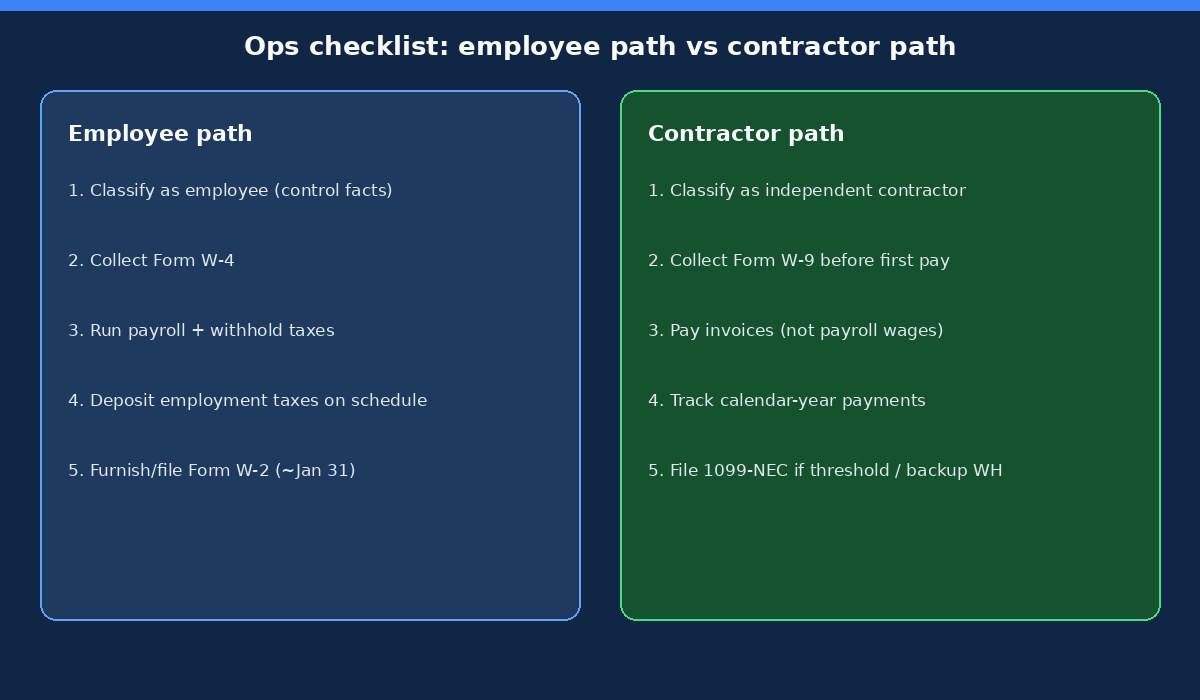
If the worker is an employee
- Confirm employee status using IRS common-law factors (and state rules where they apply).
- Collect Form W-4 and required new-hire / payroll setup data.
- Run payroll, withhold, and deposit employment taxes on schedule.
- At year-end, furnish and file Form W-2 (plan around the January 31 statutory date).
If the worker is an independent contractor
- Confirm contractor status on the facts—not only the invoice template.
- Collect Form W-9 before the first payment when practical (how to collect a W-9 from a contractor).
- Pay against invoices through your contractor payment process—not as payroll wages. See how to pay contractors with Gusto if you already use that stack.
- Track calendar-year totals; file Form 1099-NEC when the threshold or backup-withholding rules require it.
Takeaway: Build two short playbooks—employee (W-4 → payroll → W-2) and contractor (W-9 → pay → 1099-NEC)—and refuse to mix them for the same controlled job.
FAQ: W9 form vs W2
What is the difference between a W-9 and a W-2?
A W-9 is completed by a payee to certify their TIN for information reporting. A W-2 is prepared by an employer to report an employee’s wages and taxes withheld. One is inbound contractor/vendor data; the other is outbound employee wage reporting.
Do employees fill out a W-9 or a W-4?
Employees generally complete Form W-4 for federal income tax withholding. Form W-9 is the TIN form used for many nonemployee payees, not the standard employee withholding certificate.
When should a small business request a W-9 from a contractor?
Request it before the first payment when you can. Waiting until January makes TIN mismatches and rush filings more likely. Store the completed form with your vendor records.
Does a W-9 mean I will get (or must issue) a 1099-NEC?
Not automatically. A W-9 supplies the TIN you may need. Filing Form 1099-NEC depends on whether payments meet IRS reporting rules for that year—including the amount threshold and backup-withholding situations.
What is the 1099-NEC reporting threshold for 2026 payments?
For payments made in 2026, the IRS states a $2,000 threshold for the nonemployee compensation situations described on its information-return page (up from $600 for payments made before 2026). Always confirm the current Instructions for Forms 1099-MISC and 1099-NEC before filing.
Can the same person receive both a W-2 and a W-9 in one year?
Yes, across different relationships—for example, W-2 wages from an employer and a W-9 provided to a separate business for unrelated contracting work. Do not use dual paperwork to re-label one controlled job.
What is backup withholding in plain language?
It is federal income tax a payer may have to withhold from certain payments when the payee’s TIN is missing or incorrect, or when other IRS backup-withholding triggers apply. Collecting an accurate W-9 early reduces that risk. See IRS Publication 1281 and the W-9 requester instructions for details.
What if I am unsure whether someone is an employee or a contractor?
Do not solve uncertainty by picking the “easier” form. Review IRS common-law factors, check state rules that may be stricter, and ask a qualified advisor. Form SS-8 exists for IRS determinations when you need a formal answer; those reviews can take time.
Related reading and next step
If the real decision is employee versus contractor, start with W-2 vs 1099, then come back here for the forms map. Building a contractor file? Use collect a W-9 from a contractor and how to file 1099-NEC. Hiring on payroll? Browse the payroll and tax compliance hubs, or compare tools under comparisons.
When you are ready to run employee payroll (W-4 → withhold → W-2) without juggling spreadsheets, look at Gusto as one payroll option for small teams. Confirm current pricing and features on Gusto’s site; this is an affiliate link.