Disclosure: This guide is educational and may include affiliate links. We may earn a commission if you sign up through our Gusto partner link, at no extra cost to you. It is not legal, tax, accounting, or financial advice. Federal and state payroll rules change; verify requirements with IRS Publication 15 (Circular E), your state agencies, and a qualified professional before you act.
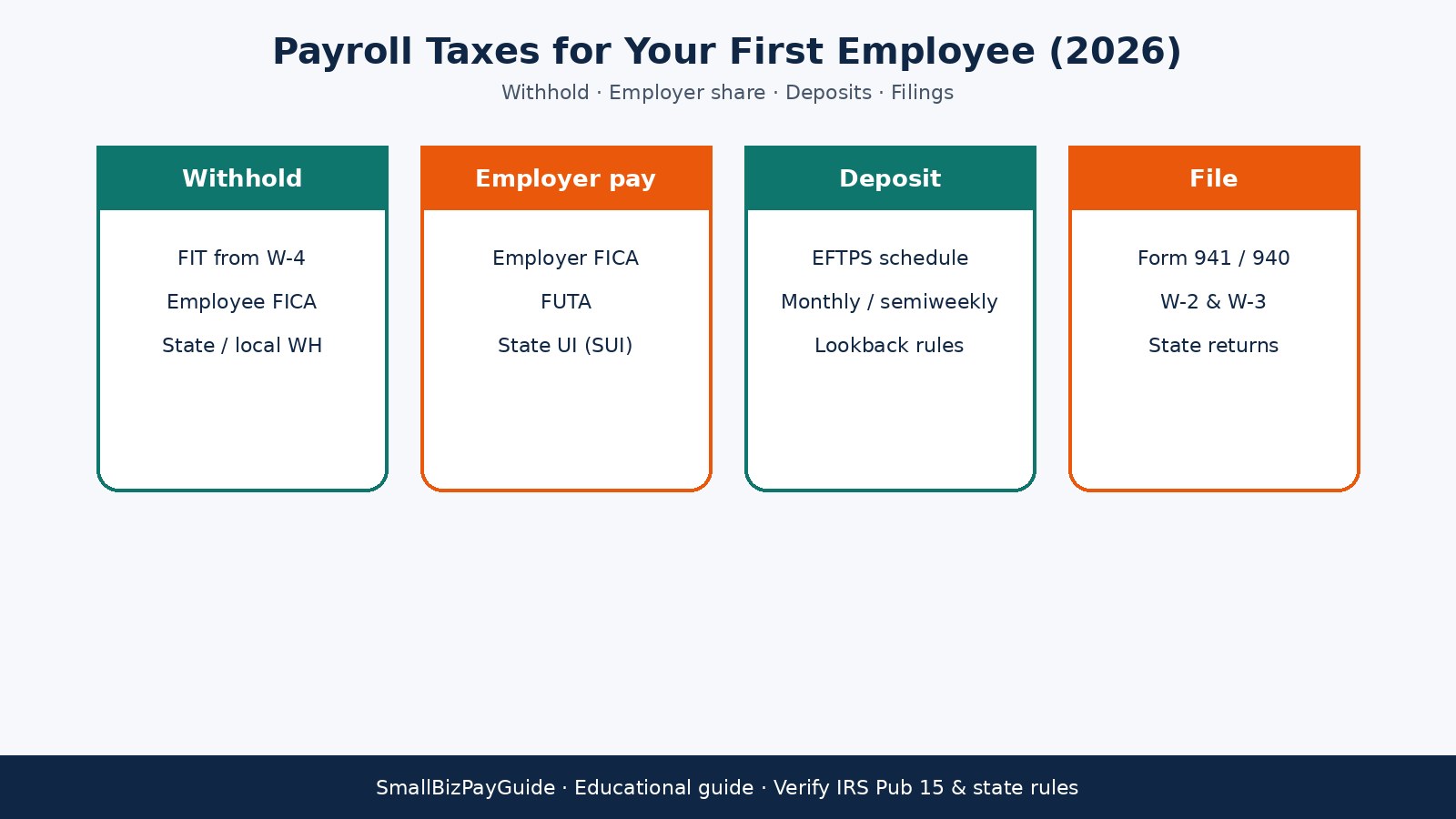
Hiring your first employee adds four payroll-tax jobs that contractors rarely trigger: withhold taxes from wages, pay the employer share, deposit those amounts on the IRS schedule that applies to you, and file the right returns on time. This Ops and Finance map walks through those pieces for a typical US small business in 2026 so you can set calendars, software, and cash reserves before the first payday.
Quick answer: what are payroll taxes for a first employee?
You usually withhold federal income tax using Form W-4, withhold the employee share of Social Security and Medicare (FICA), and withhold any required state or local income tax. As the employer you pay a matching FICA share, federal unemployment tax (FUTA), and state unemployment insurance (SUI). You deposit federal employment taxes on a monthly or semiweekly schedule (often through EFTPS), then file Form 941 quarterly and Form 940 annually, plus year-end Forms W-2 and W-3. Deposit deadlines and filing deadlines are different calendars. Confirm current rates, wage bases, and your deposit schedule in IRS Publication 15 and your IRS correspondence. For day-zero onboarding steps, pair this with the new hire payroll checklist.
Who this guide is for
Use this if you are hiring a first W-2 employee, moving from contractor payments to employer payroll, running an LLC that needs a clear tax map before choosing software, or comparing Gusto, QuickBooks Payroll, or a local bureau with a CPA. If you are still deciding whether your entity needs payroll at all, start with do I need payroll for my LLC? and return here when a hire is real.
Employee vs contractor: why the tax map changes
A W-2 employee works under your direction in ways the IRS weighs for employment status. You withhold income and employment taxes, pay employer FICA and unemployment taxes, and issue Form W-2. A true independent contractor typically invoices for services, controls more of how the work gets done, and may receive Form 1099-NEC when payment thresholds apply. You do not withhold FICA from contractor pay the way you do for employees.
Misclassification creates back taxes, penalties, and interest exposure. Settle the classification decision before you collect W-4 data or promise a contractor-style pay routine. Side-by-side differences are covered in W-2 vs 1099 for small business owners. When the role is ambiguous, get advice from a CPA or employment counsel before the start date.
What you withhold from the employee
Federal income tax (FIT). The employee completes Form W-4. You calculate withholding with the methods in IRS Publication 15-T (percentage method or wage-bracket tables, depending on your process). Keep the signed W-4 with payroll records and update software the same day you accept a revised certificate.
Employee FICA. Social Security tax is generally 6.2% of wages up to the annual Social Security wage base (commonly cited as $184,500 for 2026; confirm the current SSA/IRS figure). Medicare tax is generally 1.45% of all wages with no wage base. Combined employee FICA is 7.65% until Social Security wages hit the base.
Additional Medicare Tax. Once an employee’s wages exceed $200,000 in a calendar year, you generally withhold an extra 0.9% Medicare tax on wages above that threshold. There is no employer match on that additional 0.9%.
State and local withholding. Many states require employee income-tax withholding based on a state certificate or equivalent. Some cities add local tax. Enter every applicable certificate in payroll software before the first pay run so the stub matches the forms.
What you pay as the employer
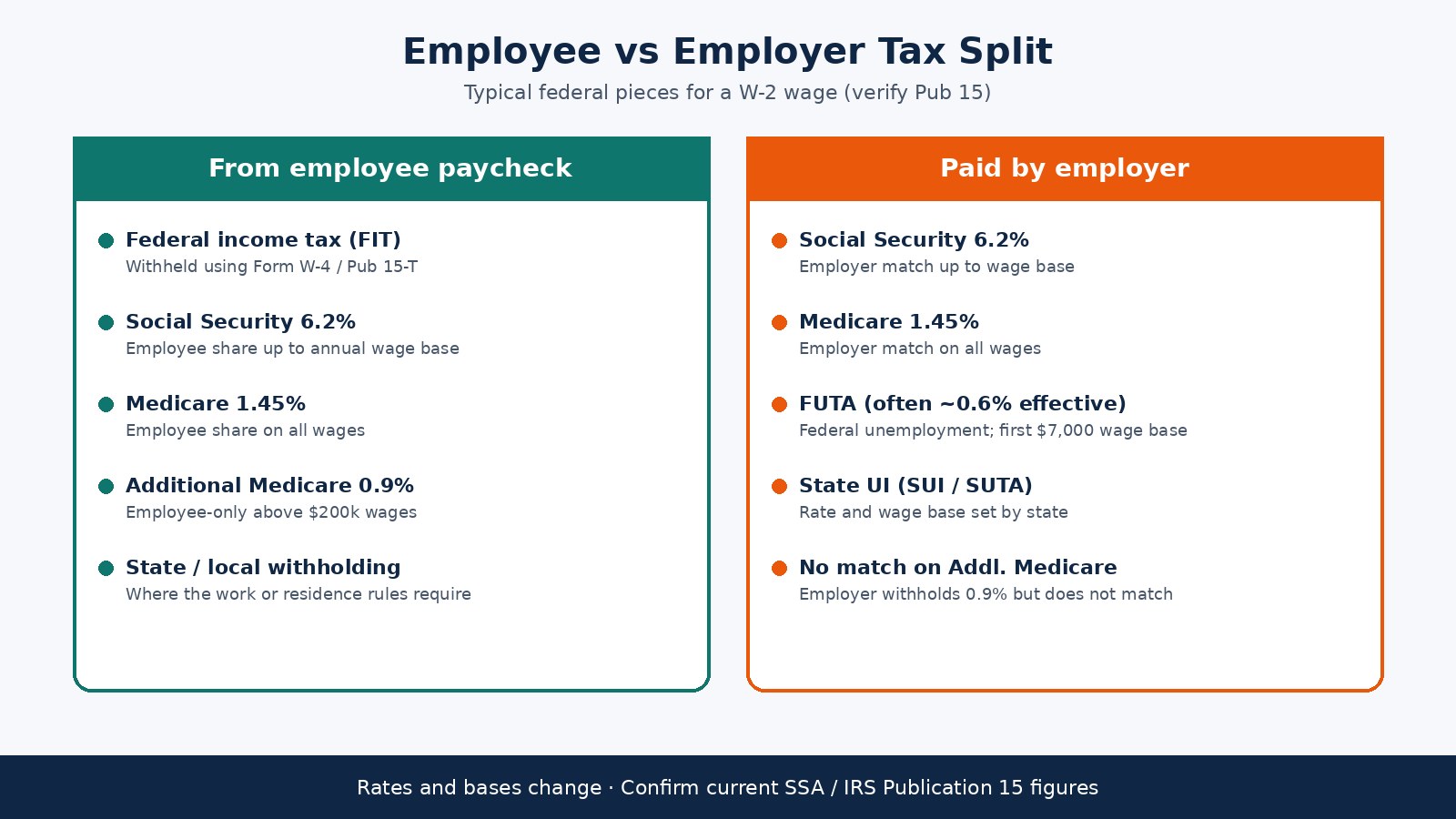
Employer FICA match. You generally pay another 6.2% Social Security (up to the wage base) and 1.45% Medicare on the same wages. That employer half is a business cost, not a deduction from the employee’s net pay.
FUTA. Federal unemployment tax uses a statutory rate of 6.0% on the first $7,000 of wages per employee. Most employers that pay state unemployment tax on time can claim a credit that often brings the effective FUTA rate to 0.6%. Credit reduction states and special situations can change that outcome, so verify Form 940 instructions for your year.
State unemployment insurance (SUI / SUTA). Register with your state unemployment agency, learn the new-employer rate and wage base, and calendar contribution due dates. SUI is usually an employer tax; a few states also have employee UI contributions.
Budget employer taxes as a percentage of gross wages, not as a surprise after payday. A rough planning range for employer FICA plus effective FUTA plus SUI often lands in the low-to-mid teens of wages for many first hires, but your state UI rate and any local taxes can move that number. Build cash for deposits before you promise a large starting salary.
Deposit schedules: when money leaves your bank
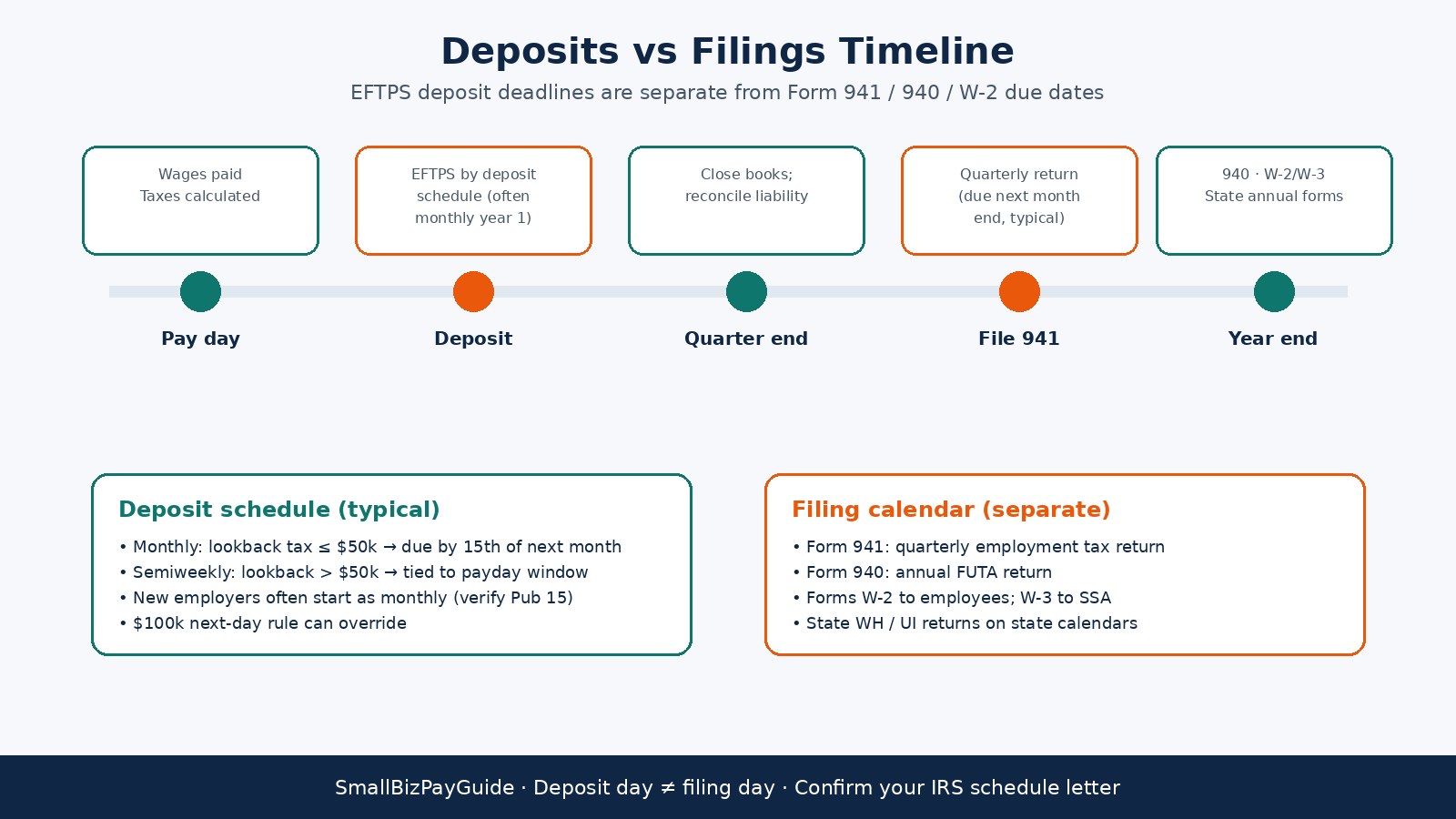
The IRS assigns a deposit schedule based on a lookback period of Form 941 tax liability. In broad terms described in Publication 15:
- Monthly depositor: lookback-period tax of $50,000 or less. Deposit taxes for a calendar month by the 15th of the following month.
- Semiweekly depositor: lookback-period tax over $50,000. Deposit timing ties to the payday window (Wednesday–Friday paydays vs Saturday–Tuesday paydays).
- New employers: many new employers are treated as monthly depositors for their first calendar year. Confirm the rule that applies to you in Pub 15 and any IRS notice.
- $100,000 next-day rule: if you accumulate $100,000 or more in tax liability on any day, deposit by the next business day and expect a schedule change.
Federal employment tax deposits are generally made by electronic funds transfer. Many employers use EFTPS; some payroll providers deposit on your behalf. Enroll early. A late deposit penalty can start even when you later file Form 941 on time.
Deposits are not Form 941 filings. EFTPS (or your provider’s deposit rail) moves money on the deposit schedule. Form 941 reports wages and tax liability for the quarter and is usually due by the last day of the month after the quarter ends (for example, Q1 due April 30 in a typical year). You can deposit correctly and still miss a 941 deadline, or file 941 on time after missing deposits. Calendar both.
Forms you will meet in year one
Form 941 (Employer’s Quarterly Federal Tax Return). Reports wages, FIT withheld, and Social Security and Medicare taxes for the quarter. File each quarter on the IRS due date that applies. If you deposited all taxes when due, a short filing extension to the 10th of the second month after the quarter may apply in some cases; verify current Form 941 instructions rather than assuming the extension.
Form 940 (Employer’s Annual Federal Unemployment Tax Return). Reports FUTA for the calendar year. FUTA deposits, when required, follow a quarterly threshold pattern (often deposit when cumulative FUTA liability exceeds $500). Filing is annual, typically due January 31 for the prior year.
Forms W-2 and W-3. Furnish Form W-2 to each employee and file Copy A with Form W-3 with the Social Security Administration by the January deadline for the prior year. Your payroll software or provider usually generates these; you still own accuracy and timing.
State withholding and UI returns. States set their own deposit and filing cycles for income-tax withholding and unemployment contributions. Some use monthly or quarterly coupons; others are fully electronic. Put state due dates on the same calendar as federal ones.
State pieces that sit beside federal rules
State income-tax withholding accounts, SUI accounts, new-hire reporting, and (where required) workers compensation sit next to federal payroll taxes. Local income taxes in some cities add another withholding layer. Remote or multi-state employees can create registration and withholding duties in more than one state. Treat multi-state setup as a CPA conversation early; it is the most common place first-time employers under-register.
Workers compensation is insurance, not a federal payroll tax, but many states require coverage before an employee starts. Budget premiums separately from FICA and FUTA so cash planning stays honest.
Software vs DIY for a first employee
A spreadsheet can calculate gross pay. It does not reliably track deposit schedules, lookback changes, Form 941 reconciling, state UI rates, or W-2 generation. For one employee, payroll software or a local payroll service is usually cheaper than fixing a missed deposit later.
When you compare tools, look for automated tax calculations, EFTPS or provider-led deposits, quarterly and annual form filing, direct deposit, and employee self-service for W-4 updates. Product comparisons live in Gusto vs QuickBooks Payroll and best payroll software for 1 to 5 employees. A step-by-step first pay run is in how to run payroll for your first employee.
DIY still makes sense for owners who already work with a CPA that reviews every pay run and deposit. If that support is missing, treat software as part of the control environment, not as optional polish.
Common mistakes on a first hire
- Treating a W-2 role as a contractor to avoid payroll setup.
- Collecting W-4 data but never registering for state withholding or SUI.
- Confusing EFTPS deposit due dates with Form 941 filing due dates.
- Assuming every new employer is semiweekly (or monthly) without checking lookback and Pub 15 new-employer rules.
- Forgetting employer FICA and SUI when pricing the job offer.
- Skipping a preview payroll, then discovering wrong withholding on live payday.
- Missing Additional Medicare Tax withholding after wages cross $200,000.
- Leaving year-end W-2 work until January without reconciling quarterly 941 totals first.
First-year payroll tax checklist
- Confirm W-2 classification and collect Form W-4 (plus state withholding forms).
- Confirm EIN; enroll in EFTPS or confirm your payroll provider deposits for you.
- Register for state withholding and SUI accounts that apply.
- Identify your federal deposit schedule (monthly vs semiweekly) and note the $100,000 next-day rule.
- Calculate employee withholdings and employer FICA / FUTA / SUI each pay period.
- Deposit federal taxes on schedule; deposit state taxes on state schedules.
- File Form 941 each quarter; track FUTA toward Form 940 and any quarterly FUTA deposits.
- Reconcile wages and tax liability before issuing Forms W-2 and filing Form W-3.
- Store payroll records, deposit receipts, and filed returns where your retention policy can find them.
FAQ
Are payroll tax deposits the same as filing Form 941?
No. Deposits send tax money on your deposit schedule. Form 941 is the quarterly return that reports wages and liability. You need both calendars.
What deposit schedule do new employers usually follow?
Many new employers start as monthly depositors in their first calendar year, then follow lookback results. Verify the current Publication 15 rule and any IRS notice that names your schedule.
What is the employer share of FICA in 2026?
Generally 6.2% Social Security up to the annual wage base plus 1.45% Medicare on all wages. Confirm the wage base and any updates in SSA and IRS Publication 15 for the year you are paying.
Do I pay FUTA for one employee?
Often yes once wages meet FUTA thresholds and you are not in an exempt category. Many small employers owe FUTA on the first $7,000 of wages at the effective rate after state credits. Check Form 940 instructions for your facts.
Can payroll software replace reading Publication 15?
Software automates calculations and many filings, but you remain responsible for correct setup, classification, and deadlines. Skim Pub 15 enough to understand deposit schedules and what your software claims to file.
What if my employee works remotely in another state?
You may need withholding and unemployment accounts in the work state, the residence state, or both, depending on reciprocal agreements and agency rules. Register before the first payday that creates nexus for those agencies.
Where does Gusto fit for a first employee?
Gusto is one payroll platform that calculates withholdings, runs deposits and filings for supported jurisdictions, and handles W-2 season for small teams. Compare current plans and supported states on Gusto’s site, and pair product choice with the tax map in this article.
Related reading
- New hire payroll checklist for small businesses
- How to run payroll for your first employee
- Do I need payroll for my LLC?
- W-2 vs 1099
- Gusto vs QuickBooks Payroll
- Best payroll software for 1 to 5 employees
- Payroll hub
Try Gusto for first-employee payroll taxes
If you want software that calculates withholdings, schedules deposits, and files common federal and state payroll forms for a small US team, Gusto is a practical place to compare. Run a preview payroll, confirm your deposit schedule in the product, and verify supported states before you approve the first live pay run.
Try Gusto (partner link). We may earn a commission at no extra cost to you. Confirm pricing, tax filing services, and state coverage on Gusto’s official pages before you enroll.
Again: this article is educational only. It is not tax or legal advice. Verify IRS Publication 15, SSA wage-base updates, Form 941/940 instructions, and your state agency rules for your facts, and consult a qualified professional when deposit schedules, multi-state work, or classification questions are unclear.