Disclosure: This guide is educational and may include affiliate links. We may earn a commission if you sign up through our Gusto partner link, at no extra cost to you. It is not legal, tax, accounting, or financial advice. How you pay yourself from an LLC depends on tax elections, state rules, and your facts. Verify details with the IRS, your state agencies, and a qualified CPA or attorney before you act.
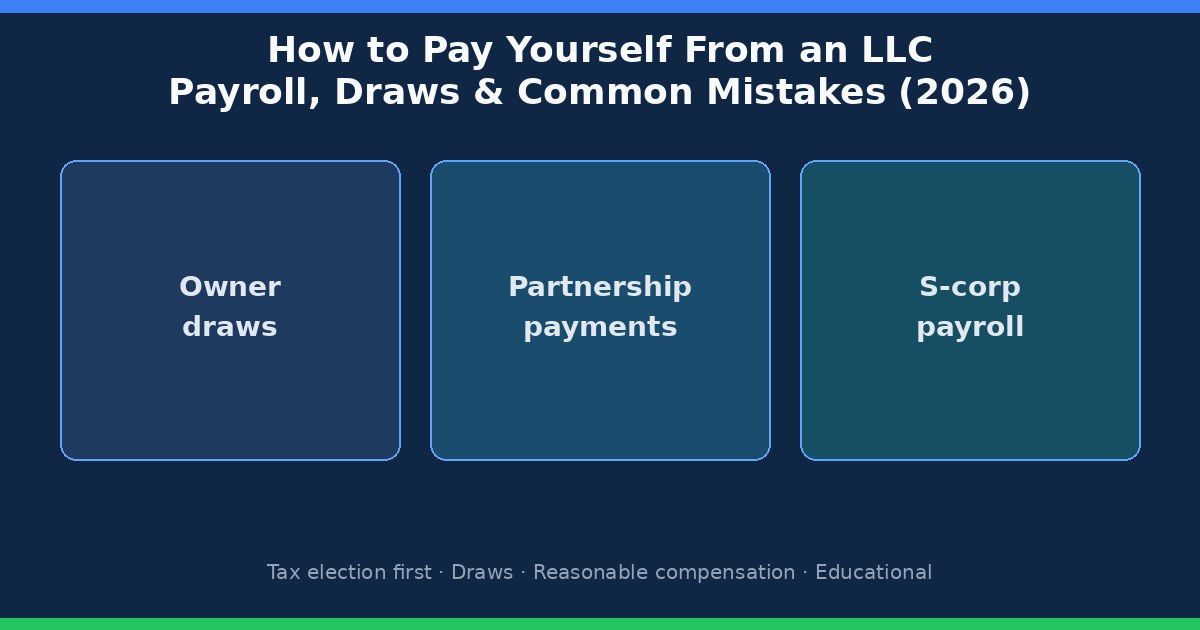
Many LLC owners ask the same Ops question after the bank account is open: how do I move money to myself without creating a tax mess? The short operational answer is that the LLC’s legal wrapper and its federal tax treatment are different levers. A single-member LLC that is disregarded for tax purposes often uses owner’s draws. A multi-member LLC taxed as a partnership uses draws or guaranteed payments under partnership rules. An LLC that elects S corporation taxation generally needs a reasonable W-2 salary for owner-employees before profit distributions. This 2026 guide maps those paths so you can keep books clean, set a pay rhythm, and know when payroll software actually helps.
Quick answer: how do you pay yourself from an LLC?
Confirm how the LLC is taxed for federal purposes first. If it is a single-member disregarded entity (often treated like a sole proprietorship), you typically transfer money as an owner’s draw and record it against equity, while planning estimated taxes on business profit. If it is a multi-member LLC taxed as a partnership, partners usually take draws or distributions, and some arrangements include guaranteed payments. If the LLC is taxed as an S corporation and you work in the business, you generally run reasonable compensation through payroll as W-2 wages, then take additional profit as distributions under S-corp rules. Draws alone do not replace payroll when wages are required. For the “do I even need payroll?” decision, see do I need payroll for my LLC?
Who this guide is for
Use this if you are a single-member LLC owner still mixing personal and business transfers, a multi-member LLC sorting partner draws, an owner considering or already on S-corp tax treatment, or a founder deciding whether Gusto or another payroll tool is required yet. Skip this if you need a binding tax election strategy for your facts; that belongs with a CPA. This article is an Ops and Finance map, not a substitute for Form 2553 advice or a reasonable-compensation study.
LLC legal status vs tax status
Forming an LLC under state law gives you a legal entity and, in many states, liability separation when you respect corporate formalities. It does not automatically tell the IRS how profits and owner pay are taxed. By default, a single-member LLC is often a disregarded entity, and a multi-member LLC is often taxed as a partnership. The LLC can elect corporate taxation, and with additional steps it may elect S corporation status when eligible. Those elections change whether owner pay looks like draws, W-2 wages, dividends or distributions, or a mix.
Write your current tax treatment on a one-page ops note: disregarded, partnership, C-corp, or S-corp; election dates; and who signs payroll or equity transfers. Update the note when your CPA files an election. Paying yourself “like everyone else on the internet” without that note is how books drift away from reality.
Owner’s draws for single-member / disregarded LLCs
When a single-member LLC is disregarded, the business profit generally flows to your personal return (often on Schedule C, depending on your facts). Moving cash from the business checking account to your personal account is commonly recorded as an owner’s draw or owner distribution against equity, not as a deductible wage expense of the LLC. You are usually not running yourself through W-2 payroll just because you took a draw, unless you have elected a tax treatment that requires wages or you have other employees.
Ops practice that keeps books readable:
- Separate business and personal bank accounts and cards.
- Schedule draws on a cadence (for example biweekly or monthly) so cash forecasting is possible.
- Label transfers consistently in accounting software as owner draws, not “salary,” unless wages truly apply.
- Leave a tax reserve in the business or a dedicated savings account for estimated taxes.
- Reconcile monthly so draws do not silently drain working capital.
A draw can feel like a paycheck. For tax timing, profit recognition and self-employment tax rules still follow your return, not the day you clicked “transfer.” Confirm estimated-tax needs with your CPA. Draws also do not replace documented business expense reimbursements; keep those on an accountable plan or clear expense categories so draws stay clean.
Multi-member LLC / partnership notes
Multi-member LLCs taxed as partnerships usually allocate profit under the operating agreement and report on Form 1065 with K-1s. Partners often take draws or distributions of cash that reduce capital accounts. Some agreements provide guaranteed payments for services or capital, which follow partnership tax rules and are not the same as W-2 wages. Whether a payment is a draw, a guaranteed payment, or something else depends on the agreement and tax treatment—ask your CPA before you invent labels in the bank feed.
Operationally, document who can authorize partner draws, keep a shared draw log, and avoid informal “I’ll just Venmo myself” patterns that leave partners arguing at year-end. If the partnership later elects S-corp taxation (when eligible), owner-pay mechanics can change toward payroll for working owners. Treat that as a planned cutover with your tax pro, not a mid-year surprise.
S-corp election: reasonable compensation before distributions
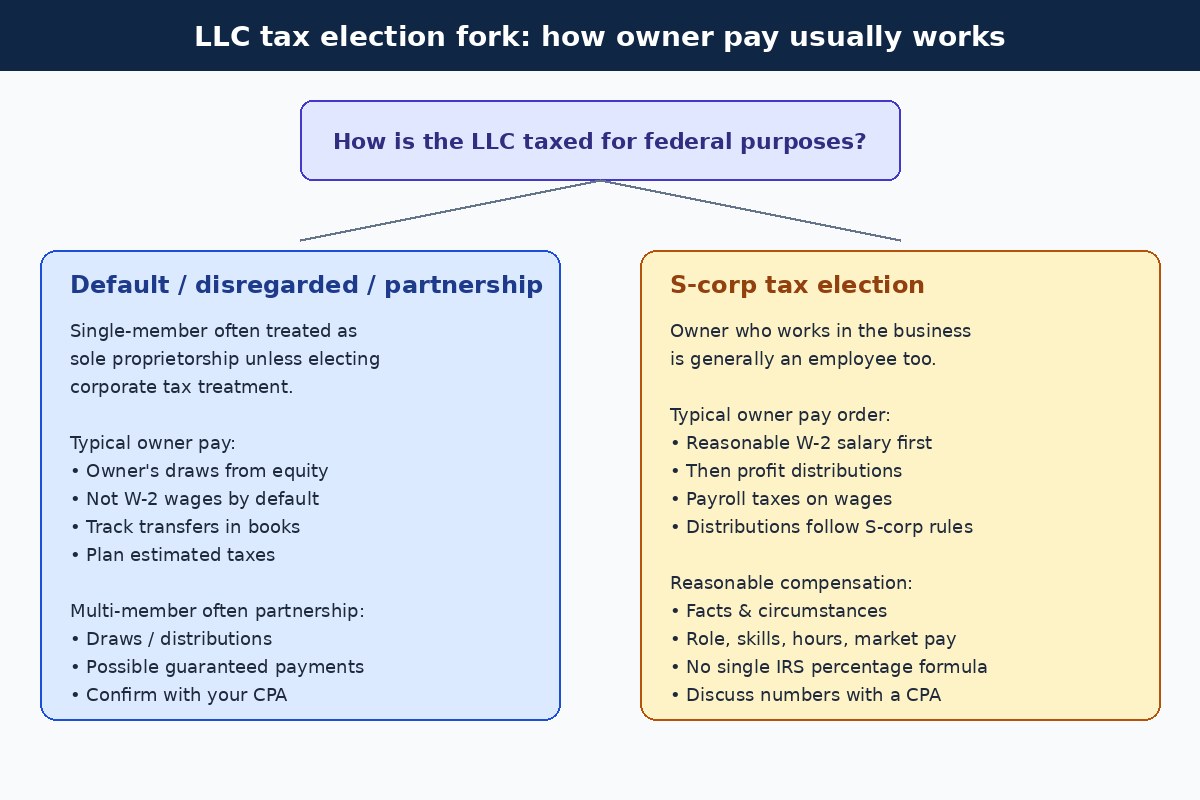
When an LLC is taxed as an S corporation, shareholders who perform services for the company are generally treated as employees for the wages they earn. The IRS expects reasonable compensation for those services before profit is taken as distributions. Distributions and wages are different buckets: wages run through payroll with income and employment tax withholding; distributions follow S-corp basis and reporting rules and are not a substitute for wages when services are substantial.
What “reasonable” means is a facts-and-circumstances analysis. Common factors advisors discuss include the owner’s role and responsibilities, hours worked, training and experience, what comparable businesses pay for similar work, and the company’s history of wages versus distributions. There is no single IRS percentage-of-profit formula that safely replaces that analysis. Do not treat blog “rules of thumb” as a safe harbor. Have a CPA document how you set salary, then update it when the role or market changes.
Once salary exists, you need the payroll plumbing: EIN setup as needed, state withholding accounts where required, Form W-4 on file, deposit schedules, Forms 941/940 as applicable, and year-end W-2s. That map overlaps the first-employee tax workflow in payroll taxes for your first employee and the runbook in how to run payroll for your first employee, even when the only employee is you.
When payroll software helps
Payroll software is most useful when you have W-2 wages: S-corp owner-employee salary, hired employees, or both. It calculates withholdings, helps with deposits and filings in supported jurisdictions, and produces pay stubs and W-2s. If you only take owner draws from a disregarded single-member LLC and have no employees, a full payroll product is often optional; bookkeeping and estimated-tax planning matter more than a fake “payroll run” that creates W-2 noise you did not intend.
Gusto is one option small teams use for US payroll once wages are real. Compare it with QuickBooks Payroll and other tools on features, state coverage, and price for your headcount. Our side-by-side notes live in Gusto vs QuickBooks Payroll and the shortlist in best payroll software for 1 to 5 employees. Confirm current pricing and supported states on the vendor’s site before you enroll.
Bookkeeping hygiene for owner pay
Whatever tax path you use, the bank feed should tell a clear story:
- Owner draws and distributions coded to equity (or partner capital), not to random expense accounts.
- W-2 wages coded through payroll liability and wage expense accounts that match payroll reports.
- Personal expenses kept off the business books, or reclassified quickly if they slip through.
- A monthly close that ties payroll registers, draw logs, and bank balances.
- A shared folder for election forms, payroll filings, and CPA memos on compensation.
Classification of helpers also matters. Paying a spouse, family member, or contractor through the wrong form creates year-end cleanup. Use W-2 vs 1099 when roles are ambiguous, and keep owner pay in its own documented process so it does not collide with contractor payments.
Common mistakes
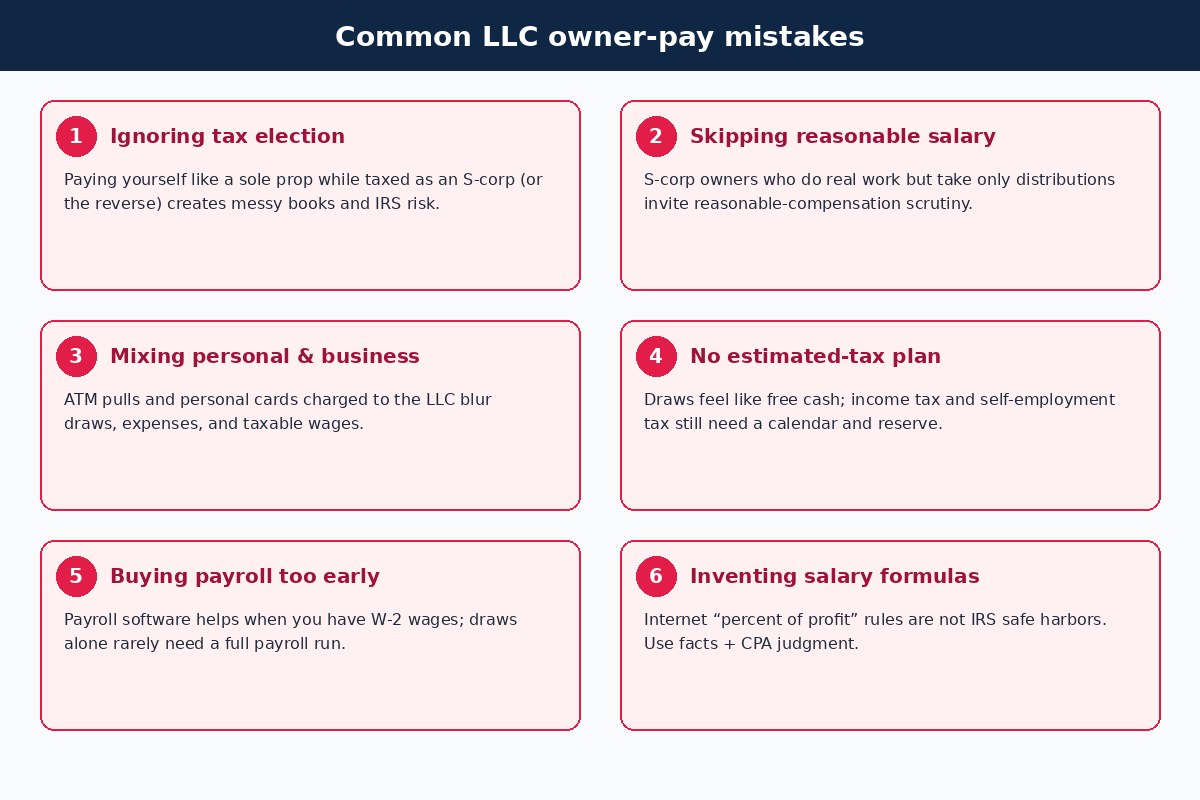
Ignoring the tax election. Taking “draws only” while taxed as an S-corp, or running unnecessary W-2s while still a disregarded entity, creates filing and bookkeeping conflicts. Confirm treatment every January and after any election filing.
Skipping reasonable compensation on an S-corp. Working full-time in the business while taking only distributions is a classic audit theme. Set and document salary with a CPA.
Mixing personal and business cash. Daily ATM withdrawals and personal Amazon orders on the LLC card blur draws, expenses, and wages. Separate accounts and a simple reimbursement process fix most of this.
No estimated-tax reserve. Draws spend easily. Profit can still create quarterly estimated tax needs. Build a reserve percentage with your CPA and treat it as non-discretionary.
Buying payroll software before wages exist. Tools help when you have filings to automate. They do not invent the correct tax election for you.
Inventing salary formulas from social media. “Pay yourself X% of profit” is not an IRS safe harbor. Use role, market pay, and professional judgment.
Late state payroll accounts. S-corp salary can trigger state withholding and unemployment accounts even with one employee-owner. Register before the first payday that creates an obligation.
Owner-pay checklist
- Write down current federal tax treatment and any election dates.
- Confirm with a CPA whether draws, guaranteed payments, W-2 wages, or a mix apply this year.
- Separate business and personal banking; stop informal personal charges on business cards.
- If S-corp wages apply, set a documented reasonable salary and enroll in payroll before the first pay date.
- Open or verify federal and state payroll accounts when wages start.
- Schedule draws or paydays on a calendar the bookkeeper can reconcile.
- Create an estimated-tax reserve process for non-wage profit where needed.
- Reconcile owner equity, payroll liabilities, and bank balances monthly.
- Store election forms, payroll returns, and compensation memos in one folder.
- Revisit compensation and software choice when you hire, change hours, or change elections.
FAQ
Can I pay myself with an owner’s draw from my LLC?
Often yes when the LLC is a single-member disregarded entity and your CPA agrees draws fit your setup. Record draws against equity and plan taxes on profit. If you are taxed as an S-corp and work in the business, draws alone usually are not enough; reasonable W-2 wages generally come first.
Do LLC owners need payroll?
Not always. Many disregarded single-member owners use draws without running themselves on payroll. Payroll becomes important when you have employees, when S-corp owner-employee wages apply, or when state rules require wage reporting. Details: do I need payroll for my LLC?
What is reasonable compensation for an S-corp owner?
It is pay that reflects the value of services you provide, based on facts such as duties, hours, skills, and comparable wages. The IRS does not publish a single percentage formula that replaces that analysis. Work the number with a CPA and keep notes on how you set it.
Are owner draws subject to payroll taxes?
Owner draws from a disregarded entity are generally not processed as W-2 wages with payroll tax withholding. Business profit may still face income tax and, in many sole-prop-style situations, self-employment tax on the return. S-corp W-2 wages do go through payroll taxes. Confirm your path with a tax professional.
What about guaranteed payments in a multi-member LLC?
Guaranteed payments are a partnership-tax concept for certain payments to partners for services or capital. They are not identical to W-2 wages. Whether you should use them depends on the operating agreement and tax advice. Do not relabel random transfers as guaranteed payments in the bank feed without CPA guidance.
Should I elect S-corp status so I can take distributions?
S-corp elections have payroll, reasonable-compensation, and eligibility tradeoffs. Some owners benefit; others do not at their profit level or with their state rules. This article does not recommend an election. Ask a CPA to model wages, employment taxes, filing costs, and administrative burden before Form 2553.
When should I use Gusto or similar payroll software?
When you have W-2 wages to run—owner-employee salary, staff, or both—and you want help calculating withholdings, deposits, and filings in supported states. If you only take draws and have no wages, prioritize bookkeeping and tax reserves first, then revisit payroll tools when the tax treatment requires them.
Can I pay myself as a 1099 contractor from my own LLC?
Issuing yourself a 1099 from your own disregarded LLC is usually the wrong mental model and can confuse books. Owner pay typically follows draws or, for S-corp owner-employees, W-2 wages. Classification rules for other workers still matter; see W-2 vs 1099.
Related reading
- Do I need payroll for my LLC?
- Payroll taxes for your first employee
- How to run payroll for your first employee
- Gusto vs QuickBooks Payroll
- W-2 vs 1099
- Best payroll software for 1 to 5 employees
- Payroll hub
Try Gusto for LLC owner payroll
If your LLC tax treatment requires W-2 wages—for you as an S-corp owner-employee, for hired staff, or both—Gusto is a practical payroll platform to compare for small US teams. Preview a payroll run, confirm state support, and align the product setup with the salary your CPA documented.
Try Gusto (partner link). We may earn a commission at no extra cost to you. Confirm pricing, tax filing services, and state coverage on Gusto’s official pages before you enroll.
Again: this article is educational only. It is not tax, legal, or accounting advice. LLC elections, reasonable compensation, partnership payments, and payroll deposits depend on your facts. Verify IRS guidance, state rules, and your operating agreement with a qualified professional before you change how you pay yourself.