Disclosure: This guide is educational and may include affiliate links. We may earn a commission if you sign up through our Melio partner link, at no extra cost to you. Pricing and features change; verify current rates on each vendor’s site before you buy.
Research note: Fee percentages and dollar examples below are illustrative research anchors for September 2026 (Melio card payments commonly around 2.9%; Melio ACH often free allotment then about $0.50; checks often about $1.50 class; Plastiq card fees often about 2.9-2.99%). Direct pricing pages change and some fetches can be incomplete, so treat every figure as a worksheet input. Confirm live Melio and other official pricing before you budget. We did not invent client case studies or conversion stats.
Paying a vendor with a credit card is usually a cash-cycle decision, not a loan substitute. You are trading a processing or platform fee for float days, rewards, and sometimes workflow convenience when a supplier will not swipe a card. For most US small businesses the default should still be: fund the bill in a way you can clear on the next statement in full. Interest on a carried balance almost always beats the rewards story.
Quick answer: when does paying vendors by card make sense?
It makes sense when (1) the vendor accepts cards directly at an acceptable cost, or (2) a bill pay platform lets you fund an ACH or check with a card and the fee is smaller than the combined value of rewards plus the float you actually need, and (3) you will pay the card statement in full. It usually does not make sense when you are already short on cash, when utilization would hurt other credit needs, or when ACH or bank transfer is available at near-zero cost and you do not need the float.
If your main job is moving vendor bills online without mailing checks, start with a lean bill pay tool such as Melio and use card funding selectively. If several people approve invoices and you need structured AP controls, compare broader platforms such as BILL. See our bill pay overview and comparisons hub.
What “pay vendors with a credit card” actually means
Owners use the phrase for three different workflows. Mixing them up is how fee math goes wrong.
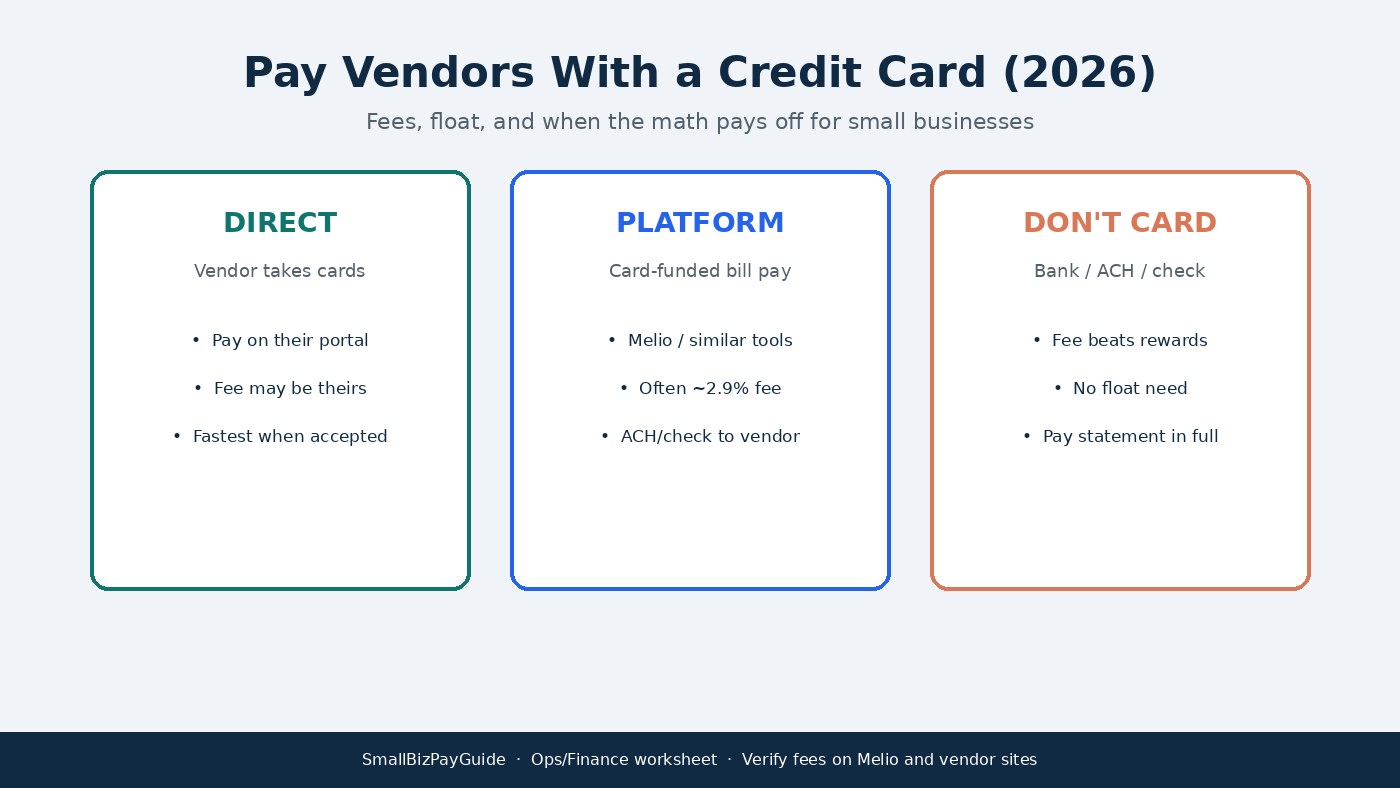
- Direct card acceptance: The vendor’s portal, invoice link, or terminal takes Visa/Mastercard/Amex. You pay like any other card purchase. The merchant (or their processor) sets the fee structure; you may or may not see a surcharge.
- Card-funded bill pay: A platform charges your card, then pays the vendor by ACH, check, or another method the vendor already accepts. You often pay a percentage fee (commonly around 2.9% on Melio-class tools; Plastiq often around 2.9-2.99%). The vendor may never know you used a card.
- Virtual card or single-use card: Some AP tools issue a card number for one invoice. Useful for controls and reconciliation; fees and vendor acceptance still apply.
This guide focuses on the Ops/Finance question behind all three: is the fee worth the float, the rewards, and the operational win, given interest risk if you cannot clear the statement?
Three paths: direct, platform, or don’t
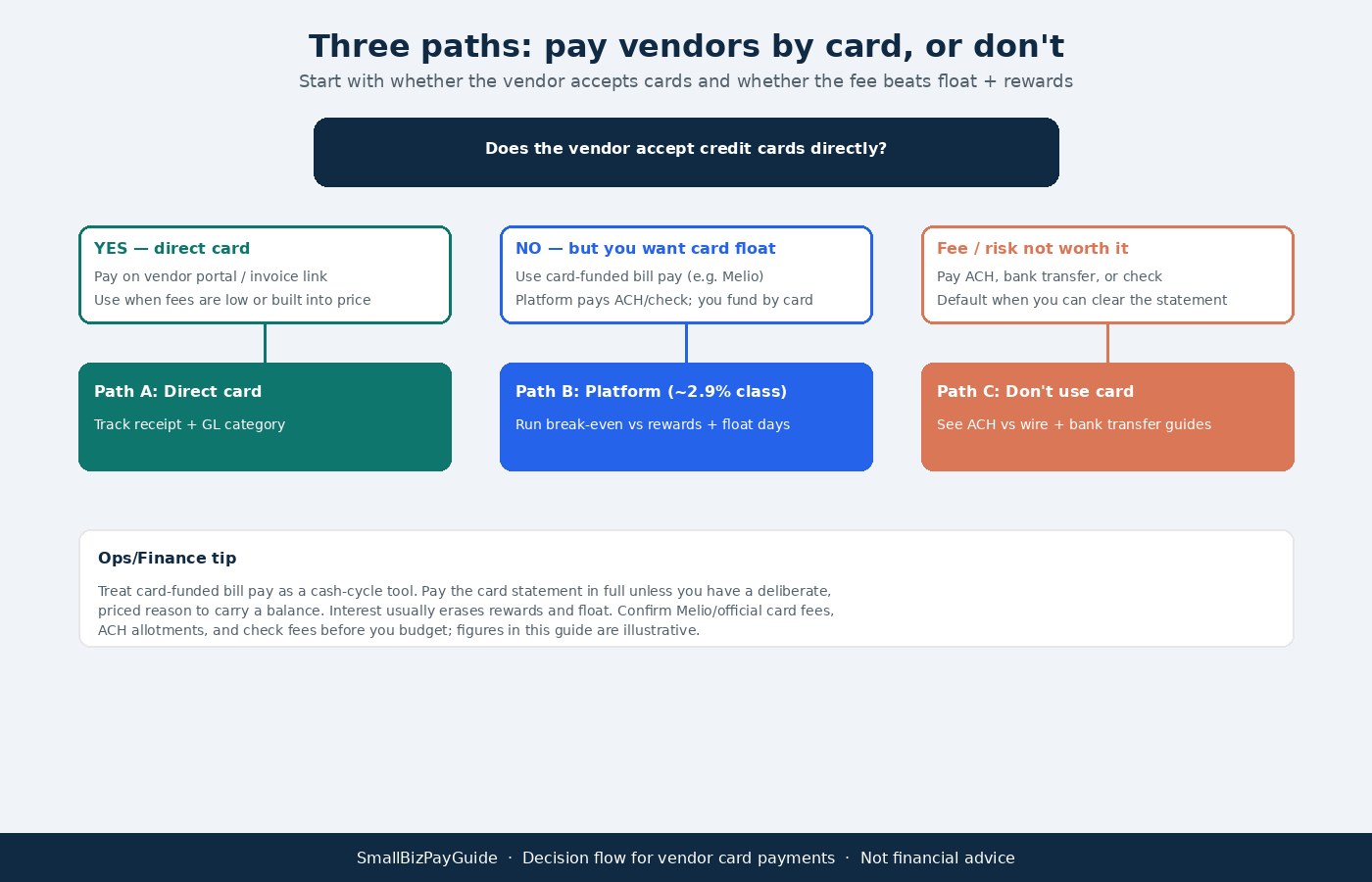
Path A: Vendor accepts cards directly
Ask first. Many SaaS vendors, agencies, and suppliers already take cards. If they do, compare any surcharge or higher invoice price against funding via ACH. Direct card is often the simplest bookkeeping path: one receipt, one GL category, no platform fee layered on top.
Path B: Card-funded bill pay platform
Use this when the vendor wants ACH or a check and you still want to put the payment on a card. Melio is a common fit for US small businesses that want online bill pay with optional card funding. The platform pays the vendor by bank rails or check; you pay the platform fee on the card side. Details and eligibility vary; confirm on Melio before you rely on a rewards strategy. Related: Melio review for small business owners and Melio vs Bill.com.
Path C: Skip the card
If bank balance can cover the bill on time, ACH or bank transfer is usually cheaper. Melio ACH is often free for a limited allotment, then around $0.50 per payment on published patterns; checks are often about $1.50 class. Those fixed fees beat a 2.9% card charge on almost any mid-size invoice. See ACH vs wire for vendor payments and how to pay vendors by bank transfer.
How card-funded bill pay works
In a typical Melio-style flow you add the vendor and invoice, choose to fund with a credit or debit card when the product allows it, and the platform originates an ACH credit or mails a check to the vendor. Delivery timing depends on method: ACH is usually multi-day; checks add print and mail time. Your card issuer posts the charge on its own cycle. The vendor’s bank does not need to accept cards.
That separation is the product: card on your side, bank rails on theirs. It also creates two clocks you must manage: the vendor due date (and any early-pay discount) and your card statement due date. Miss the second clock and interest can erase the first clock’s benefit. For the broader “stop mailing checks” workflow, see how to pay business bills online without mailing checks.
Fee math and a break-even worksheet
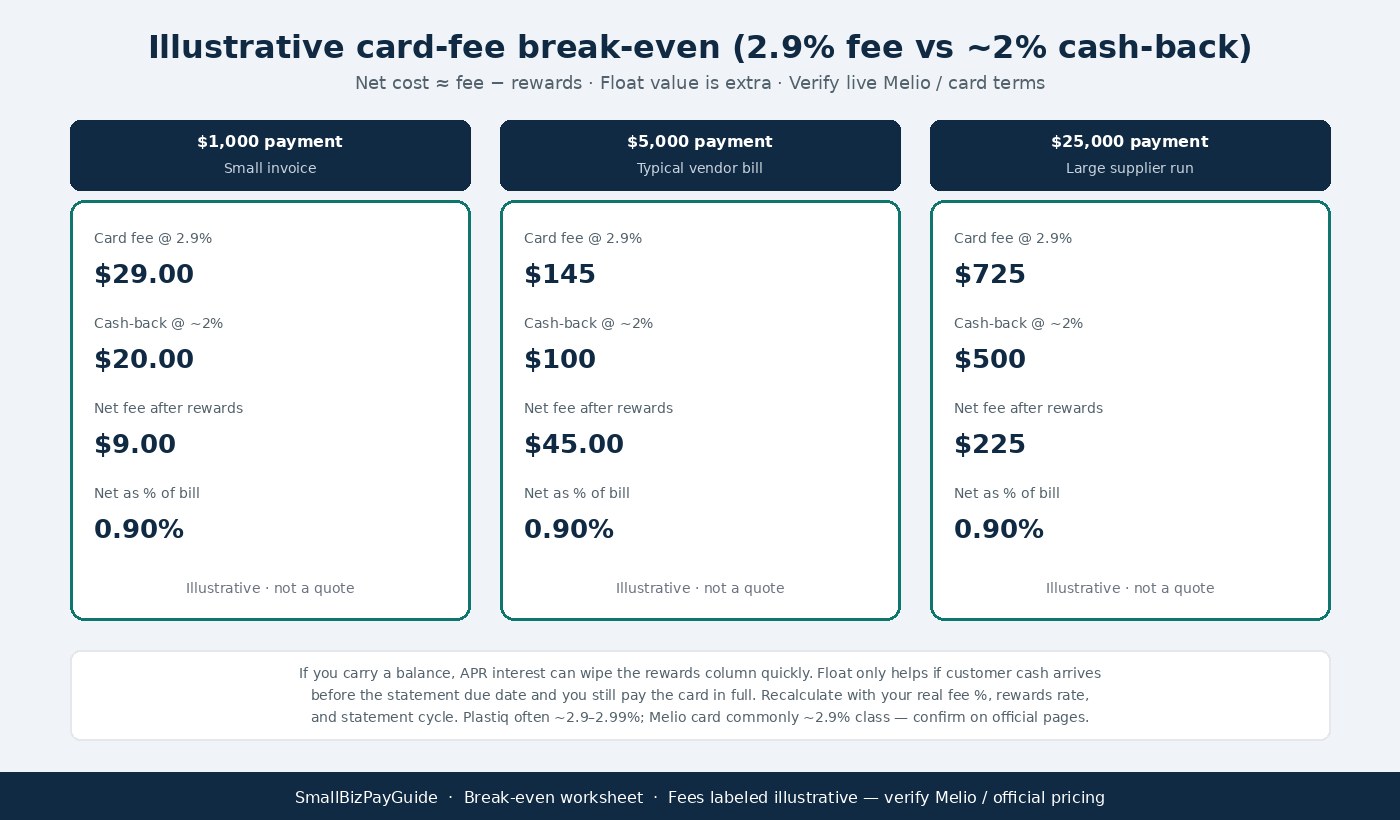
Use this worksheet with your real numbers. Labels below are illustrative; verify Melio, Plastiq, BILL, and your card’s rewards terms.
Simple net cost after rewards ≈ (card fee % × invoice) − (rewards % × invoice). Float value is separate: estimate what it is worth to keep cash in the operating account for N days (for example, avoided overdraft fees, avoided short-term borrowing, or simply the buffer you need until receivables clear).
| Invoice | Fee @ 2.9% | Rewards @ ~2% | Net after rewards | Net as % of bill |
|---|---|---|---|---|
| $1,000 | $29 | $20 | $9 | 0.90% |
| $5,000 | $145 | $100 | $45 | 0.90% |
| $25,000 | $725 | $500 | $225 | 0.90% |
At a flat 2.9% fee and 2% cash-back, you still pay about 0.9% of the invoice for the privilege of using the card. That 0.9% has to be justified by float, workflow time saved, or a higher rewards rate (points that you can value above 2%, category bonuses, or statement credits). If your effective rewards value is only 1%, the net cost is closer to 1.9%. If you carry a balance at 20%+ APR, the interest column dominates quickly.
Compare against ACH: a $0.50 ACH fee on a $5,000 bill is 0.01%. A ~$1.50 check on the same bill is still tiny next to $145 of card fee. Card funding wins on cost only when rewards plus float (and sometimes avoided late fees) cover the gap, or when the vendor path leaves you no cheap alternative and cash timing is the binding constraint.
Float and the cash cycle
Float is the gap between when the vendor is paid (or marked paid) and when your card issuer requires cash. If customer payments arrive in that window and you still pay the statement in full, card-funded bill pay can smooth a short receivables lag. If customer cash will not arrive, you have borrowed from the card company at processing-fee prices today and possibly at interest tomorrow.
Practical checks before you use float on purpose:
- Map invoice due date, payment delivery ETA (ACH vs check), card posting date, and statement due date on one calendar.
- Confirm whether early-pay discounts from the vendor exceed the card fee. A 2/10 net 30 discount is often worth more than card rewards.
- Keep utilization low enough that the charge does not crowd out other credit needs (payroll float, inventory, unexpected repairs).
- Treat recurring card funding of the same vendors as a process smell: fix the cash cycle or renegotiate terms rather than normalizing a monthly fee tax.
Rewards versus carrying a balance
Rewards only help if you pay the statement in full. A month of interest at a typical purchase APR can wipe months of cash-back on the same spend. Card-funded vendor pay is a poor substitute for a line of credit, invoice factoring, or a real cash plan when the business is short every cycle.
If you do chase rewards, know your effective value per point, whether vendor payments code as the bonus category you expect (many bill-pay charges do not), and whether your issuer restricts “manufactured spend” or bill-pay partners. When in doubt, model the cash-back percentage you actually receive on a test payment before you put a $25,000 supplier run on the card.
Timing and vendor delivery
Card authorization speed is not the same as vendor receipt. On card-funded ACH, the vendor still waits for bank settlement. On check delivery, mail and deposit add more days. Schedule the payment early enough that the vendor’s due date is met on their rails, not only that your card was charged today.
Also watch cutoffs inside the bill pay tool: same-day or rush options may cost more, and first-time vendors sometimes need extra verification. Build a short buffer for new payees.
Bookkeeping the fee
Record the vendor expense at the invoice amount your books expect, then record the platform or card processing fee as its own expense (or as part of bank fees / merchant fees, consistent with how your bookkeeper already treats similar charges). Do not bury a $145 fee inside COGS without a clear policy. Attach the platform receipt and the card statement line so reconciliation is boring later.
If you sync Melio or another AP tool to QuickBooks or Xero, map the fee account once and spot-check the first few card-funded payments. For a fuller AP rhythm, use an accounts payable checklist for small business owners.
When card pay makes sense (and when it does not)
Often worth evaluating: a short, predictable receivables lag; a one-off large bill where float prevents a cash crunch you have already planned to clear; vendors who will not take ACH from your bank but will accept platform ACH/check; rewards rates that demonstrably exceed the fee after you include float value; cleaner digital audit trails versus paper checks.
Usually skip card funding: you cannot pay the statement in full; ACH is available at near-zero cost and float is unnecessary; the net fee (after rewards) exceeds any early-pay discount you would otherwise take; utilization would jump into a range that hurts other financing; the “need” is recurring every month without a plan to fix timing.
Tool fit: Melio versus broader AP
Melio fits many solos and lean teams that want to pay vendors online, mix ACH and occasional card funding, and keep software cost low. Card payments are commonly in the ~2.9% class when available; ACH often has a free allotment then a small per-payment fee; checks are a low fixed fee class. Confirm current plan limits on Melio’s site.
BILL (formerly Bill.com) also supports card pay in many setups at a similar percentage class, but its stronger story is multi-user AP: approvals, roles, and audit trails as the team grows. If your bottleneck is controls rather than “can I fund this one bill by card,” shortlist BILL and compare in Melio vs Bill.com. Plastiq is another card-to-bill specialist with fees often around 2.9-2.99%; evaluate it when card funding itself is the product you need.
For contractor-specific Melio questions, see can you pay contractors with Melio.
30-minute decision checklist
- List this month’s vendor bills and mark who already accepts cards directly.
- For the rest, note preferred method (ACH, check, wire) and due dates.
- Pull your card’s effective rewards rate on bill-pay or general spend (test one small payment if unsure).
- Plug invoice amounts into the 2.9% vs rewards worksheet; adjust fee % to the live Melio/official number.
- Estimate float days you truly need and whether receivables will cover the statement.
- Check utilization after the planned charges.
- Decide Path A, B, or C per vendor; default to ACH when the net card cost is not justified.
- If using Melio, confirm ACH allotment, check fee, and card fee on the current pricing page, then schedule with delivery buffers.
- Tell bookkeeping how fees will be categorized before the first run.
- Revisit any vendor you card-funded two cycles in a row: fix terms or cash timing if it is becoming habit.
Common mistakes
- Using card-funded bill pay as standing working capital instead of fixing collections or terms.
- Ignoring interest and only counting rewards.
- Assuming the vendor is paid the moment your card is charged.
- Skipping fee coding in the ledger so margins look better than they are.
- Maxing utilization and then needing the same card for a true emergency.
- Chasing points on invoices that would have earned a larger vendor early-pay discount via ACH.
FAQ
Can I pay a vendor with a credit card if they only take ACH or checks?
Often yes, through a card-funded bill pay platform. The platform charges your card and pays the vendor by ACH or check. Availability, fees, and vendor eligibility depend on the tool; Melio is a common option for US small businesses. Verify current terms before you schedule a large payment.
What is Melio’s credit card fee?
Published patterns commonly put Melio card payments around 2.9%. Treat that as illustrative and confirm on Melio’s official pricing and checkout screens for your account. ACH and check fees are separate and usually much lower per payment.
Is paying vendors by card always more expensive than ACH?
On pure fee math, yes almost always: a percentage card fee dwarfs a $0.50-class ACH on mid-size invoices. Card can still win on total value if rewards plus necessary float exceed the net fee and you pay the statement in full.
Do credit card rewards cover the Melio fee?
Only if your effective rewards value is higher than the fee percentage, or close enough that float value covers the gap. At 2.9% fee and 2% cash-back, you still net about 0.9% cost before float. Run the worksheet with your card’s real earn rate.
Should I carry a balance to stretch float further?
As a default, no. Purchase APR interest usually destroys the economics of card-funded bill pay. Use float only inside the interest-free statement window, then pay in full.
How should I book the processing fee?
Keep the vendor bill at the invoice amount and post the platform/card fee to a clear expense account. Attach receipts and reconcile to the card statement so audits and margin reviews stay clean.
When should I use BILL instead of Melio for card vendor payments?
When multi-user approvals, roles, and AP audit trails matter more than a minimal bill-pay stack. Both may support card funding with percentage fees; BILL’s differentiator is structured AP, not cheaper card rates. Compare in our Melio vs Bill.com guide.
Is this the same as paying contractors on a card?
Related but not identical. Contractor pay may involve 1099 workflows and different tool choices. For Melio-specific contractor questions, see can you pay contractors with Melio. Worker classification still belongs with your tax advisor.
Next steps and related guides
Decide per vendor: direct card, card-funded platform, or ACH/bank/check. Run the fee-versus-rewards worksheet, protect the statement payoff, and only use float when receivables timing is clear. Verify 2026 fees on Melio and other official pages before you commit a large supplier run.
If Melio fits the bill payment workflow described here, you can explore Melio through our partner link: Try Melio. Terms, eligibility, and offers can change; verify pricing, free-tier ACH limits, card fees, and plan features directly on Melio before you enroll.
Related SmallBizPayGuide resources:
- Bill pay overview
- Software comparisons
- Melio vs Bill.com
- Melio review for small business owners
- Pay business bills online without mailing checks
- ACH vs wire transfer for vendor payments
- Pay vendors by bank transfer
- Accounts payable checklist
- Can you pay contractors with Melio?
Fees and rewards change. Recheck Melio and official pricing, map your cash cycle, and choose the payment path that keeps vendors paid without turning the card into an expensive line of credit.