Disclosure: This guide is educational and may include affiliate-oriented recommendations for tax tools. It is not legal, tax, accounting, or financial advice. Sales tax taxability, nexus thresholds, marketplace facilitator rules, and VAT treatment of digital supplies change by jurisdiction. Verify current requirements with each state’s department of revenue (DOR), EU/UK tax authority guidance, and a qualified professional before you collect, register, or remit anything.
If you sell downloads, courses, SaaS seats, or memberships, the tax question rarely has a single yes or no. US states disagree about which digital offers are taxable. Nexus and registration sit in a separate column from taxability. EU and UK rules for digital B2C supplies use a different playbook than US sales tax. This 2026 Ops and Finance guide walks those forks so you can classify products, tag customer location, and know which related guides to open next.
Quick answer
Digital products can create sales tax or VAT obligations. Whether you must collect depends on what you sell, where the customer is, whether you have nexus or a registration duty in that place, and whether a marketplace already collects on the order. Some digital SKUs are taxable in one state and not in another. Some sellers owe collection after economic nexus, physical presence, or EU/UK digital-supply rules kick in. Start with product classification and customer location, then read the jurisdiction’s current guidance. Companion maps: sales tax nexus for digital products and when should an online business register for sales tax?
Who this guide is for
Use this if you sell templates, ebooks, or assets; run online courses or paid communities; operate a small SaaS or subscription product; or sell digital goods on a marketplace and also through your own checkout. Founders with only home-state buyers can still use the classification section, then revisit nexus and VAT when remote customers appear. This is an operations map, not a substitute for a CPA or sales tax attorney on edge cases.
What counts as a digital product
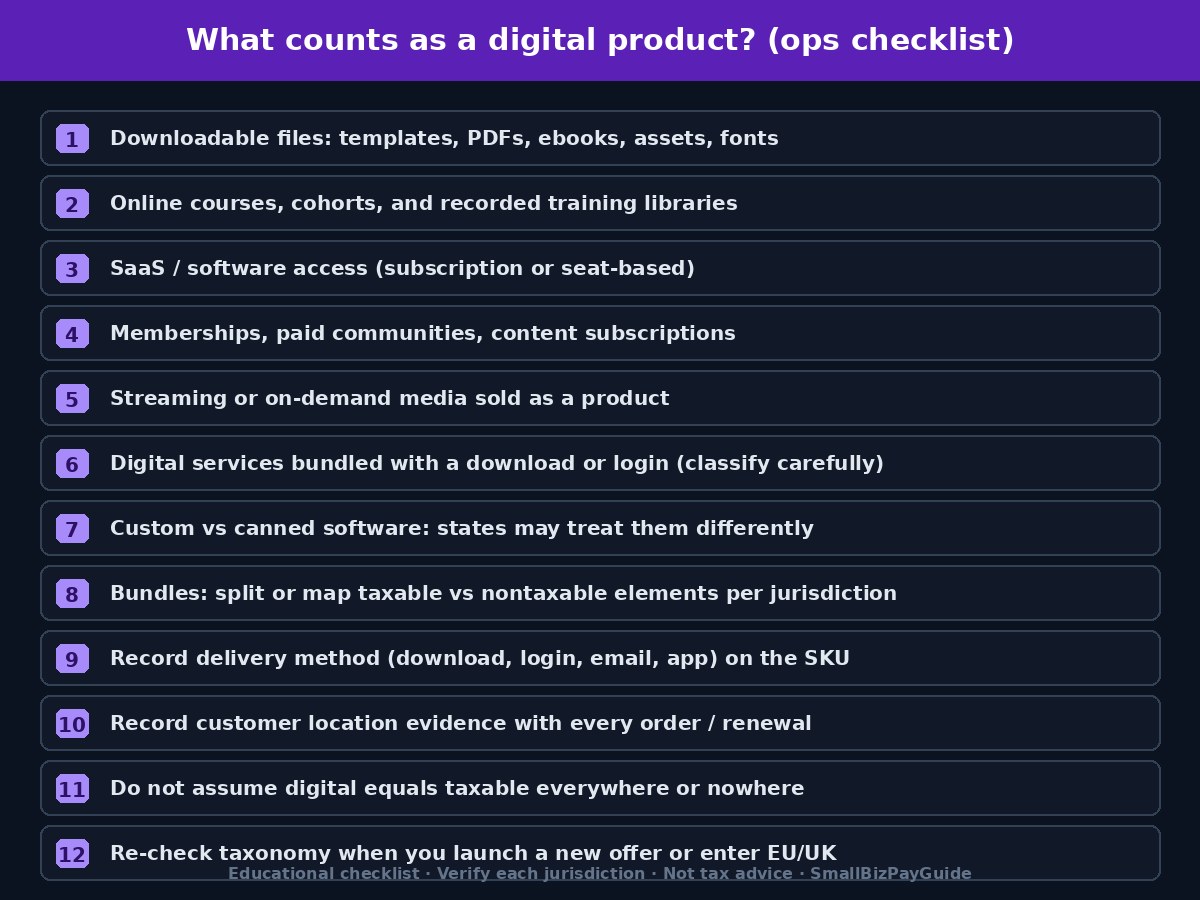
For ops purposes, treat “digital product” as a working label for goods or access delivered electronically without a physical ship. Common examples include downloadable files (templates, PDFs, ebooks, fonts, design assets), online courses and recorded libraries, SaaS or software access sold by subscription or seat, memberships and paid content communities, and streaming or on-demand media sold as a product. Bundles that mix a download with a live service, coaching call, or custom deliverable need extra care. Many states and VAT regimes draw lines between canned software, custom software, information services, and electronically supplied services.
Build a short product taxonomy in your ops wiki. For each SKU record delivery method (download, login, email link, app), whether access is perpetual or subscription, whether humans customize the deliverable, and which channel sells it (own checkout vs marketplace). That taxonomy feeds tax codes later. Do not assume every “digital” offer is taxable everywhere, and do not assume nontaxable status travels with you into a new state or country.
US sales tax overview: taxability first
US sales tax is state (and often local) law. States publish different rules for digitally delivered software, streaming access, downloadable content, online courses, and subscription SaaS. Some treat certain digital goods like tangible personal property. Others tax specified categories and leave others out. Local rates and destination sourcing can apply even when the product never ships in a box.
Ops implication: classify each major offer the way the destination state would, then map a product tax code in your checkout or invoicing tool. When taxability is unclear, use the state’s published guidance or get a written view from a sales tax professional. Revisit the map when you launch a new SKU, change delivery (for example from download to login portal), or start selling into states that previously had little volume.
Taxability answers whether a given sale is taxable if you are required to collect. It does not, by itself, tell you whether you must register. That is the nexus and registration question covered next and in the dedicated nexus and registration guides.
Nexus reminder: why “taxable” is not the whole story
Nexus is the connection that lets a state require you to register and collect. Physical presence covers footprints such as people, inventory, offices, and, in some states, temporary presence. Economic nexus covers remote sellers once sales into the state (and sometimes transaction counts) cross a published threshold during a defined lookback period. Public summaries often mention figures people casually describe as around “$100,000 or 200 transactions.” Those numbers are a common pattern in guidance and commentary, not a single federal statute that applies the same way in every state.
States set different dollar amounts, include or exclude different receipts, use different lookback windows, and may drop or keep a transaction prong. Always open the current DOR remote-seller or economic nexus page for each state that shows up in your sales report. Do not hard-code one universal threshold into a spreadsheet as if it were law everywhere. For the full ops map, see sales tax nexus for digital products. For registration timing, see when should an online business register for sales tax?
You can have nexus and still owe little or nothing on a nontaxable digital SKU. You can also launch a taxable offer into a state where you already registered and suddenly need correct rates at checkout. Keep nexus monitoring and product taxability as two columns on the same monthly report.
EU and UK VAT overview for digital B2C
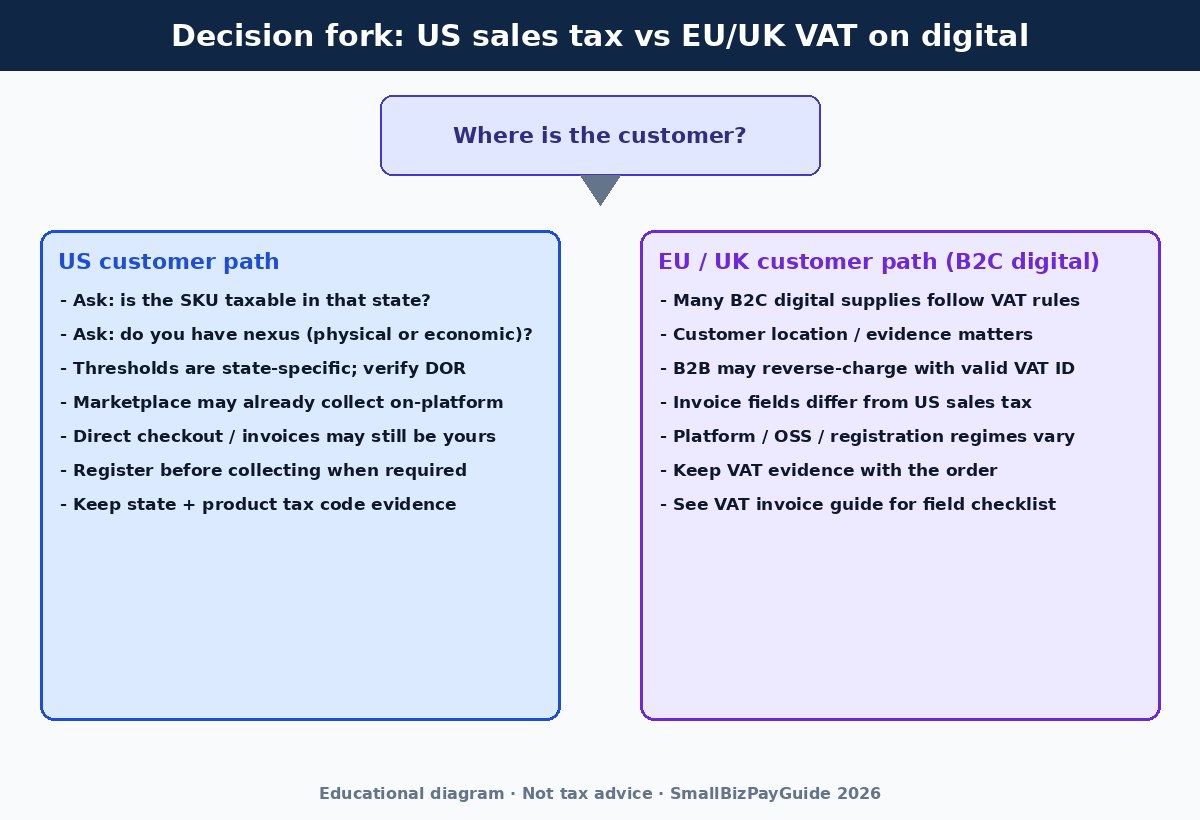
Selling digital supplies to consumers in the EU or UK is a different regime from US sales tax. Many electronically supplied services to B2C customers are subject to VAT rules that look at customer location, evidence of that location, invoice content, and how you register or report (including schemes that exist for non-established suppliers). B2B supplies can follow reverse-charge mechanics when a valid VAT identification number and other conditions are met. Platform or marketplace roles can shift who accounts for VAT on some sales.
Ops implication for mixed US and EU/UK catalogs: keep separate rows for US sales tax and VAT. Do not reuse a US product tax code as a VAT answer. Capture location evidence at checkout (billing address, IP, payment proxy, and whatever combination your advisor and tools recommend). Invoice fields for VAT-compliant digital sales often differ from a simple US sales tax line. For a field-level checklist, see VAT invoice requirements for digital products.
Thresholds, One Stop Shop (OSS) or equivalent options, and UK digital services rules change with policy updates. Treat this section as a fork in your decision tree, then verify current authority pages and professional advice before you enable VAT collection or change invoice templates.
Marketplace vs direct sales
Many US states require marketplace facilitators to collect and remit sales tax on facilitated sales. If most of your volume runs through a platform that already collects, your remittance burden on those orders may shrink. That does not erase every duty. Direct website sales, Stripe or PayPal checkout on your own site, invoice sales, and other non-facilitator channels can still create nexus and collection obligations. Some states still want marketplace sellers registered or reporting in certain cases.
Tag every order as marketplace-facilitated or direct. Keep facilitator remittance reports from the platform. Keep your own economic nexus math on total remote sales into each state when physical presence or direct-channel rules may still apply. When you leave a platform or add a direct storefront, re-run the analysis the same month. In the EU/UK, ask the same channel question for VAT: who is the supplier for VAT purposes on that sale, and what evidence remains in your books?
Evidence to keep
Audits and platform disputes are easier when order-level evidence travels with the sale. For US sales tax, prioritize customer state (and local jurisdiction when your tool supports it), product tax code, taxable amount, tax collected, channel tag, and exemption certificates when a business buyer claims an exemption. For EU/UK VAT on digital supplies, prioritize location evidence, VAT ID validation when used, invoice or receipt content, and whether the sale was B2C or B2B.
Store renewals with the same fields as the original sale. Subscriptions are where location drift and product-code mistakes accumulate. Export a monthly report that Finance or your advisor can read without opening five dashboards. If your payment processor or tax tool stores evidence, confirm you can still export it if you change processors later.
Tools that help (without replacing judgment)
Spreadsheets work until you have many states, renewals, product types, and a mix of US and EU/UK buyers. Tax tools can store buyer location, apply rates and product tax codes, generate invoice content, and sometimes help with filings or evidence packs. Stripe Tax sits close to Stripe Checkout and Billing. Quaderno and peers often focus on multi-channel calculation, invoices, and compliance workflows for digital sellers. Other services appear in many stacks as well.
Pick software for the jobs you actually need: taxability mapping, nexus monitoring signals, checkout calculation, VAT invoice fields, filing support, and audit trails. Compare pricing against transaction volume and the number of jurisdictions you touch. For a side-by-side of two common options for digital sellers, see Quaderno vs Stripe Tax. Broader comparisons live under comparisons, and the tax compliance hub collects related guides. No tool replaces reading DOR or tax authority guidance, or getting professional advice on whether and when you must collect.
Common mistakes
- Treating all digital products as taxable (or nontaxable) in every state
- Confusing taxability with nexus and skipping registration analysis
- Hard-coding one nationwide economic nexus dollar figure as if it were universal law
- Ignoring direct-channel sales because a marketplace already collects on-platform
- Reusing US sales tax settings as a VAT answer for EU/UK buyers
- Missing location evidence on renewals and free-trial conversions
- Collecting tax before registration is authorized in a state that requires a permit first
- Launching a new SKU without updating the product taxonomy and tax codes
A practical working afternoon
You will not finish every legal edge case in a few hours. You can finish a decision packet that makes the next conversation with an advisor useful.
- List every digital SKU with delivery method, subscription vs one-time, and channel.
- Export the last twelve months of orders and renewals with customer country/state, revenue, product type, and marketplace vs direct.
- For top US states by revenue, open current DOR pages for digital product taxability and economic nexus / remote seller rules. Record lookback windows without inventing a universal threshold.
- Split marketplace-facilitated volume from direct volume for those states.
- Flag EU/UK B2C digital volume separately and note what location evidence you already store.
- Mark each major jurisdiction clear, approaching, or needs advisor review. Assign owners for tax codes, registration, and invoice templates.
Revisit the packet monthly while growth is fast, and after any new product launch or channel change.
FAQ
Are all digital products taxable?
No. Taxability depends on the jurisdiction and the type of digital product. Classify each SKU against the destination state’s (or country’s) published categories.
Do US state rules differ for SaaS, courses, and downloads?
Yes. Sales tax treatment for digital products can vary by state and by product type. A course, a SaaS seat, and a PDF template may land in different buckets in the same state.
If my product is taxable, do I automatically have to collect everywhere?
No. Collection duties generally follow nexus and registration rules. Taxability and nexus are separate questions. See the nexus guide and the registration guide.
Is there one nationwide economic nexus threshold?
No. Many states publish tests that look similar, often involving a sales amount and sometimes a transaction count, but the details differ. Do not treat a casual “$100k / 200 transactions” summary as binding law in every jurisdiction.
If a marketplace collects tax, am I done?
Not necessarily. Facilitator collection may cover marketplace orders, but direct sales, physical presence, and state-specific seller duties can still apply. Keep channel-tagged reports.
How do EU/UK VAT rules differ for digital B2C sales?
They use a different framework focused on electronically supplied services, customer location evidence, invoice content, and registration or reporting schemes. Do not reuse US sales tax settings as the VAT answer. See VAT invoice requirements for digital products.
Should I use a tax automation tool?
If you sell across multiple states or countries, a dedicated tax tool is often worth a closer look for calculation, evidence, and invoices. Compare options in Quaderno vs Stripe Tax. Tools still do not replace professional advice on nexus and registration.
What should I check on my last 20 digital orders?
Confirm customer location fields, product type, channel (marketplace vs direct), whether tax or VAT was collected, and whether evidence would survive an export. Fix missing state or country fields before the next month closes.
Related guides
- Sales tax nexus for digital products
- When should an online business register for sales tax?
- VAT invoice requirements for digital products
- Quaderno vs Stripe Tax
- Tax compliance hub
- Comparisons
Official references to verify
Confirm current rules on primary sources before you change checkout tax settings or register:
- Streamlined Sales Tax: Remote Seller State Guidance
- Streamlined Sales Tax: Remote Sellers FAQ
- Each relevant state’s department of revenue pages for digital product taxability, economic nexus, and registration
- EU and UK tax authority pages for VAT on electronically supplied services / digital supplies to consumers
Start with a product taxonomy, a state-and-country sales export, and a channel split between marketplace and direct. Those three artifacts turn “do digital products need sales tax?” into a maintenance routine you can hand to Finance or a tax advisor with clear questions.