Disclosure: This guide is educational and may include affiliate-oriented recommendations. It is not legal, tax, accounting, or financial advice. EU and UK VAT rules change, and details can vary by Member State of Identification. Verify current requirements with European Commission pages, your local tax authority, HMRC (for UK customers), and a qualified professional before you act.
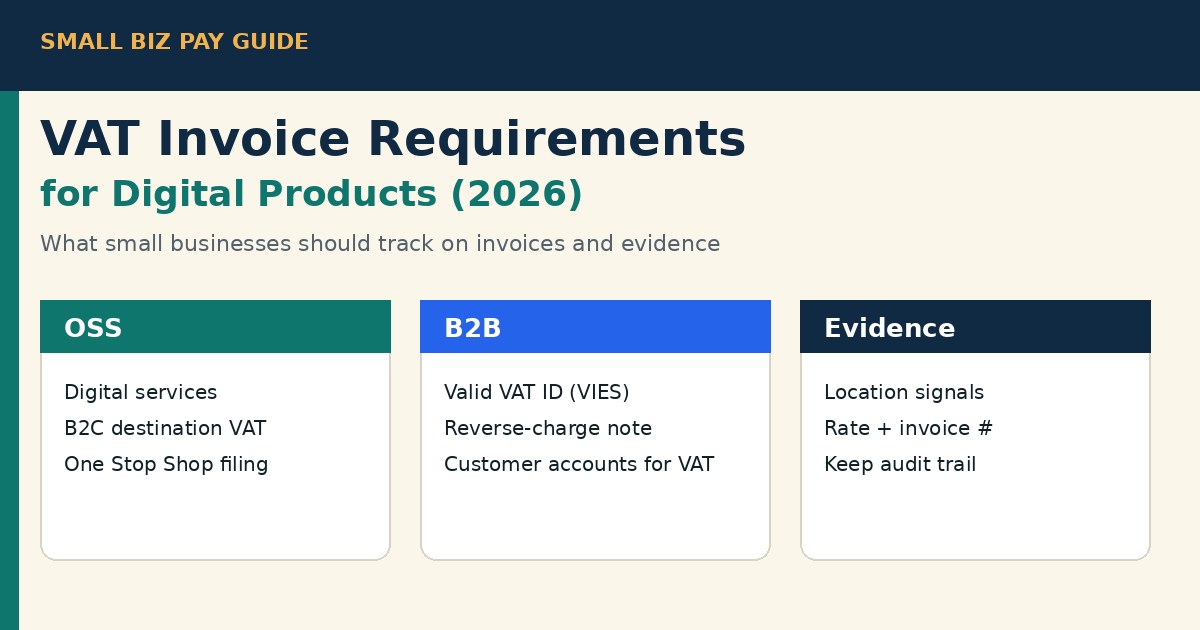
If you sell SaaS, courses, templates, downloads, or other digital products to customers in the EU or UK, VAT shows up in two places at once: what you print on the invoice, and what evidence you keep to defend the tax decision. This 2026 ops checklist focuses on those fields and records for small digital businesses. It is a tracking guide, not a substitute for registration advice or filing software setup.
Quick answer: what should you track?
For each international digital sale, capture customer location evidence, whether the buyer is a business with a validated VAT ID, the VAT treatment (B2B reverse charge vs B2C destination rate), the invoice fields required for that treatment, the rate and amounts, and the payment reference. Store those records with the same care you give bank statements. US sales-tax questions are related but separate; start with do digital products need sales tax? and sales tax nexus for digital products when the buyer is in the United States.
Who this checklist is for
Use this if you sell digital products or subscriptions to EU or UK customers, run a small SaaS with mixed B2B and B2C checkout, sell courses or downloadable goods online, or you are comparing a tax tool against a spreadsheet. Founders who only sell inside one home country can skim the evidence section and skip OSS details until cross-border buyers appear.
OSS vs IOSS: which scheme fits digital services?
The EU One Stop Shop (OSS) lets many sellers report certain B2C supplies of services (including many digital / electronically supplied services) and distance sales of goods through a single Member State of Identification instead of registering in every customer country. Digital services sold to consumers typically sit in the OSS world (Union OSS or Non-Union OSS, depending on where you are established), subject to the rules that apply to your facts.
The Import One Stop Shop (IOSS) is a different scheme aimed at low-value consignments of goods imported into the EU. If you only deliver software access, a hosted course, or a digital download with no physical goods shipment, IOSS is usually the wrong mental model. Mixing OSS and IOSS labels on invoices or in your accounting notes creates cleanup work later. When you read official guidance, check whether the page is about services, goods distance sales, or import consignments before you copy a process into your ops wiki.
The EUR 10,000 threshold nuance (and why non-EU sellers often treat B2C digital differently)
EU-established sellers of certain B2C telecommunications, broadcasting, and electronically supplied services (and related distance sales of goods) may have an EU-wide annual threshold around EUR 10,000 under the special scheme rules. Below that threshold, some EU-established businesses can apply VAT rules of their own Member State for those supplies, subject to conditions and any option to use OSS earlier. Above it, destination taxation and OSS (or local registrations) become the practical path. Confirm the current threshold, what supplies count toward it, and any election rules on European Commission and national tax authority pages. Thresholds move in policy updates, so do not hard-code a number into your checkout without a yearly review.
Non-EU sellers of B2C digital services into the EU generally do not get that same de minimis comfort. In many common setups, destination VAT applies without an EU-wide small-seller threshold of the kind EU-established businesses discuss. That is why US course sellers and SaaS teams often meet VAT obligations as soon as they sell to EU consumers, even at low volume. Your exact registration path (Non-Union OSS vs other options) depends on establishment and product type. Treat “we only sold EUR 2,000 last year” as a reason to keep clean invoices, not as proof that no VAT duty exists.
B2B reverse charge vs B2C destination VAT
Cross-border B2B supplies of digital services to a customer who is a taxable person with a valid VAT identification number often use the reverse-charge mechanism: you invoice without charging EU VAT (or show 0% with a clear reverse-charge note), and the customer accounts for VAT in their Member State. Ops still issues a proper invoice. Ops also keeps proof that the VAT ID was checked (commonly via the EU VIES system) at or near the time of supply.
B2C digital services are usually taxed where the customer belongs (destination). You charge the VAT rate of the customer’s Member State, show net, rate, VAT amount, and gross on the invoice or receipt when a full invoice is required, and report through OSS or another compliant registration path. If a buyer types a VAT number that fails validation, treat the sale as B2C until the identity is fixed. Self-declared “I am a business” without a validated ID is weak evidence.
UK customers sit outside the EU OSS system after Brexit. UK VAT for digital services to UK consumers is a separate HMRC regime. Keep UK location, UK VAT registration decisions, and UK invoice wording in their own folder or tax profile so EU OSS filings do not absorb UK rows by accident.
Invoice field checklist (B2B and B2C)
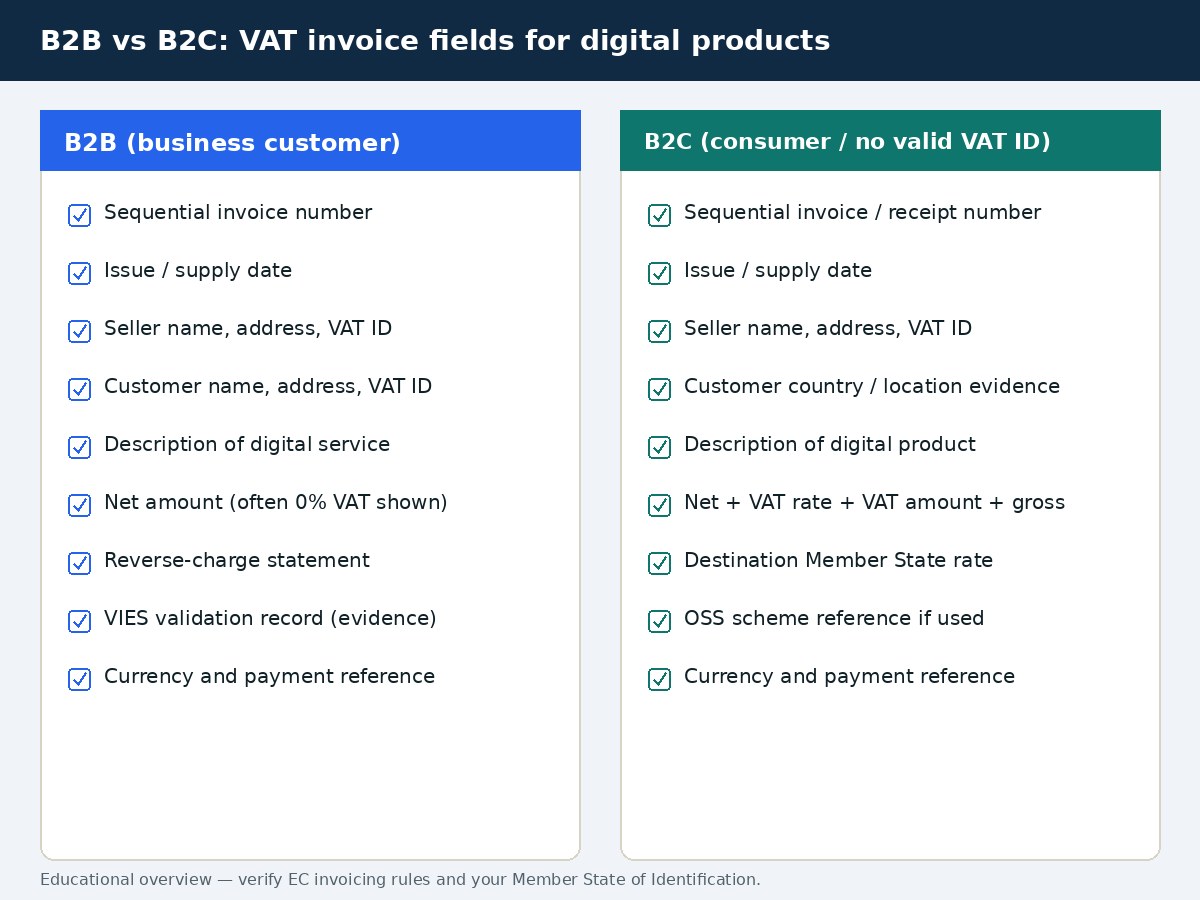
European Commission invoicing guidance describes full and simplified invoice content. Member States can set extras. For digital-product ops, aim to capture these fields consistently even when your payment processor’s default receipt looks sparse:
- Sequential invoice number that does not reuse IDs after refunds
- Date of issue and date of supply (or tax point) when they differ
- Seller legal name, address, and VAT identification number
- Customer name and address (and customer VAT ID for B2B)
- Clear description of the digital product or subscription period
- Net amount, VAT rate, VAT amount, and gross (or reverse-charge presentation for eligible B2B)
- Currency; convert carefully if you report in EUR for OSS
- Payment reference linking the invoice to the processor charge
- Explicit reverse-charge wording when that mechanism applies
B2C destination invoices should make the Member State rate obvious. B2B reverse-charge invoices should make the customer’s VAT ID and the reverse-charge statement obvious. If your template cannot show both modes cleanly, maintain two templates rather than editing PDFs by hand after each sale.
Evidence to keep beyond the PDF
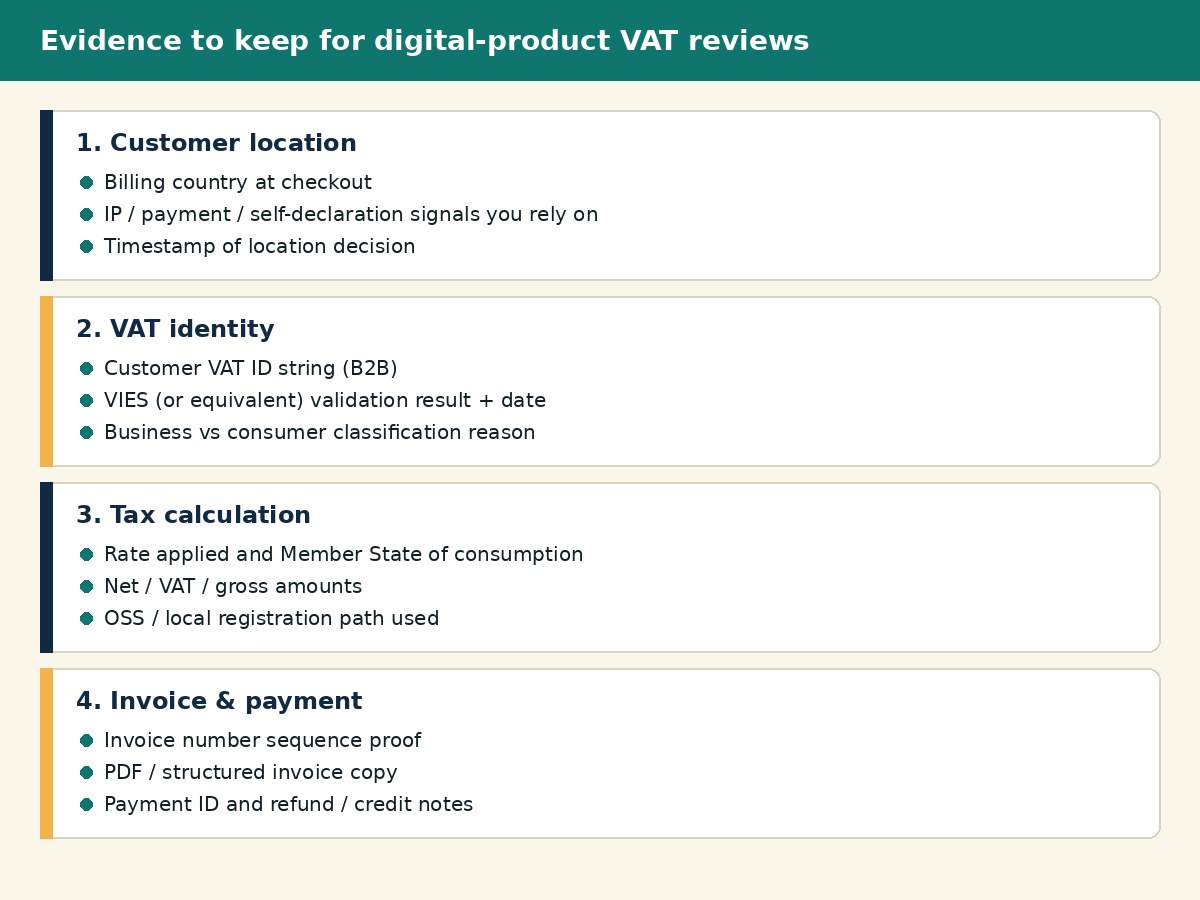
Audits and accountant questions usually ask how you knew where the customer was and why you chose a rate. Keep:
- Billing country and any other location signals your policy uses (payment country, IP, self-declaration), plus the timestamp of the decision
- VAT ID string, VIES (or equivalent) validation result, and validation date for B2B
- Classification reason: business vs consumer
- Rate table source or tax-engine output for that order
- OSS (or other) registration identifier you rely on in filings
- Credit notes, refunds, and plan changes that alter taxable amounts
- A copy of the issued invoice in durable storage
Payment processors rarely store every field you need for VAT evidence. Export early. Map checkout fields into your bookkeeping tool so location and VAT ID survive subscription renewals. For broader compliance context across US and international sellers, see the tax compliance hub and when an online business should register for sales tax.
Document your Member State of Identification (or Non-Union OSS registration country) in the same ops wiki as your invoice templates. Filings, currency conversion conventions, and invoice language often follow that state’s administrative practice even when destination rates come from other Member States. When you change registration or move establishment, re-test a sample B2B and B2C invoice before the next quarter closes.
Credit notes deserve the same field discipline as original invoices. Link each credit note to the original invoice number, restate net and VAT (or reverse-charge) adjustments, and keep the reason code (refund, chargeback, plan downgrade, goodwill). OSS returns and accountant reviews both trip on silent refunds that never appear in the invoice sequence.
Ops workflow: from checkout to archive
1. At checkout, collect billing country and optional VAT ID. Block “business” pricing that skips VAT until validation succeeds.
2. Classify the order as B2B reverse charge, B2C destination VAT, UK digital VAT, or out-of-scope based on written rules you can show an advisor.
3. Issue the invoice from a numbered sequence the same day as payment when your process requires it, or on the tax point your advisor confirms.
4. File OSS (or local) returns on the calendar your Member State of Identification publishes. Reconcile return lines to invoice exports monthly even if returns are quarterly.
5. Archive invoice PDF, validation screenshot or API log, and payment ID together. Retention periods differ by country; ask your accountant for a minimum and then keep longer if storage is cheap.
When a tax calculation tool helps
Manual invoices work for a handful of EU sales per month if someone owns the checklist. Volume, mixed B2B/B2C, multi-currency subscriptions, and renewals usually push teams toward a tax engine that calculates destination rates, stores evidence, and generates invoices. If you are weighing product fits, read our internal comparison of Quaderno vs Stripe Tax. More tool roundups live under comparisons. Check each vendor’s official pricing and supported countries before you rely on a feature list from memory.
Common mistakes on digital-product VAT invoices
- Using IOSS language for pure digital services
- Assuming the EUR 10k threshold applies to a non-EU seller the same way it can for certain EU-established sellers
- Accepting an unvalidated VAT number and still issuing a reverse-charge invoice
- Showing a single “EU VAT” rate instead of the customer’s Member State rate on B2C sales
- Reusing invoice numbers after voids
- Leaving UK digital sales inside an EU OSS export
- Keeping only the payment processor email receipt with missing seller VAT ID or reverse-charge text
- Updating subscription pricing without refreshing location evidence on renewal
FAQ
Do I need a VAT invoice for every digital download?
Invoice and receipt rules depend on customer type, amount, Member State rules, and whether a full or simplified invoice is allowed. Many B2B cross-border supplies still need a complete invoice with reverse-charge details. B2C may allow simplified documents in some cases. Build a default that issues a full invoice when unsure, then tighten with advisor input.
What is the difference between OSS and IOSS for my SaaS?
OSS is the scheme most digital service sellers discuss for B2C EU supplies. IOSS targets low-value imported goods. Hosted software and online courses are not import consignments. Label your internal docs “OSS (services)” so nobody copies an IOSS goods playbook.
How do I show reverse charge on the invoice?
Include the customer’s VAT ID, show that VAT is not charged by you (or is 0% under reverse charge), and add clear wording that the customer accounts for VAT under the reverse-charge mechanism. Many teams also reference the relevant VAT Directive article their advisor recommends. Keep the VIES validation with the order.
What location evidence is enough?
EU rules for electronically supplied services describe non-contradictory evidence categories (for example billing address, IP address, bank country). Your tax engine or advisor should define which two pieces you will store. Log the decision time. Conflicting signals need a written rule, not a one-off guess in Slack.
Does the EUR 10,000 threshold mean I can ignore VAT under that amount?
No. For certain EU-established sellers it can change whether destination taxation applies yet. For many non-EU digital sellers selling B2C into the EU, destination VAT can apply without that threshold. Confirm which rule set matches your establishment and product type.
Are UK digital sales filed through EU OSS?
Generally no. UK VAT for digital services is administered under UK rules. Separate UK registration, invoicing, and returns from your EU OSS process.
Can Stripe Tax or Quaderno replace my accountant?
Tax tools calculate, invoice, and help collect evidence. They do not replace registration decisions, interpretation of edge cases, or professional advice. Use them to reduce manual errors once an advisor confirms your registration path. Compare feature fit in Quaderno vs Stripe Tax.
What if my customer is in the EU but pays with a US card?
Card country is only one evidence signal. Follow the location evidence policy you documented for electronically supplied services. Conflicting billing address and card country should trigger your written tie-break rule, not an automatic exemption from VAT.
What should I review on the last 20 international orders?
For each order: customer country, B2B vs B2C flag, VAT ID validation if claimed, invoice number, net/VAT/gross or reverse-charge note, rate used, and payment ID. Fix template gaps before the next filing period.
Next step
Export your last twenty EU/UK digital orders into a sheet with columns for location evidence, VAT ID validation, tax treatment, invoice number, amounts, and payment ID. Fill every blank. Then decide whether manual templates still scale or whether a tax tool comparison is overdue. Keep reading on US nexus and digital products if your mix includes domestic US buyers, and verify every registration step on official European Commission, national tax authority, and HMRC pages before you change checkout.
Keep reading
- Quaderno vs Stripe Tax
- Do digital products need sales tax?
- Sales tax nexus for digital products
- When should an online business register for sales tax?
- Tax compliance hub
- Comparisons
Official references to verify
Read primary sources before you change processes. Start with European Commission pages on VAT invoicing, place of taxation, and One Stop Shop / Import One Stop Shop guidance, plus your Member State of Identification tax authority and HMRC digital services pages for UK customers. Rules and thresholds change; treat this article as an ops checklist of what to capture, not as a filing determination.