Disclosure: This guide is educational and may include affiliate-oriented recommendations. It is not legal, tax, accounting, or financial advice. State sales tax nexus rules, economic nexus thresholds, and digital product taxability change, and details differ by state. Verify current requirements with each state’s department of revenue (DOR), Streamlined Sales Tax guidance where relevant, and a qualified professional before you act.
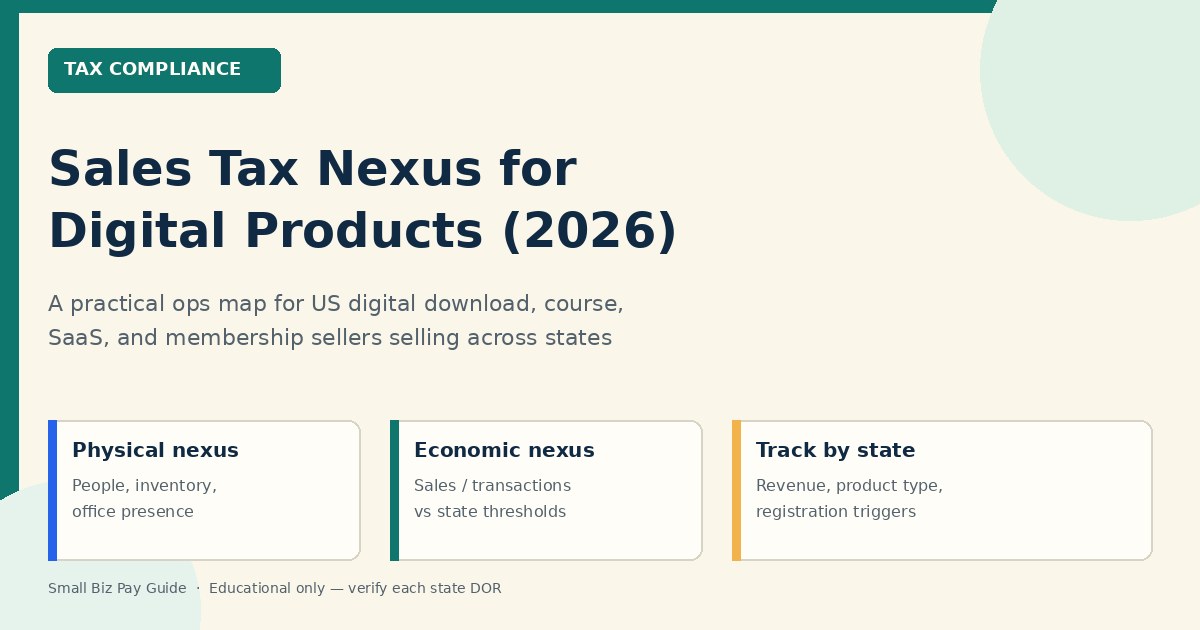
If you sell digital downloads, online courses, memberships, or SaaS to customers in many US states, sales tax questions usually arrive as a tangle: Do we have nexus? Is this product taxable here? Should the marketplace collect for us? This 2026 guide is an Ops and Finance map for those questions. It helps you track presence, revenue, and thresholds state by state so registration decisions rest on records instead of guesswork.
Quick answer: when does sales tax nexus matter for digital products?
Sales tax nexus for digital products depends on where you have business presence, where customers are located, whether your product category is taxable in that state, and whether your sales or transactions meet that state’s economic nexus rules. Physical presence (people, inventory, offices) can create nexus even at low volume. Economic nexus can create nexus for remote sellers once a state-specific sales or transaction threshold is crossed. Track revenue and order counts by customer state, check taxability separately from nexus, and register or collect only after you confirm the state’s current DOR rules. For the broader taxability question, see do digital products need sales tax? Timing of registration is covered in when an online business should register for sales tax.
Who this guide is for
Use this if you sell digital downloads across state lines, run courses or memberships with US buyers in many states, operate a small SaaS with self-serve checkout, or sell templates and newsletters from a home office while customers live everywhere. Marketplace sellers should still read the facilitator section, because platform collection does not always cover every channel. Founders who only sell inside one home state can skim physical nexus and skip multi-state tracking until remote buyers appear.
What nexus means in plain language
Nexus is the connection between your business and a state that can require you to register for sales tax, collect tax on taxable sales, and file returns. Without nexus, a state generally cannot require you to collect. With nexus, collection duties can apply to taxable sales into that state, subject to exemptions, marketplace rules, and local rates where they exist.
For digital product sellers, nexus is easy to miss because there is no warehouse full of boxes. A remote contractor in another state, inventory in a fulfillment network, or a growing stream of SaaS subscriptions can each change the picture. Treat nexus as an ops inventory problem: list where you are present, list where customers buy, then compare those lists to written state rules.
Physical nexus vs economic nexus
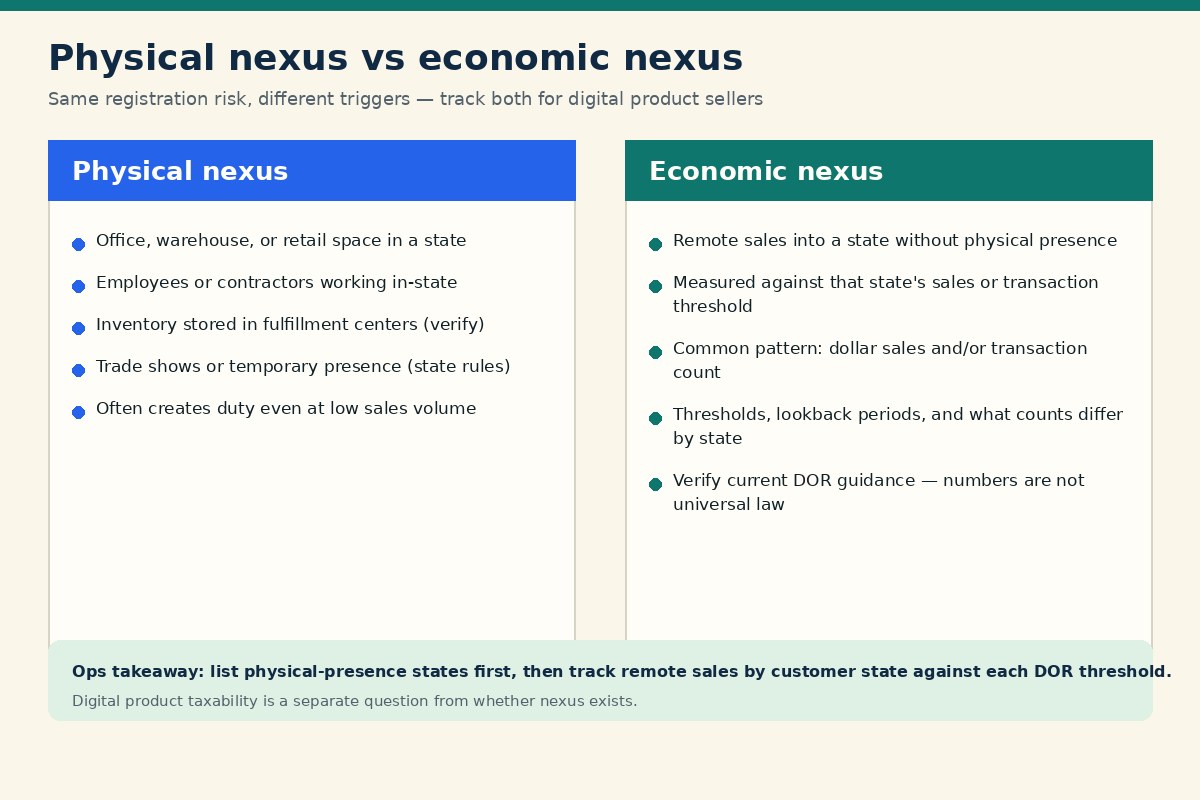
Physical nexus is the older idea: you have a real footprint in the state. Common triggers include an office, warehouse, or retail location; employees or regular contractors working there; inventory stored for fulfillment; and, in some states, temporary presence such as trade shows. Exact facts and safe harbors vary. If someone on your team works from a state for months, put that state on your physical-presence list and ask an advisor whether it creates registration duties even before sales volume looks large.
Economic nexus is the remote-seller rule many states adopted after the US Supreme Court’s South Dakota v. Wayfair decision. In broad terms, a state can require remote sellers to collect once their sales into the state (and sometimes their number of transactions) cross a published threshold during a defined lookback period. A pattern you will see often in public guidance is a sales dollar threshold paired with a transaction count, sometimes in the neighborhood of figures people casually summarize as “$100,000 or 200 transactions.” Those numbers are a common pattern, not a single federal statute that applies the same way in every state. States set different dollar amounts, include or exclude different receipts, use different lookback windows (calendar year, prior or current twelve months), and may drop or keep a transaction prong. Always read the current DOR page for each state you care about. Do not hard-code one universal threshold into your spreadsheet as if it were law everywhere.
Ops implication: maintain two lists. List A is physical presence. List B is remote sales by state versus that state’s current economic nexus test. Either list can force registration. Digital product taxability is a third column, not a substitute for nexus analysis.
Are digital products taxable?
Nexus answers whether a state can require you to collect. Taxability answers whether your specific product is taxable there. States disagree about digitally delivered software, streaming access, downloadable content, canned vs custom software, and subscription SaaS. Some tax many digital goods; some tax narrower categories; some treat certain electronically delivered products differently from tangible personal property.
Classify each SKU the way a state would: download, electronically delivered software, SaaS access, online course, membership, or mixed bundle. Bundles that mix taxable and nontaxable elements need special care. Keep a product taxonomy in your ops wiki and update it when you launch a new offer. When taxability is unclear, get a written view from a sales tax professional or the state’s published guidance rather than copying a blog’s summary table. Our companion piece do digital products need sales tax? goes deeper on product categories.
How to track sales by state
You cannot monitor economic nexus without a reliable customer-state field on every order and renewal. Billing address country and state (or ship-to when you collect it for digital goods) should land in the same export you use for bookkeeping. Prefer one source of truth: payment processor export mapped into accounting, or a tax engine that stores location evidence with the order.
Build a monthly report with at least these columns: sale date, order ID, customer state, product type, channel (direct vs marketplace), net revenue, and refunds. Roll the report to year-to-date and to each state’s lookback window once you know how that state measures the threshold. Reconcile renewals and upgrades so subscription businesses do not undercount mid-cycle changes.
If you sell on multiple platforms, merge exports before you judge thresholds. Marketplace facilitator collection can change who remits tax, but your internal volume by state still matters for registration planning, audit questions, and channels where you sell direct. EU and UK VAT evidence is a different regime; if you also sell internationally, keep US state rows separate from VAT location evidence covered in VAT invoice requirements for digital products.
When to register and collect
Registration timing is state-specific. Some states expect registration once you cross the economic nexus threshold (or when physical nexus exists). Filing start dates, voluntary registration options, and amnesty programs differ. Collecting tax before you are registered can create its own mess; waiting long after a clear threshold crossing can create another. Use your tracking report to flag “approaching” states early so Finance can talk to an advisor before the busy season.
After you register, you typically need to collect on taxable sales, file on the state’s schedule, and keep exemption certificates when business customers claim exemptions. Local rates and sourcing rules can apply even for remote digital sellers in some states. Software helps with rate lookup, but registration and filing calendars still need an owner. For a decision framework on timing, see when an online business should register for sales tax.
Marketplace facilitators: what changes (and what does not)
Many states require marketplace facilitators (large platforms that list third-party sellers) to collect and remit sales tax on marketplace sales. If most of your volume runs through a platform that already collects, your remittance burden on those orders may shrink. That does not erase every duty. Direct website sales, invoice sales, and other non-facilitator channels can still create nexus and collection obligations. Some states still want marketplace sellers registered or reporting in certain cases. Read the platform’s tax settings and the state’s facilitator statute summary; do not assume “Etsy/Amazon/Teachable collected” covers your Stripe checkout.
Ops checklist for channels: tag every order as marketplace-facilitated or direct. Keep facilitator remittance reports. Keep your own economic nexus math on total remote sales into each state, because physical nexus and direct-channel rules may still apply. When you leave a platform or add a direct storefront, re-run the analysis the same month.
Tools: Stripe Tax, Quaderno, and similar options
Manual spreadsheets work until you have many states, renewals, and product types. Tax calculation tools can store buyer location, apply rate and product tax codes, and sometimes help with filings or evidence. Stripe Tax sits close to Stripe Checkout and Billing. Quaderno and peers often focus on multi-channel tax calculation, invoices, and compliance workflows for digital sellers. TaxJar and other services appear in many stacks as well.
Pick software for the jobs you actually need: nexus monitoring, product taxability mapping, checkout calculation, invoice or receipt content, filing support, and audit trails. Compare pricing against transaction volume and the number of jurisdictions you file in. For a side-by-side of two common options for digital sellers, see Quaderno vs Stripe Tax. Broader tool comparisons live under comparisons, and the tax compliance hub collects related guides. No tool replaces reading DOR guidance or getting professional advice on registration.
Common mistakes digital product sellers make
- Treating one popular threshold figure as universal law instead of checking each state’s current test
- Tracking nexus without checking whether the SKU is taxable in that state
- Ignoring physical presence from remote team members or stored inventory
- Assuming marketplace collection covers direct checkout sales
- Waiting until year-end to notice a mid-year threshold crossing
- Exporting processor reports that lack a reliable customer state field
- Mixing US sales tax rows with EU/UK VAT evidence in one undifferentiated ledger
- Registering in a state without a filing calendar owner or software profile
Ops checklist: threshold tracking
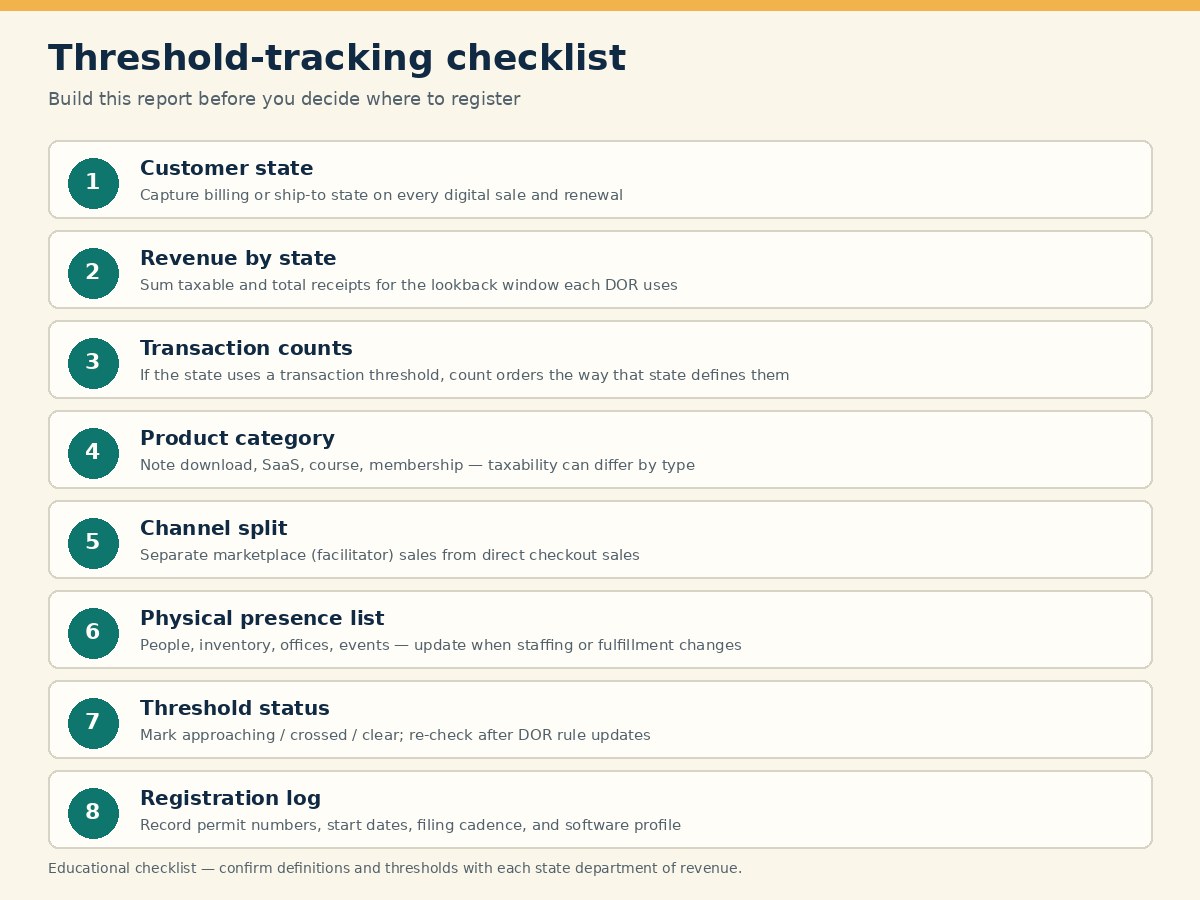
Use this as a working list before you decide where to register:
- Capture customer state on every digital sale and renewal
- Sum revenue by state for each DOR lookback window you rely on
- Count transactions the way each relevant state defines them, if a transaction prong applies
- Tag product category (download, SaaS, course, membership, bundle)
- Split marketplace facilitator sales from direct sales
- Maintain a physical presence list and update it when staffing or fulfillment changes
- Mark each state as approaching, crossed, or clear; revisit after rule updates
- Log registrations, permit numbers, filing cadence, and tax software profiles
Put the report on a recurring calendar (monthly is a practical default for growing digital businesses). Share it with whoever owns bookkeeping so refunds and chargebacks stay in sync.
FAQ
Do I need nexus in a state if my digital product is not taxable there?
Nexus and taxability are separate. You may have nexus without owing tax on a nontaxable product, and you may later sell a taxable SKU into a state where you already have nexus. Track both columns.
Is there one nationwide economic nexus threshold for digital sellers?
No. Many states publish economic nexus tests that look similar (often a sales amount and sometimes a transaction count), but the dollar amounts, what receipts count, lookback periods, and transaction definitions differ. Confirm each state’s DOR page; do not treat a blog’s “$100k / 200 transactions” summary as binding law in every jurisdiction.
If a marketplace collects tax for me, can I ignore economic nexus?
Not safely. Facilitator collection may cover marketplace orders, but direct sales, physical presence, and state-specific seller duties can still apply. Keep channel-tagged volume reports.
Does a remote contractor in another state create physical nexus?
It might. States differ on employees, agents, and temporary presence. Add the state to your physical-presence list and get advice before you assume remote work is invisible for sales tax.
Should SaaS and downloadable courses use the same tax code?
Often no. States may tax electronically delivered software, SaaS access, and educational content differently. Map each offer to the state’s product categories instead of one catch-all “digital” code.
When should I buy tax software instead of a spreadsheet?
When you sell into many states, renew subscriptions automatically, or need consistent location evidence and rate application at checkout. Compare tools such as those discussed in Quaderno vs Stripe Tax against your channel mix and filing load.
How does this relate to VAT for EU or UK customers?
US sales tax nexus is a state-level system. EU/UK VAT for digital services uses different registration and invoice rules. Keep separate evidence and processes; see VAT invoice requirements for digital products.
What should I review on the last 20 US orders?
Check customer state, product type, channel (marketplace vs direct), whether tax was collected, and whether the order would appear correctly in your nexus report. Fix missing state fields before the next month closes.
Related guides
- Do digital products need sales tax?
- When should an online business register for sales tax?
- Quaderno vs Stripe Tax
- VAT invoice requirements for digital products
- Tax compliance hub
- Comparisons
Official references to verify
Confirm current rules on primary sources before you register or change checkout tax settings:
- Streamlined Sales Tax: Remote Seller State Guidance
- Streamlined Sales Tax: Economic Nexus Threshold Best Practices
- Each relevant state’s department of revenue pages for economic nexus thresholds and digital product taxability
Start with a state-by-state sales report and a physical presence list. Those two artifacts turn nexus from a vague worry into a maintenance routine you can hand to Finance or a tax advisor with clear questions.