Disclosure: This guide is educational and may include affiliate-oriented recommendations. It is not legal, tax, accounting, or financial advice. Sales tax registration rules, economic nexus thresholds, marketplace facilitator laws, and product taxability change by state. Verify current requirements with each state’s department of revenue (DOR), Streamlined Sales Tax guidance where relevant, and a qualified professional before you register, collect, or remit anything.
Online sellers usually ask this question too late or too early. Too late looks like a surprise letter after a busy year of remote sales. Too early looks like collecting tax without a permit, or filing in states you do not yet owe. This 2026 Ops and Finance guide frames registration as a set of decision triggers you can check in a working afternoon, then maintain on a monthly report.
Quick answer: when should you register?
An online business should look hard at sales tax registration when any of these is true: you have physical presence in a state (people, inventory, office, or similar footprint); your remote sales into a state approach or cross that state’s economic nexus test; or you sell through channels where marketplace facilitator collection does not cover your direct or invoice sales. Registration is separate from product taxability. You may have nexus without owing tax on a nontaxable SKU, and you may later add a taxable offer into a state where you already registered. For how nexus works for downloads, courses, and SaaS, see sales tax nexus for digital products. For whether digital goods are taxable at all, see do digital products need sales tax?
Who this guide is for
Use this if you run an online store, sell courses or digital downloads, operate a small SaaS with US buyers in many states, or sell on a marketplace and also through your own checkout. Founders who only sell inside one home state can still use the physical-presence section, then revisit economic nexus when remote buyers appear. This is an operations map, not a substitute for a CPA or sales tax attorney on edge cases.
What sales tax registration means
Registration is the state’s process that gives you permission (often called a seller’s permit, sales tax license, or similar account) to collect sales tax on taxable sales into that state and to file returns on the state’s schedule. After you register, the usual loop is collect the correct tax at checkout or on the invoice, file on time (even zero returns when required), and remit what you collected. Some states also want local rates, destination sourcing rules, or separate accounts for special jurisdictions.
Two timing traps show up often. Collecting tax before you are authorized to collect can create trust and remittance problems. Waiting long after a clear nexus trigger can create back-period exposure. Exact start dates, voluntary registration options, and lookback windows differ by state, so treat “register when triggered” as a process owned by Finance, not a one-time blog checklist.
Trigger 1: physical presence
Physical presence is the classic nexus idea: your business has a real footprint in the state. Common examples include an office, warehouse, or retail location; inventory stored for fulfillment; employees or regular contractors working there; and, in some states, temporary presence such as trade shows or pop-ups. Remote team members can matter. If someone works from another state for months, put that state on your physical-presence list and get advice before you assume home-office work is invisible for sales tax.
Ops implication: keep a living list of where people, inventory, and facilities sit. Update it when you hire, change fulfillment, or attend events. Physical presence can create registration duties even when sales volume into that state still looks small compared with popular economic nexus headlines.
Trigger 2: economic nexus (state-specific thresholds)
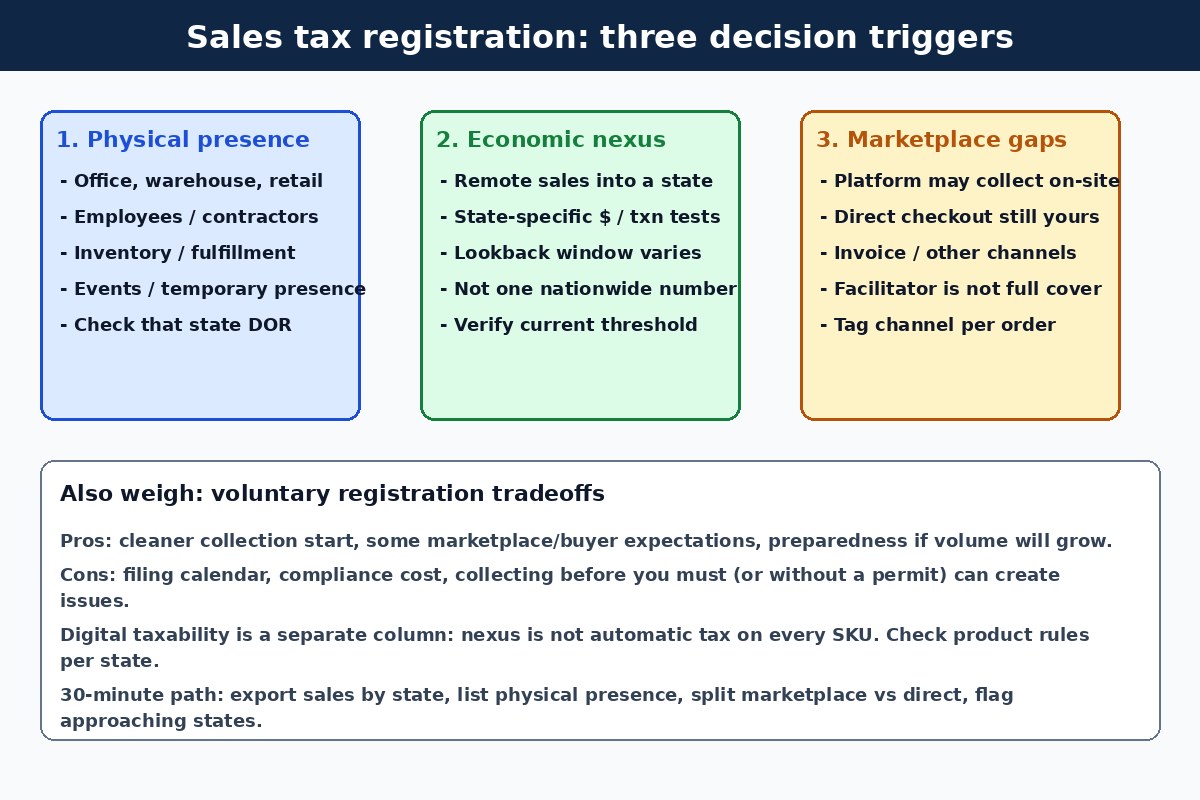
Economic nexus is the remote-seller rule many states use after the US Supreme Court’s South Dakota v. Wayfair decision. In broad terms, a state can require remote sellers to register and collect once sales into the state (and sometimes the number of transactions) cross a published threshold during a defined lookback period. Public summaries often mention figures people casually describe as around “$100,000 or 200 transactions.” Those numbers are a common pattern in guidance and commentary, not a single federal statute that applies the same way everywhere.
States set different dollar amounts, include or exclude different receipts, use different lookback windows (calendar year, prior twelve months, current twelve months), and may drop or keep a transaction prong. Always open the current DOR remote-seller or economic nexus page for each state that shows up in your sales report. Do not hard-code one universal threshold into your spreadsheet as if it were law in every jurisdiction. Streamlined Sales Tax publishes remote seller state guidance and economic nexus threshold best practices that help you ask better questions; they still do not replace the state page for the state you are about to register in.
Ops implication: export sales by customer state monthly. Roll totals to each relevant lookback window once you know how that state measures the test. Flag “approaching” states early so you can talk to an advisor before peak season, not after a threshold has already been crossed for months.
Trigger 3: marketplace facilitator coverage gaps
Many states require marketplace facilitators (large platforms that list third-party sellers) to collect and remit sales tax on marketplace sales. If most of your volume runs through a platform that already collects, your remittance burden on those orders may shrink. That does not erase every duty. Direct website sales, Stripe or PayPal checkout on your own site, invoice sales, and other non-facilitator channels can still create nexus and collection obligations. Some states still want marketplace sellers registered or reporting in certain cases.
Ops checklist for channels: tag every order as marketplace-facilitated or direct. Keep facilitator remittance reports from the platform. Keep your own economic nexus math on total remote sales into each state when physical presence or direct-channel rules may still apply. When you leave a platform or add a direct storefront, re-run the analysis the same month. “The marketplace collected” is not a complete answer for a seller with mixed channels.
Digital product taxability caveat
Registration answers whether you are in the system for a state. Taxability answers whether a given SKU is taxable there. States disagree about digitally delivered software, streaming access, downloadable content, canned versus custom software, online courses, and subscription SaaS. You can have nexus and still owe little or nothing on a nontaxable product. You can also launch a new taxable offer into a state where you already registered and suddenly need correct rates at checkout.
Classify each offer the way a state would, not as one catch-all “digital” bucket. Bundles that mix taxable and nontaxable elements need extra care. Keep a product taxonomy in your ops wiki and update it when you launch something new. When taxability is unclear, get a written view from a sales tax professional or the state’s published guidance. Companion reading: do digital products need sales tax? and sales tax nexus for digital products.
Voluntary registration: when it helps and when it costs
Some states allow voluntary registration before you clearly meet a nexus test. Reasons founders consider it include preparing for expected growth, meeting marketplace or enterprise buyer expectations, or simplifying a planned expansion. Tradeoffs include filing calendars, compliance cost, software or accountant fees, and the risk of collecting when you are not yet ready operationally. Voluntary registration is a business judgment call with state-specific rules. Treat it as a decision with a named owner, not a default “register everywhere” habit.
How to decide in about 30 minutes
You will not finish legal analysis in half an hour. You can finish a decision packet that makes the next conversation with an advisor useful.
- Export the last twelve months of orders and renewals with customer state, revenue, product type, and channel (marketplace vs direct).
- Write a one-page physical presence list: people, inventory, offices, recurring events.
- Sort states by revenue. Open the current DOR economic nexus / remote seller page for your top states and note the published test and lookback window (do not invent a universal number).
- Split marketplace-facilitated volume from direct volume for those states.
- Mark each state clear, approaching, or likely crossed. Add a taxability note per major SKU.
- Decide who owns registration applications, filing calendars, and tax software profiles if you proceed.
That packet is enough to stop guessing and start verifying. Revisit it monthly while growth is fast.
After you register: collect, file, remit
Once a state account is active, assign an owner for three jobs. Collect: map product tax codes and rates into checkout or invoicing so taxable sales pick up the right tax. File: put return due dates on a shared calendar, including periods with zero taxable sales when the state still wants a return. Remit: move collected tax on time and reconcile software totals to the bank and the return. Keep exemption certificates when business customers claim exemptions, and keep location evidence with the order for audits or disputes.
Local rates and sourcing rules can apply even for remote digital sellers in some states. Software helps with rate lookup; it does not remove the need for a human who notices failed filings or a new SKU without a tax code. If you also sell to EU or UK customers, keep US sales tax rows separate from VAT evidence covered in VAT invoice requirements for digital products.
Tools that help (without replacing judgment)
Spreadsheets work until you have many states, renewals, and product types. Tax tools can store buyer location, apply rates and product tax codes, and sometimes help with filings or evidence. Stripe Tax sits close to Stripe Checkout and Billing. Quaderno and peers often focus on multi-channel calculation, invoices, and compliance workflows for digital sellers. TaxJar and other services appear in many stacks as well.
Pick software for the jobs you actually need: nexus monitoring, taxability mapping, checkout calculation, invoice content, filing support, and audit trails. Compare pricing against transaction volume and the number of jurisdictions you file in. For a side-by-side of two common options for digital sellers, see Quaderno vs Stripe Tax. Broader comparisons live under comparisons, and the tax compliance hub collects related guides. No tool replaces reading DOR guidance or getting professional advice on whether and when to register.
Common mistakes
- Treating one popular threshold figure as universal law instead of checking each state’s current test
- Collecting tax before registration (or waiting long after a clear trigger)
- Ignoring physical presence from remote team members or stored inventory
- Assuming marketplace collection covers direct checkout and invoice sales
- Tracking nexus without checking whether the SKU is taxable in that state
- Exporting processor reports that lack a reliable customer state field
- Registering without a filing calendar owner or software profile
- Mixing US sales tax rows with EU/UK VAT evidence in one undifferentiated ledger
Registration checklist
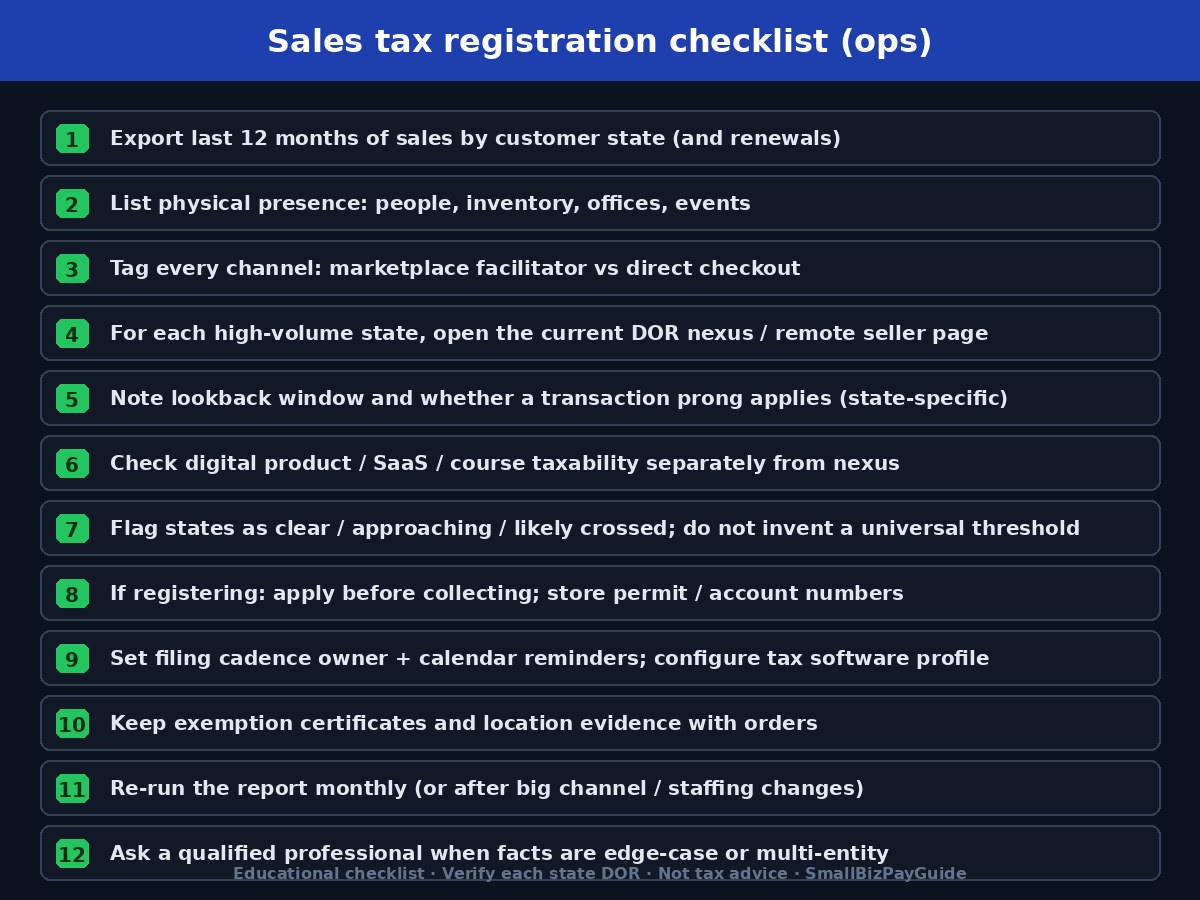
Use this as a working list before and after you decide where to register:
- Capture customer state on every sale and renewal
- Maintain a physical presence list and update it when staffing or fulfillment changes
- Tag marketplace facilitator sales separately from direct sales
- Open current DOR nexus pages for high-volume states; record lookback rules without inventing a nationwide threshold
- Map product taxability per major SKU
- Mark states clear, approaching, or crossed; revisit after rule or channel changes
- If registering: apply before collecting; store permit or account numbers
- Assign filing cadence, remittance owner, and tax software profiles
- Keep exemption certificates and location evidence with orders
- Re-run the report monthly while growth is active
FAQ
Do I have to register in every state where I have a customer?
No. Registration generally follows nexus (physical or economic) and state-specific rules, not the mere existence of a single buyer. Track presence and volume, then verify each relevant DOR page.
Is there one nationwide economic nexus threshold?
No. Many states publish tests that look similar, often involving a sales amount and sometimes a transaction count, but the details differ. Do not treat a casual “$100k / 200 transactions” summary as binding law in every jurisdiction.
If a marketplace collects tax, do I still need to register?
Maybe. Facilitator collection may cover marketplace orders, but direct sales, physical presence, and state-specific seller duties can still apply. Keep channel-tagged reports and read the state’s facilitator summary.
Should I collect tax before my registration is approved?
Usually you want authorization in place before you collect. Rules and practical timing differ by state. Confirm with the DOR process and a professional rather than improvising at checkout.
Does registering mean every digital product is taxable?
No. Nexus and taxability are separate columns. See do digital products need sales tax? for category-level questions.
When does voluntary registration make sense?
When you expect to cross a threshold soon, need operational readiness, or have a clear business reason, and you accept the filing and compliance cost. It is optional only where the state allows it, and it is still a judgment call.
What should I review on the last 20 US orders?
Check customer state, product type, channel (marketplace vs direct), whether tax was collected, and whether the order would appear correctly in your nexus report. Fix missing state fields before the next month closes.
How do Quaderno and Stripe Tax fit into registration timing?
They help with calculation, location evidence, and sometimes filings after you decide where you must collect. They do not decide nexus for you. Compare options in Quaderno vs Stripe Tax.
Related guides
- Sales tax nexus for digital products
- Do digital products need sales tax?
- Quaderno vs Stripe Tax
- VAT invoice requirements for digital products
- Tax compliance hub
- Comparisons
Official references to verify
Confirm current rules on primary sources before you register or change checkout tax settings:
- Streamlined Sales Tax: Remote Seller State Guidance
- Streamlined Sales Tax: Remote Sellers FAQ
- Each relevant state’s department of revenue pages for economic nexus thresholds, registration, and digital product taxability
Start with a state-by-state sales report, a physical presence list, and a channel split between marketplace and direct. Those three artifacts turn “when should we register?” into a maintenance routine you can hand to Finance or a tax advisor with clear questions.