Disclosure: This guide is educational and may include affiliate links. We may earn a commission if you sign up through our Melio partner link, at no extra cost to you. It is not legal, tax, accounting, or financial advice. Product terms, pricing, payment rails, and fraud controls change; verify details with Melio, your bank, your accounting software, and a qualified professional before you act.
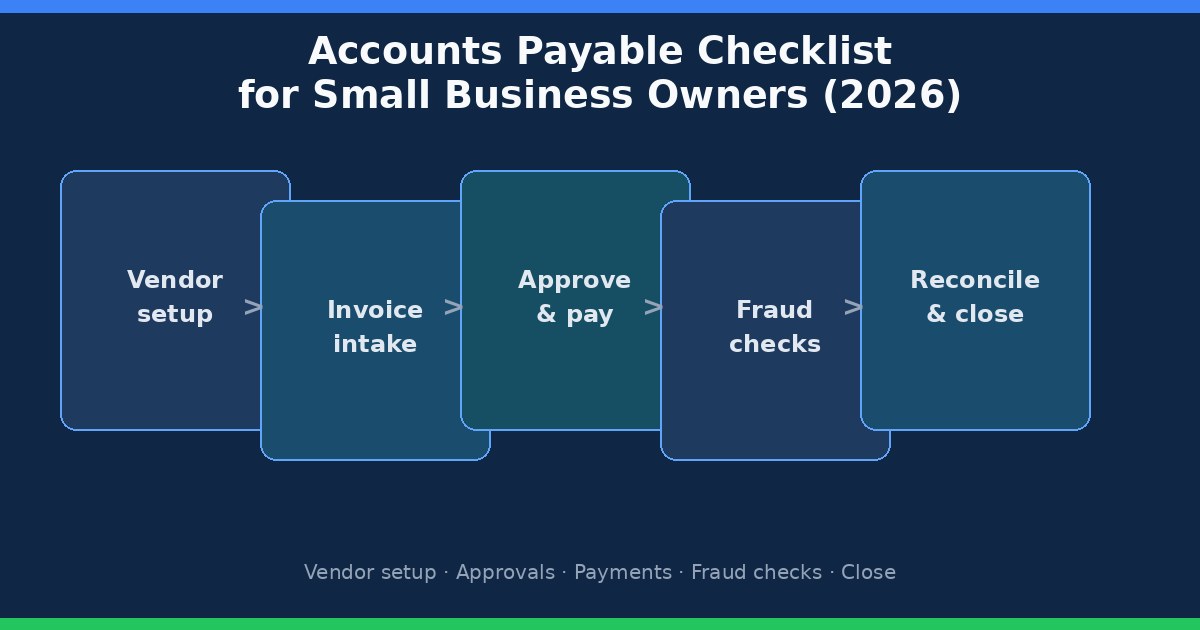
Accounts payable for a small business is a loop you run every week, not a one-time cleanup. Vendors get set up once, invoices keep arriving, someone has to review and approve them, money leaves the bank on a schedule, and books only stay clean if you reconcile. This 2026 Ops and Finance checklist walks US small business owners through that loop end to end, then shows where a lean bill pay tool like Melio fits versus a fuller AP stack when more people touch every bill.
Quick answer: what belongs on an accounts payable checklist?
A practical small business AP checklist covers vendor onboarding, invoice intake and coding, two-way or three-way review, approval by amount or department, payment scheduling (ACH, check, card, or wire), fraud checks before release, bank and vendor reconciliation, and month-end records. If you pay fewer than about ten bills a month, document the loop on a calendar first. If volume, card funding, or multi-person approvals are growing, test a bill pay platform after the manual process is written down. For a broader bill pay overview, see bill pay.
Who this checklist is for
Use this if you still pay suppliers from memory and a checking account login, if you are a bookkeeper building a repeatable monthly close, or if you pay landlords, agencies, freelancers, software vendors, and inventory suppliers on different rails. It also helps teams comparing Melio, BILL (formerly Bill.com), bank bill pay, and accounting software workflows. If you only need a contractor pay path or payroll, this guide is adjacent reading, not a substitute for those processes.
Vendor onboarding before the first payment
Create or update the vendor record before you pay the first invoice. Capture legal name, remit-to name if different, mailing address, primary contact, phone you can call, email for invoices, payment terms (Net 15, Net 30, due on receipt), preferred payment method, and tax ID details when Form W-9 collection applies for US payees. Store the W-9 (or equivalent) with the vendor master so year-end 1099 work does not start from a scramble.
Verify bank details through a channel you already trust. A PDF attachment that suddenly lists a new routing number is a classic fraud pattern. Call a number from your original contract or the vendor’s known website, confirm the change, and note who you spoke with. Do not reuse the phone number printed only on the change request email. For first-time international or high-dollar wires, add an extra day for confirmation before money moves.
Decide who may add vendors and who may edit banking fields. In many shops the owner adds the first ten vendors, then a bookkeeper maintains them under dual review. Limit edit rights in Melio, BILL, bank portals, and QuickBooks-style vendor lists so one compromised login cannot silently reroute payments.
Invoice intake and coding
Pick one inbox or portal for vendor bills. Forwarding every PDF to a shared AP address beats hunting Slack DMs at month end. Log invoice number, date, due date, amount, currency, purchase order or contract reference if you use them, and the GL or class code you will post. Reject or park invoices that lack a vendor match, a clear description, or a due date you can schedule against.
Coding early prevents close-week surprises. Map rent, inventory, contractors, software subscriptions, shipping, and marketing to the accounts your P&L already uses. If two departments share a vendor, require a department tag on intake so approval and reporting stay accurate. Attach the invoice PDF to the bill record the same day you code it.
Two-way and three-way review
Two-way matching compares the invoice to a purchase order or contract: did we order this, at this price, under these terms? Three-way matching adds a receiving record: did goods or services arrive in the quantity billed? Inventory and project businesses lean on three-way more often. Service shops with recurring retainers often live on two-way plus a manager sign-off that work happened.
Write clear exception rules. Overages above a dollar or percent threshold need a named approver. Partial deliveries should not auto-pay the full invoice. Credits and short-pays need a note on the bill so cash and AP aging stay honest. Keep the matching evidence with the invoice so an auditor or future you can see why the bill cleared.
Approval before money leaves
Route by amount and risk, not by whoever happens to be online. A simple ladder works for many SMBs: bookkeeper or office manager approves routine bills under a set threshold; the owner or finance lead approves above that threshold; capital purchases and new vendors always need the higher tier. Document substitutes when the primary approver is out so invoices do not stall into late fees.
Approvals should answer four questions: Is this a real vendor? Does the invoice match what we agreed to buy? Is the coding correct? Is the due date and payment method intentional for cash flow? Capture the approver name and timestamp in your bill pay tool or on a shared sheet. For workflow design detail, see how to set up a bill approval workflow for a small business.
Payment scheduling: ACH, check, card, and wire
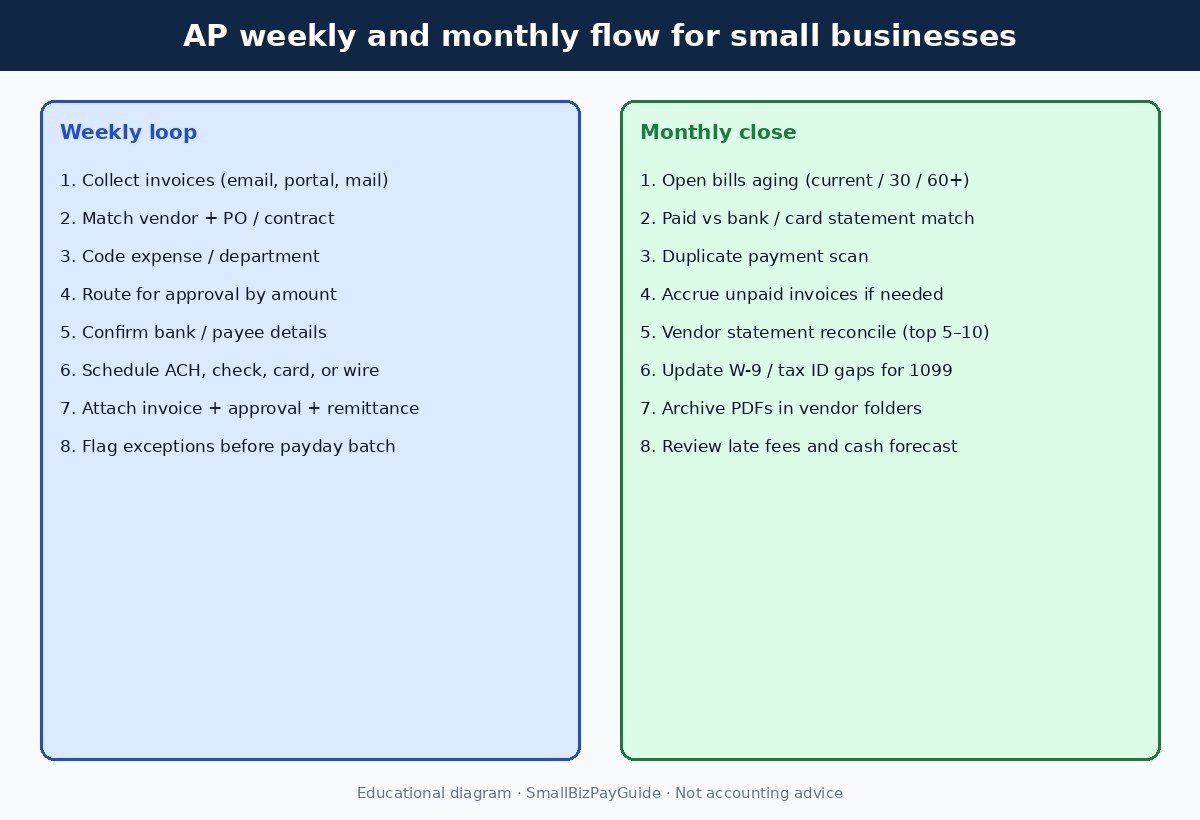
Schedule payment after approval, not before. Aim to pay early enough to avoid late fees and late vendor relationships, while keeping cash available for payroll and tax deposits. Batch vendor payments on one or two days per week so bank activity is easier to reconcile.
ACH is the default for many domestic vendors: lower cost than wires, predictable clearing, and easy to automate in Melio or bank bill pay. Confirm cutoffs so a Friday schedule still lands before the due date. Checks still appear for landlords and vendors who refuse electronic pay; if you print or mail them, track check numbers and void stale ones. Online bill pay that mails a check for you can reduce stamp work; see how to pay business bills online without mailing checks.
Card-funded bill pay can help when a vendor will not take cards directly but you want rewards or short float. Fees are usually a percentage, so run the math before you fund large invoices. Details live in pay vendors with a credit card. Wires fit urgent or high-dollar transfers when ACH timing is too slow, at higher bank fees and higher fraud risk if details are wrong. Compare rails in ACH vs wire transfer for vendor payments.
After release, save remittance advice or confirmation with the invoice. If a vendor asks “did you pay?”, you should answer from the record, not from memory.
Fraud checks and dual control
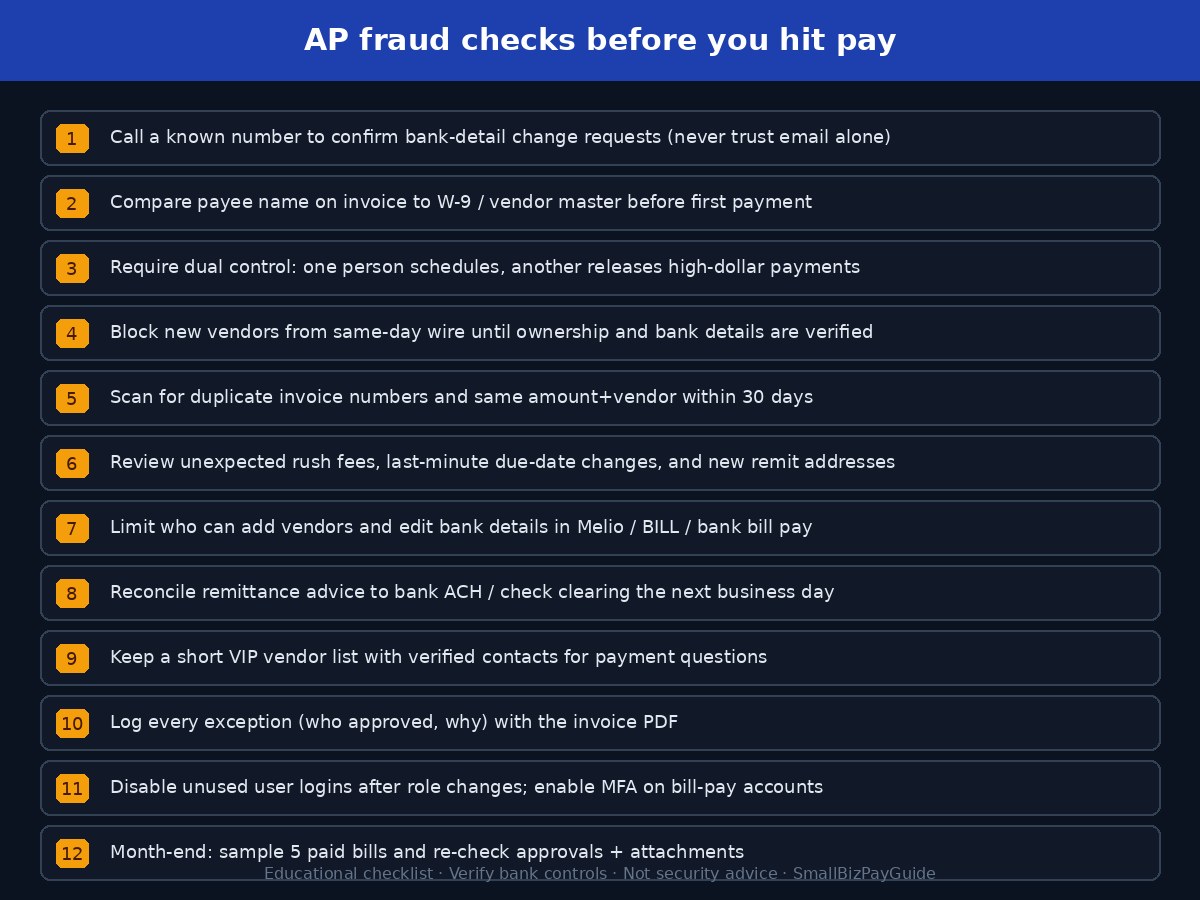
Business email compromise and fake invoice schemes target small teams that move money quickly. Build a short pre-pay gate: verify bank changes by phone on a known number, compare payee name to the vendor master and W-9, scan for duplicate invoice numbers or same amount-plus-vendor pairs, and treat rush wires to new payees as high risk until dual review clears them.
Dual control means one person schedules or prepares payment and another person releases or confirms above a dollar threshold. Even a two-person company can split “enter the bill” from “approve the bank release” with MFA on every bill pay login. Disable unused users after role changes. Log exceptions with the invoice so patterns show up at month end.
Reconciliation after payments clear
Match cleared ACH, checks, card charges, and wires to the bills you marked paid. Investigate unmatched bank lines the same week, not at year end. If a check never clears, void and reissue on purpose rather than leaving open items that confuse cash. For card-funded payments, reconcile both the bill amount to the vendor and the fee line to the platform or card statement.
Pull statements from your top vendors monthly and compare open invoices. Vendor statements catch bills stuck in the wrong inbox and payments applied to the wrong invoice number. Fix coding errors when you find them so AP aging and expense reports stay trustworthy.
Month-end close for AP
Close week should not invent the process. Run open bills aging (current, 30, 60, 90+), confirm unpaid invoices that belong in the period are accrued if your books use accrual accounting, and confirm paid bills have attachments. Review late fees and early-pay discounts you missed. Update any missing W-9s before 1099 season. Archive PDFs in a vendor folder structure your accountant can open without a scavenger hunt.
Cash forecast belongs beside AP aging. Note large rent, inventory, insurance, and tax payments coming in the next two to four weeks so payment batching does not collide with payroll. Owners who still approve every bill can still delegate intake and coding if the close packet arrives complete.
Tool fit: Melio for lean bill pay vs fuller AP tools
Software does not replace the checklist; it speeds the parts you already defined. Melio fits many small teams that want ACH and optional card-funded vendor payments without building a large AP department. Fuller platforms such as BILL tend to matter more when multiple approvers, roles, and audit trails are daily requirements. Compare tradeoffs in Melio vs Bill.com and the product walkthrough in Melio review for small business owners. More software context sits in comparisons.
Choose tools after you can answer: Who enters bills? Who approves? Who can edit bank details? Which payment methods do vendors actually accept? How do remittances sync to QuickBooks Online, Xero, or your ledger? A free-looking manual process still costs late fees, duplicate payments, and cleanup hours. Software fees only pay off when the loop is already owned.
Printable-style accounts payable checklist
- Create or update vendor master (legal name, remit info, terms, contacts, tax ID / W-9).
- Verify bank or payee changes by phone on a known number; log who confirmed.
- Collect invoice in one intake channel; capture number, dates, amount, PO/contract ref.
- Code to GL / department; attach PDF the same day.
- Run two-way or three-way match; park exceptions for named review.
- Route approval by amount / risk; record approver and timestamp.
- Confirm payment method (ACH, check, card, wire) and cash timing.
- Run fraud gate: duplicates, payee match, dual control on high-dollar or new vendors.
- Schedule and release payment; save remittance with the bill.
- Reconcile cleared bank / card activity to paid bills weekly.
- Month-end: aging, accruals if used, vendor statements, W-9 gaps, archive.
- Review tool access, MFA, and unused logins quarterly.
Common mistakes
- Paying from email PDFs without a vendor master match.
- Updating bank details from the same email that requested the change.
- Letting one person add vendors, approve bills, and release payments alone at any dollar amount.
- Scheduling payment before approval “to save time,” then forgetting to cancel when the bill was wrong.
- Skipping duplicate checks across Melio, bank bill pay, and the accounting bill list.
- Ignoring vendor statements until a collections call arrives.
- Buying AP software before documenting who owns each step.
- Mixing personal cards and business payables without a clean fee and reimbursement trail.
FAQ
How often should a small business run AP?
Most shops do intake daily or a few times per week, payment batches one or two days per week, and a fuller reconcile at month end. High-volume inventory businesses may batch payments more often; very small teams may batch weekly if due dates allow.
Do I need three-way matching?
Use three-way when you receive countable goods or milestone deliverables against POs. Recurring services with clear contracts often work with two-way matching plus manager confirmation that the period of service was delivered.
Is Melio enough, or do I need BILL?
Melio is often enough for lean teams that need ACH and optional card payments with light approvals. BILL-style tools matter more when multi-user roles and AP audit trails are constant. Read the comparison linked above and verify current pricing on each official site.
Should I pay every invoice early?
Pay early when discounts or relationship risk outweigh float value. Otherwise schedule to terms while protecting payroll and tax cash. Early payment is a cash decision, not a moral rule.
What records should I keep?
Keep the invoice PDF, approval evidence, remittance or confirmation, and vendor master support (W-9, contracts). Retention rules vary; ask your CPA for the period that fits your entity and state, and keep files searchable by vendor and date.
How do I reduce invoice fraud without slowing everything down?
Automate the boring parts (intake, coding templates, ACH batches) and keep humans on change-sensitive steps: new vendors, bank edits, wires, and exceptions above threshold. MFA plus dual control on release catches many schemes without reviewing every $40 software seat twice.
Can I use a credit card for vendors that only take ACH?
Sometimes, through card-funded bill pay platforms that pay the vendor by ACH or check while you pay the platform by card. Fees apply; run the break-even before large invoices. See the credit card vendor guide linked earlier.
What is the first step if our AP is a mess today?
List unpaid invoices with due dates and amounts, freeze new vendor bank edits until verified, pick one intake inbox, and run one clean payment batch under dual review. Expand coding and tool choice after the next close, not during a panic catch-up.
Related guides and next step
Use this checklist for your next weekly bill cycle, then decide whether software removes enough manual work to be worth testing. Keep Melio pricing, ACH limits, and card fee schedules verified on Melio’s official pages before you enroll.
If Melio fits the lean bill pay workflow described here, you can explore Melio through our partner link: Try Melio. Terms, eligibility, and offers can change; verify pricing, free-tier ACH limits, card fees, and plan features directly on Melio before you enroll.
Related SmallBizPayGuide resources:
- Bill pay overview
- Pay business bills online without mailing checks
- Bill approval workflow for a small business
- Pay vendors with a credit card
- ACH vs wire transfer for vendor payments
- Melio vs Bill.com
- Melio review for small business owners
- Software comparisons
Official references worth bookmarking include Nacha materials on ACH payments and FTC guidance on business payments and billing practices. Rules and product features change; treat this page as an operations map, then confirm current requirements with your providers and advisors.