Disclosure: This guide is educational and may include affiliate links. We may earn a commission if you sign up through our Melio partner link, at no extra cost to you. It is not legal, tax, accounting, or financial advice. Product terms, pricing, ACH cutoffs, wire fees, same-day ACH, RTP availability, and fraud controls change; verify details with Melio, your bank, your accounting software, and a qualified professional before you act.
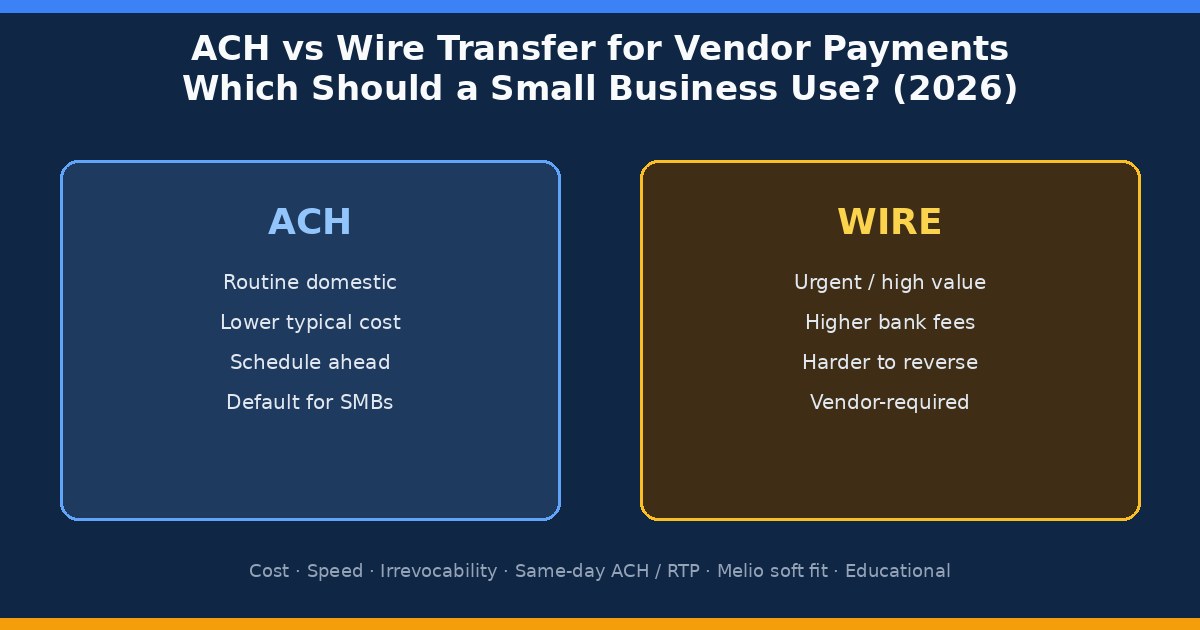
Choosing between ACH and wire transfer for vendor payments is less about which rail sounds more “businesslike” and more about cost, timing, irrevocability, and fraud risk on each invoice. Most US small businesses should default to ACH for routine domestic bills once bank details are verified, and reserve wires for urgent, high-value, international, or vendor-required remittances. This 2026 Ops comparison walks through what each rail is, how they differ at a glance, where same-day ACH and RTP sit as a middle ground, and when a bill pay tool like Melio fits the ACH path without sharing your bank login.
Quick answer: ACH or wire for vendor payments?
Use ACH for routine domestic vendor payments when the due date allows normal clearing and the vendor accepts ACH. Use a wire when the payment is time sensitive, high value under your written policy, international with wire instructions, or the vendor contract requires wire. Treat same-day ACH and real-time payment (RTP) options as a middle ground only after you confirm availability, cutoffs, and fees with your bank or bill pay processor. Double-check routing and account details before any send, and treat every bank-detail change as a fraud checkpoint. For the end-to-end bank transfer workflow, see how to pay vendors by bank transfer as a small business.
Who this comparison is for
Use this if you are replacing mailed checks with electronic bank transfers, deciding whether ACH is enough for recurring suppliers, or writing a simple policy for when wires are allowed. It also helps bookkeepers who reconcile Melio, bank bill pay, and occasional wires in the same week. It is written for US small business ops. Payroll rails and contractor tax classification are out of scope. Card-funded bill pay is adjacent; fee math for that path lives in pay vendors with a credit card.
What is ACH for vendor payments?
ACH (Automated Clearing House) moves money in batches through the US bank network. For many domestic vendors it is the default rail: you initiate a credit (or sometimes a debit authorization) from your bank portal or bill pay tool, and funds clear over one or more business days depending on initiation time, bank posting rules, and whether you used a same-day ACH product. ACH works well for rent, retainers, inventory suppliers, agencies, and other predictable bills once remittance details are on file.
Same-day ACH exists at many banks and platforms with earlier cutoffs and sometimes an extra fee. It is still an ACH product, not a wire. Confirm whether your bank and the vendor’s bank support the timing you need, and do not assume a Friday afternoon initiation will post Friday for the payee. Nacha materials on ACH payments are a useful official reference for network rules; your bank’s product page still decides what you can send.
What is a wire transfer for vendor payments?
Wire transfers settle on a different path than ACH. Domestic wires often complete the same business day when you meet the bank’s cutoff. Banks typically charge more for outgoing wires than for standard ACH, and the receiving bank may charge an incoming fee. Mistakes are harder to unwind once the wire is accepted. International wires may need SWIFT/BIC codes, intermediary banks, currency instructions, and extra compliance checks.
Wires remain useful when a landlord, supplier, closing, or overseas vendor requires them, or when the dollar amount and timing justify the fee and dual-control overhead. They are a poor default for every Tuesday supplier run. Broader online bill options, including mailed-check substitutes, are covered in how to pay business bills online without mailing checks and the bill pay overview.
ACH vs wire at a glance
| Factor | ACH (typical) | Wire (typical) |
|---|---|---|
| Best fit | Routine domestic vendor bills | Urgent, high-value, international, or required |
| Speed | Often 1–3 business days; same-day ACH when offered | Often same business day before cutoff |
| Cost | Often low or bundled in bill pay; verify | Higher outgoing fees; possible incoming fees |
| Reversibility | Limited return/dispute paths exist in some cases | Generally hard to reverse once accepted |
| Fraud sensitivity | Bank-detail fraud still bites | Rush wires to new payees are high risk |
| International | Mostly US domestic network | Common for cross-border (with extras) |
Cost: typical ranges, not a universal fee schedule
Do not treat any published “average” as your bank’s price list. Many business checking packages include a limited number of ACH credits; others charge a small per-item fee. Bill pay platforms may include ACH in a free or subscription tier and price card funding separately. Domestic outgoing wires commonly land in a higher fixed-fee band than ACH, and international wires can add intermediary and FX costs on top. Incoming wire fees on the vendor side sometimes get passed back as an invoice surcharge.
Run the decision on total cost of the payment, not the line item alone. A free ACH that clears after a late fee can cost more than a wire. A cheap rush wire that goes to a fraudster costs everything. Ask your bank and bill pay provider for current ACH, same-day ACH, RTP (if offered), and domestic/international wire schedules, then write those numbers into your AP policy so the team is not guessing at 4:55 p.m.
Speed: standard ACH, same-day ACH, RTP, and wire
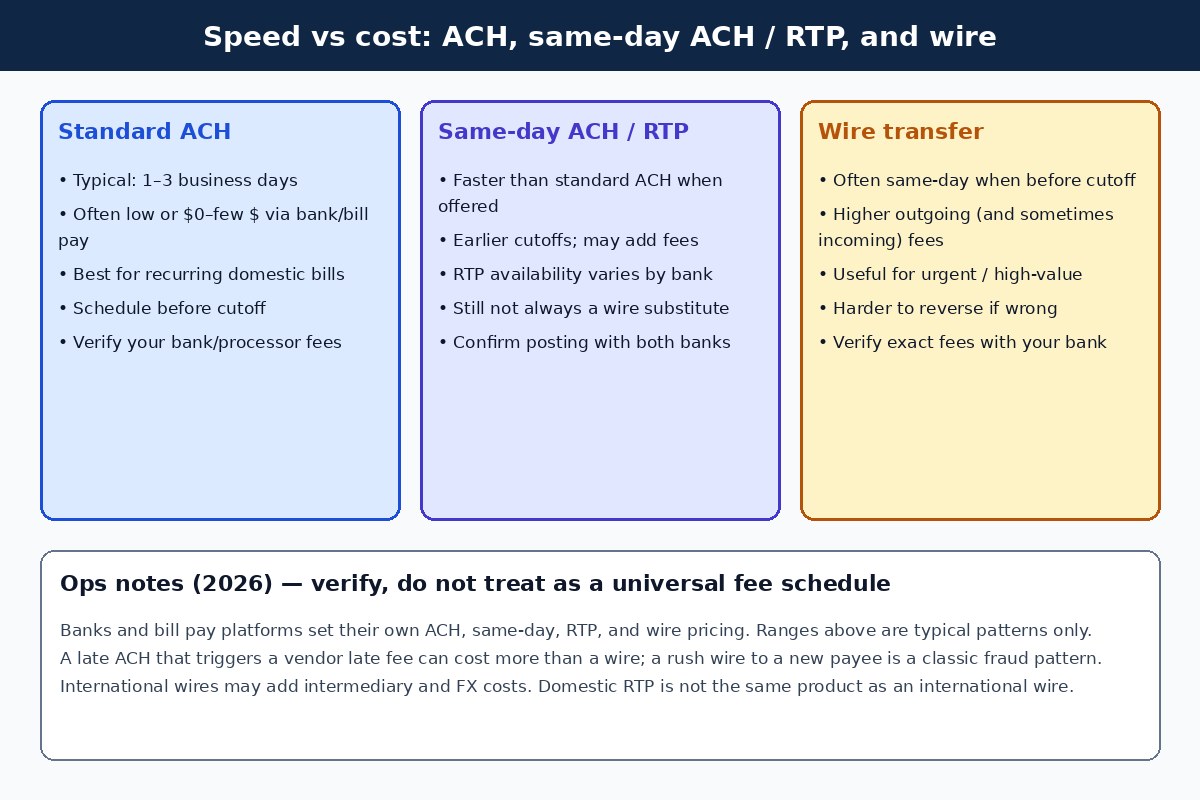
Standard ACH is built for scheduled domestic payments. Initiate early enough that business-day clearing still beats the vendor due date. Same-day ACH can compress timing when your bank or platform offers it, usually with an earlier cutoff and sometimes an extra fee. Real-time payment (RTP) and similar instant-payment products are available at some banks for eligible accounts; availability, dollar limits, and hours vary. Confirm with your bank whether RTP is enabled for your business account and whether the vendor’s bank can receive it.
Wires remain the familiar same-day path for many high-stakes vendor payments, especially when the other side will not accept ACH or when your policy prefers a wire confirmation number for large amounts. None of these products erase the need to verify bank details first. Manufactured urgency (“pay today or service stops” plus a new routing number) is a fraud pattern, not a reason to skip the callback.
Reversibility and fraud risk
ACH and wires both move real money to whatever account number you typed. ACH has network return and, in limited situations, dispute frameworks that do not exist in the same way for wires. That does not make ACH “safe to guess.” Wrong account numbers, closed accounts, and name mismatches still create pain and delays. Wires that have been accepted are generally difficult or impossible to claw back, which is why dual control and known-phone verification matter more as dollar amounts rise.
Business email compromise schemes love payment-rail confusion. Attackers send a PDF that looks like an invoice update, push for a wire “today,” and hope your team skips the call to a known number from the contract or vendor website. Build the same fraud gate for ACH detail changes and for wires: match remit-to name to the vendor master, call a trusted phone, log who confirmed, and hold release until dual review clears new payees or changed banking fields. The wider loop is in the accounts payable checklist for small business owners.
Domestic vs international vendor payments
Domestic US vendor payments are where ACH shines. Collect bank name, routing number, account number, and account type; verify them; schedule before cutoff; reconcile the confirmation to the invoice. International remittances usually need wire instructions (or a specialized cross-border product your bank offers), exact beneficiary name matching, SWIFT/BIC, and sometimes an intermediary bank. Expect longer timelines for compliance questions and higher all-in cost.
Do not paste international bank details from a sudden email attachment into a wire form. Confirm on a known channel, and allow an extra day versus domestic ACH. Currency choice (send USD vs convert) affects what the vendor receives; ask them which instruction set they use for US payers. If a domestic vendor suddenly asks for an international wire to a new country, treat that as a hard stop until ownership is proven.
When to use ACH vs when to wire
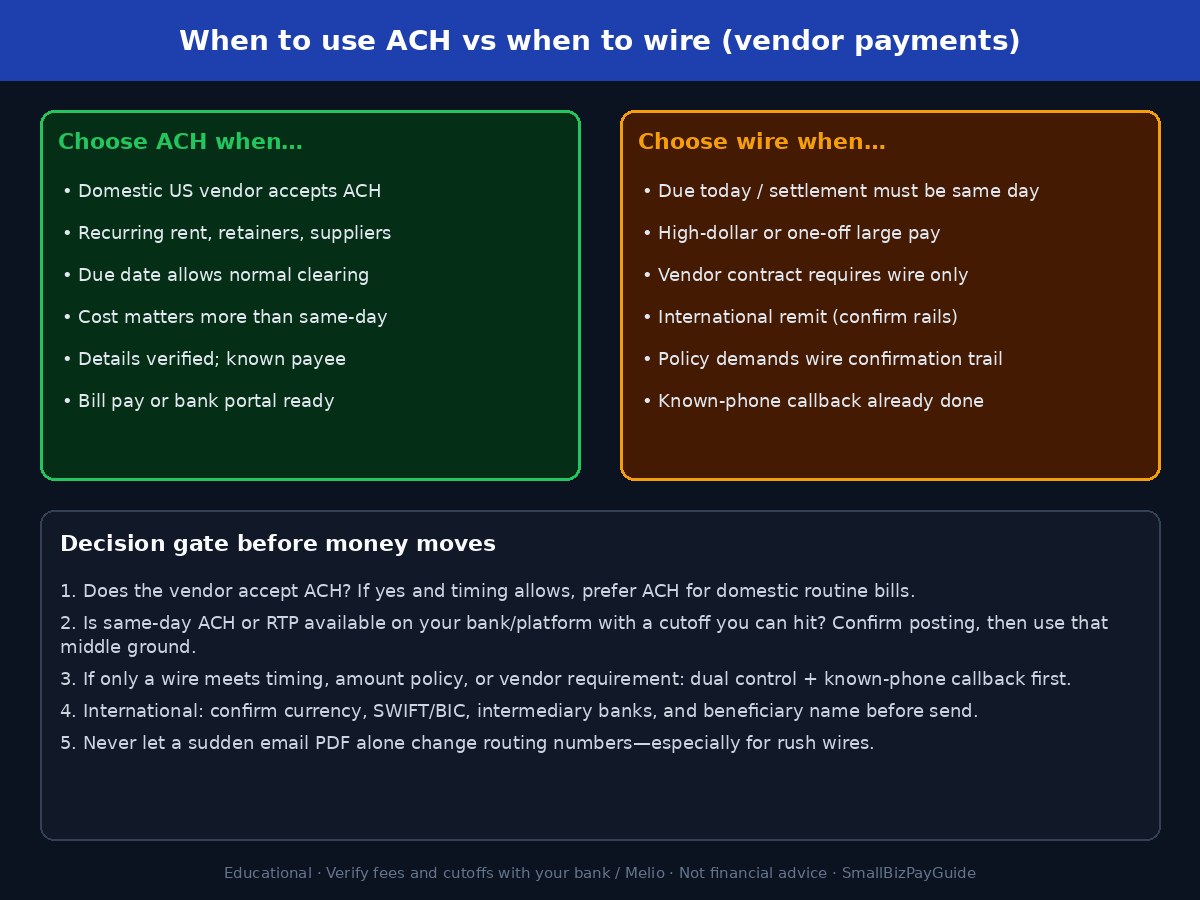
Prefer ACH when the vendor is domestic and accepts ACH, the bill is recurring or routine, the due date allows standard (or confirmed same-day) clearing, and bank details are already verified on the vendor master. Prefer wire when settlement must be same day and ACH/RTP cannot meet it, the amount trips your high-value policy, the contract requires wire, or the remittance is international with wire instructions you have confirmed.
Write the rules down so the team does not reinvent them under pressure. Example pattern many shops use: ACH for trusted domestic vendors under a threshold; owner or finance lead approval plus callback for first-time payees; wires only with dual control and a known-phone confirmation. Same-day ACH or RTP, when your bank offers them, can sit between standard ACH and wire for eligible domestic payments – verify cutoffs and limits before you rely on them for a critical due date.
Bill pay tools: where Melio fits the ACH path
Your bank portal can send ACH and wires directly. That works well at low volume when one person owns payments and bank MFA. Bill pay platforms help when you want clearer vendor remittances, more people in the approval loop without full bank admin access, optional check or card-funded paths, or accounting sync. Melio is one option many small teams use to pay vendors by ACH (and related methods) without handing out the core online banking login.
Compare Melio to your bank and to fuller AP stacks before you enroll. Soft features that matter for this rail decision: ACH scheduling, approval evidence, remittance records, and whether wires or international payments are in or out of scope for your plan. Pricing, free-tier limits, and card fees change; verify on Melio’s official pages. Side-by-side context lives in Melio vs Bill.com and the software comparisons hub.
ACH vs wire checklist for each vendor bill
- Confirm the vendor’s accepted methods (ACH, wire, check, card) on the invoice or contract.
- Match remit-to name and banking fields to the vendor master; call a known phone on any change.
- Choose the rail: ACH by default for domestic routine; wire only when timing, policy, international needs, or vendor requirement justify it.
- If using same-day ACH or RTP, confirm product availability, cutoff, fees, and receiving-bank support first.
- Approve amount, coding, and due date before release; dual control above your threshold.
- Schedule before cutoff with cash flow (payroll and tax deposits) in mind.
- Save remittance or wire confirmation with the invoice PDF for reconcile.
- Investigate returns, fails, and unmatched bank lines the same week.
Common mistakes
Wiring every bill “to be safe.” You burn fees and train the team to skip ACH scheduling. Assuming ACH is instant. Standard ACH is not a same-day guarantee; same-day products have their own rules. Trusting a PDF alone for new routing numbers. That is how wires disappear. Mixing rails without a policy. Card funding, ACH, and wires each need different fee and fraud controls. Skipping reconcile. Confirmation numbers that never attach to invoices create month-end archaeology. Inventing fee knowledge from a blog. Ask your bank and processor for current schedules.
FAQ
Is ACH cheaper than wire for vendor payments?
Usually yes for domestic payments, but your bank or bill pay platform sets the real price. Compare per-item ACH fees, subscription bundles, same-day add-ons, and wire fees side by side. Include late fees and staff time if a slow rail creates vendor friction.
Is same-day ACH the same as a wire?
No. Same-day ACH is still ACH, with network rules, cutoffs, and eligibility that differ from wires. It can be a useful middle ground when both banks support it. Confirm posting expectations with your bank before you promise a vendor “it will be there today.”
What is RTP and should I use it instead of wire?
RTP (Real-Time Payments) is a US instant-payment network available through some banks for eligible accounts. Limits, hours, and receiving-bank support vary. It can replace some domestic urgent wires when both sides are enabled, but it is not a universal substitute for international wires or for every bank relationship. Verify with your bank.
Can I reverse an ACH or a wire if I typed the wrong account?
ACH may offer limited return or recovery paths depending on the error and timing; wires that have been accepted are generally hard to reverse. Prevention beats recovery: dual entry checks, callbacks on detail changes, and dual control on large sends. Contact your bank immediately if a mistake is sent.
When should a small business require a wire?
Common triggers include vendor-required wires, international remittances, and high-dollar or same-day settlements that ACH or RTP cannot meet after you check availability. Pair those exceptions with stronger verification, not weaker ones.
Do I need Melio if my bank already offers ACH and wires?
Not always. Bank ACH and wires work for low volume and simple approvals. Melio or similar bill pay tools help when you want clearer vendor remittances, more people in the workflow without full bank admin access, optional card-funded paths, or accounting sync. Verify current pricing and features on Melio’s official site.
How do I stop wire fraud on vendor payments?
Never update banking from a cold email alone. Call a known phone number from the contract or vendor website, log the conversation, require dual control for wires and new payees, enable MFA on bank and bill pay logins, and freeze rush wires until confirmation clears. Train the team that “urgent” is a reason to slow down verification, not skip it.
What records should I keep for ACH and wires?
Keep the invoice, approval evidence, ACH remittance or wire confirmation, and vendor banking verification notes (who confirmed changes). Retention periods vary by entity and state; ask your CPA for the period that fits your books.
Related guides and Try Melio
Default to ACH for routine domestic vendor payments, keep wires for justified exceptions, and verify same-day ACH or RTP with your bank before you treat them as a middle ground. Map last month’s vendor payments by rail (ACH, wire, check, card) so the policy matches real volume.
If Melio fits the lean ACH bill pay path described here (pay vendors without sharing your bank login), you can explore Melio through our partner link: Try Melio. Terms, eligibility, and offers can change; verify pricing, free-tier ACH limits, card fees, and plan features directly on Melio before you enroll.
Related SmallBizPayGuide resources:
- How to pay vendors by bank transfer as a small business
- Accounts payable checklist for small business owners
- Pay business bills online without mailing checks
- Pay vendors with a credit card
- Bill pay overview
- Melio vs Bill.com
- Software comparisons
Official references worth bookmarking include Nacha materials on ACH payments and your bank’s published schedules for ACH, same-day ACH, RTP, and wires. Rules and product features change; treat this page as an operations map, then confirm current requirements with your providers and advisors.